Table of Contents (click to expand)
The diving bell spider (Argyroneta aquatica) is the only spider that spends its entire life underwater. Females are about 7.8–13 mm long; males are slightly larger at 7.8–19 mm (a reversal of typical spider size dimorphism). It survives by spinning a silk “diving bell” under aquatic plants and refilling it with air from the surface. Its bite is painful but not dangerous to humans.
The diving bell spider, Argyroneta aquatica, is one of the only spiders that live completely underwater. Also known as the water spider, it is a rather interesting member within its spider family as it manages to survive underwater by creating its own unique air bubble home.
The diving bell spider has all the features of a typical terrestrial spider but is known to live constantly underwater, hence its unofficial name. Diving bell spiders are so good at living underwater that they have to come up to the water’s surface for air only once a day.
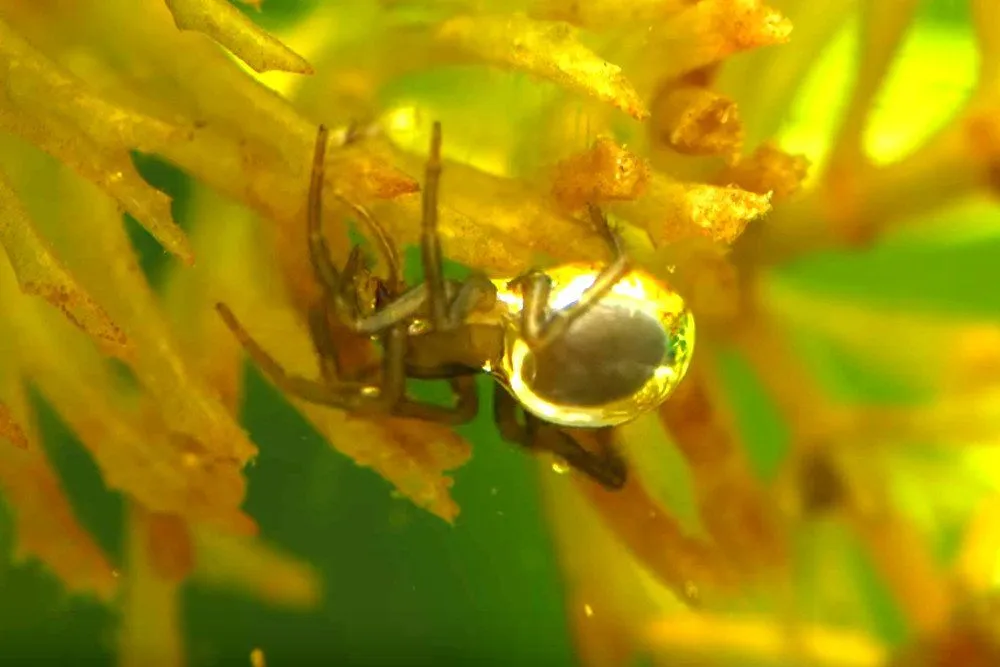 The diving bell spider (Photo Credit: Youtube)
Diving Bell Spider Anatomy
Female spiders range from 7.8 to 13.1 mm long, while male spiders range from 7.8 to 18.7 mm long. In most terrestrial spider species, the female is bigger than the male. But, this is reversed for the aquatic diving bell spider; the females are smaller than the males.
According to a 2005 paper by biologists Dolores Schütz and Michael Taborsky, the larger size of diving bell males gives them an advantage in moving underwater when they hunt or woo a mate. On land, being small is an advantage when it comes to hunting. Females are smaller because it’s easier to make a smaller bubble liveable for themselves and the babies.
Males can get away with being large yet building small bubbles because they only stick their abdomen into their diving bells. The diving bell spider’s abdomen has structures called book lungs, which help them breathe. Book lungs are mainly found in arachnids and are called so because of the vascular plates that look like pages in a book.
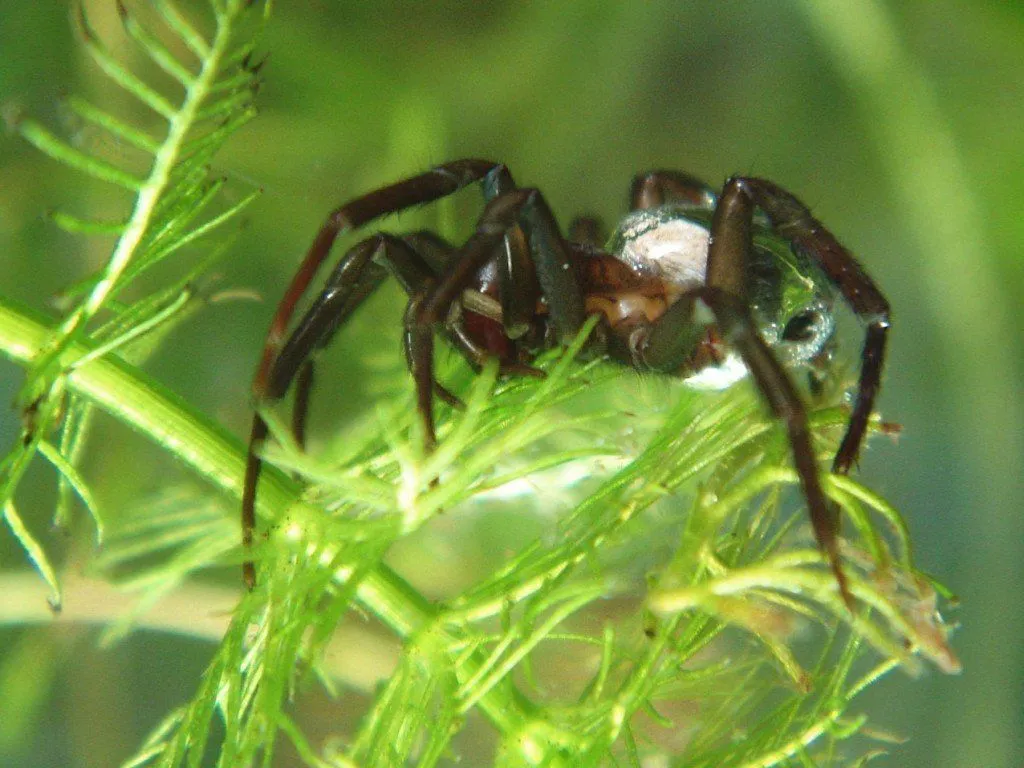
Outside of the water, the diving bell spider has a dark, velvety abdomen and a brown cephalothorax, and you could mistake it for any land spider, especially wolf spiders. But, underwater, the spider looks silvery as the air bubble surrounds its abdomen.
The water spider’s abdomen is covered with hair, which the spider uses to capture an air bubble around its abdomen. Females have shorter chelicera, a shorter pair of front legs, and a shorter body shape than males, which is what gives males diving superiority over females.
Diving Bell Spider Habitat
These spiders live in ponds and eutrophic lakes, marshes, slow-moving streams of water with relatively low pH and dissolved oxygen concentration, and swamps. It needs plants as attachment sites after diving in the water and as anchors for its ‘bubble nest.’
Diving Bell Spider Bite
The diving bell spider can bite humans. Its fangs are strong enough to penetrate human skin, and the bite is described as quite painful, sometimes with localized swelling at the bite site. You will read in places that the bite also brings on fever or vomiting that clears in a few days, but those more dramatic symptoms trace back to old, unverified reports, with recent confirmed cases lacking. What the science actually supports is modest: the only reliably documented effect of Argyroneta aquatica on people is a painful bite, with no recorded fatalities, so it is not considered medically dangerous. Bites are rare in any case, since the spider spends its whole life underwater away from us and tends to bite only defensively when handled or trapped against skin.
The spider usually preys on crustaceans (e.g., Daphnia and mosquito larvae) and aquatic insects.
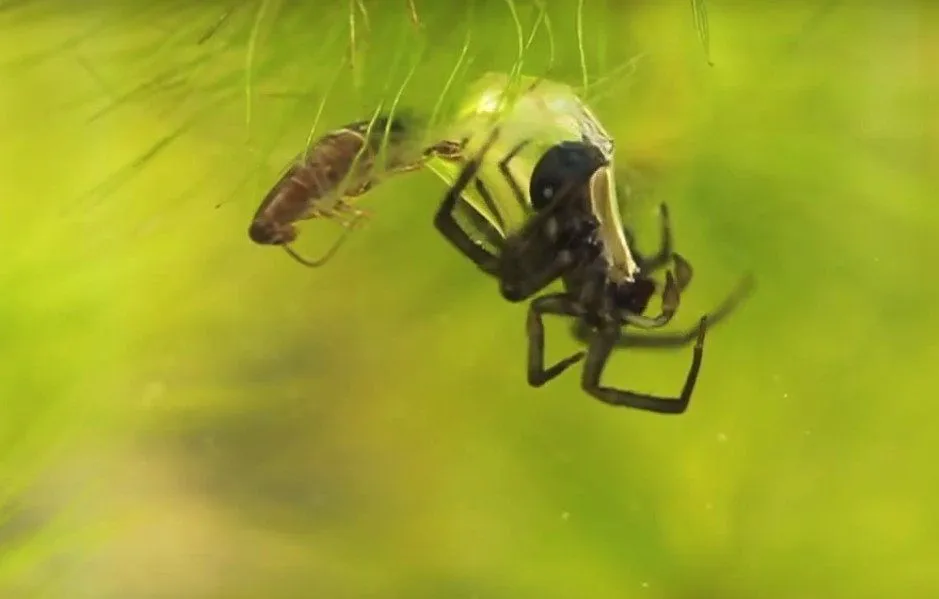
How Does The Diving Bell Spider Breathe Underwater?
Most spider species live on land, but this one spends most of its life underwater. How does it do that?
The diving bell spider lives in a homemade underwater “diving bell.”
It works like this: the spider comes to the surface, traps a bubble of air, and then dives down again to release this bubble under a ‘canopy’, a shelter that is made by a silk sheet fastened horizontally between submerged stems of water plants with silk binds.
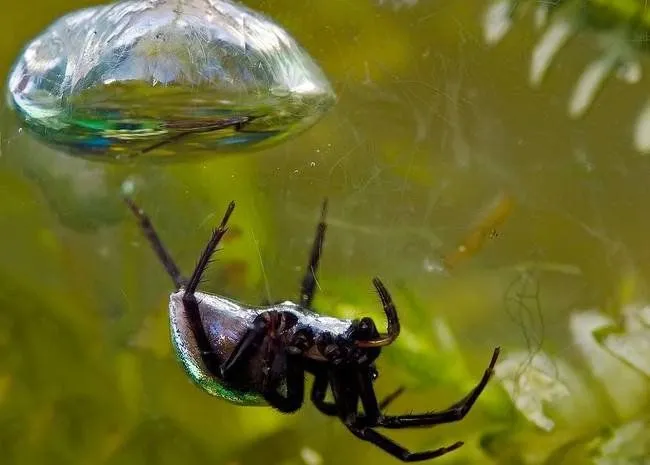
This silk sheet looks like a deep umbrella top. This is where the diving bell spider lives, eats, rests, and reproduces throughout its entire life. Whenever it runs short of air, which doesn’t happen as frequently as it would happen in our case, it simply makes a trip to the surface to grab another air bubble.
The spider can create an air bubble because the hair on its back is hydrophobic, just like oil is hydrophobic and doesn’t mix with water when the spider submerges back into the water after it surfaces its abdomen to collect oxygen-filled air, an air bubble forms around the spider’s back.
The spider’s diving bell can also function as a “physical gill.” A 2011 paper by Roger Seymour and Stefan Hetz found that the spider’s diving bell can extract dissolved oxygen straight out of the surrounding water. Their measurements showed that, sitting in warm, stagnant water (the toughest case, since warm water holds less oxygen), a spider could stay sealed inside its bell for more than a day before it needed to top up with a fresh bubble from the surface.
Are Diving Bell Spiders Venomous Or Poisonous?
This is the question most people actually type into a search bar, and the two words get mixed up all the time. Venomous and poisonous are not the same thing: venom is injected (through fangs or a sting), while a poison harms you when you touch, eat, or breathe it. By that definition the diving bell spider is venomous but not poisonous. Like nearly every spider on Earth, it has venom glands and uses them to subdue prey. It is not poisonous, so there is nothing dangerous about simply touching one.

Here is the reassuring part: that venom is tuned for water fleas and insect larvae, not for us. According to the Animal Diversity Web account maintained by the University of Michigan, the only known adverse effect of Argyroneta aquatica on humans is a painful bite. There are no records of it causing serious harm, and there are no documented deaths. So while the honest answer is yes, it is venomous, the diving bell spider sits firmly among the harmless members of its spider family when it comes to people.
What Do Diving Bell Spiders Eat?
The diving bell spider is a carnivore that hunts without ever leaving the water. Its menu is dominated by small aquatic animals: water fleas (Daphnia), freshwater isopods such as Asellus aquaticus, insect larvae (including those of mosquitoes and midges), fairy shrimp, and even other water spiders. On occasion it takes larger prey too. The species is one of a small handful of spiders the California Academy of Sciences lists as documented preying on frogs and fish from underwater, which is remarkable for an animal that breathes air.

The hunting trick is in the silk. Threads radiating out from the diving bell act like trip wires: when a passing insect bumps a strand or touches the bell itself, the vibration tips off the waiting spider, which darts out, bites, and hauls the catch back inside to eat it in the safety of its air-filled chamber. The two sexes go about it differently. Females tend to sit tight and ambush whatever blunders into the threads, while the larger, more mobile males roam more actively in search of a meal. Like most spiders, it relies on venom rather than chewing to deal with prey.
What Eats Diving Bell Spiders?
Living underwater swaps one set of enemies for another. Instead of birds and wasps, the diving bell spider has to watch out for the predators of the pond. The Animal Diversity Web lists its main threats as fish, frogs, dragonfly larvae, and both adult and larval water beetles. To cut the risk, females and juveniles spend most of their time tucked inside the diving bell and tend to venture out mainly at night. Males, which travel more in search of food and mates, pay for that mobility with a higher chance of being eaten.

There is a quiet upside to all this underwater hunting. Because a big share of the diving bell spider’s diet is insect larvae, it helps thin out the population of mosquito larvae before they can grow into biting adults, making it a small but genuine ally in keeping a healthy pond in balance.
Where Are Diving Bell Spiders Found?
The diving bell spider is a Palearctic species, which means its natural range covers Europe and northern Asia rather than the Americas. It is found across mainland Europe and the British Isles and stretches eastward through Siberia and Central Asia, reaching as far south as Iran. An isolated population in Japan is distinct enough that scientists treat it as its own subspecies, Argyroneta aquatica japonica.
Within that broad range, you will not find these spiders just anywhere there is water. They favor still or slow-moving freshwater that is thick with plants: weedy ponds and eutrophic lakes, marshes, swamps, and sluggish streams, typically where the water has a relatively low pH and is not especially rich in dissolved oxygen. The plants are not optional, because the spider needs submerged stems to anchor its silk diving bell. In much of Europe it is considered fairly common, though as a species tied to clean, weedy wetlands, it is sensitive to the loss and pollution of those habitats.
References (click to expand)
- Schütz, D. & Taborsky, M. (2005). Mate Choice and Sexual Conflict in the Size Dimorphic Water Spider Argyroneta aquatica. Journal of Arachnology.
- Seymour, R. S. & Hetz, S. K. (2011). The diving bell and the spider: the physical gill of Argyroneta aquatica. Journal of Experimental Biology.
- Argyroneta aquatica. Animal Diversity Web, University of Michigan.
- Diving bell spider. Wikipedia.
- The Adventures of the Diving-Bell Spider. American Physical Society DFD 2012.
- Water spider. Encyclopaedia Britannica.
- Fish-Eating Spiders. California Academy of Sciences.