Yes, bees do have knees. Each of a bee’s six legs has five main segments, and the bee’s “knee” is the joint between the femur and the tibia, called the femorotibial joint. Unlike the human knee, it has no kneecap (patella). So a bee has six knees, one per leg.
Yes, bees do have knees! Each of a bee’s six legs is built from five main segments that are linked together by joints, and the one that bends like a knee is the joint between the femur and the tibia. So, counting one per leg, a bee technically has six knees. Interestingly, the hind legs also carry stiff hairs near this region (on the tibia) that help pack away the pollen a bee collects.
If you hang out with people whose vocabulary is better than ‘ordinary’, i.e., people who use words like ‘boondoggle’, ‘ennui’, ‘panacea’ etc. in casual conversations, then you may have heard them using the expression “bees knees” in sentences to comment on the outstanding quality of a certain subject. In other words, when you refer to something as ‘the bee’s knees’, it means that you’re appreciating its excellent quality. Consider its usage in the following sentence:
“I love your earrings! They truly are the bee’s knees!”
As mentioned earlier, the phrase ‘the bee’s knees’ in this sentence signifies that the earrings are top notch.
This might make you wonder whether the reference to bee’s knees in this idiom really has anything to do with bees and their legs, or whether it just put there to make the idiom sound memorable.
To investigate the answer, let’s start with what we humans officially understand by the word ‘knee’.
The Human Knee
The knee joint, as you already know, connects one’s leg with its corresponding thigh. It consists of two distinct joints: the tibiofemoral joint (between the femur and tibia), and the patellofemoral joint (between the femur and patella); this is why the knee joint is also referred to as a compound joint.
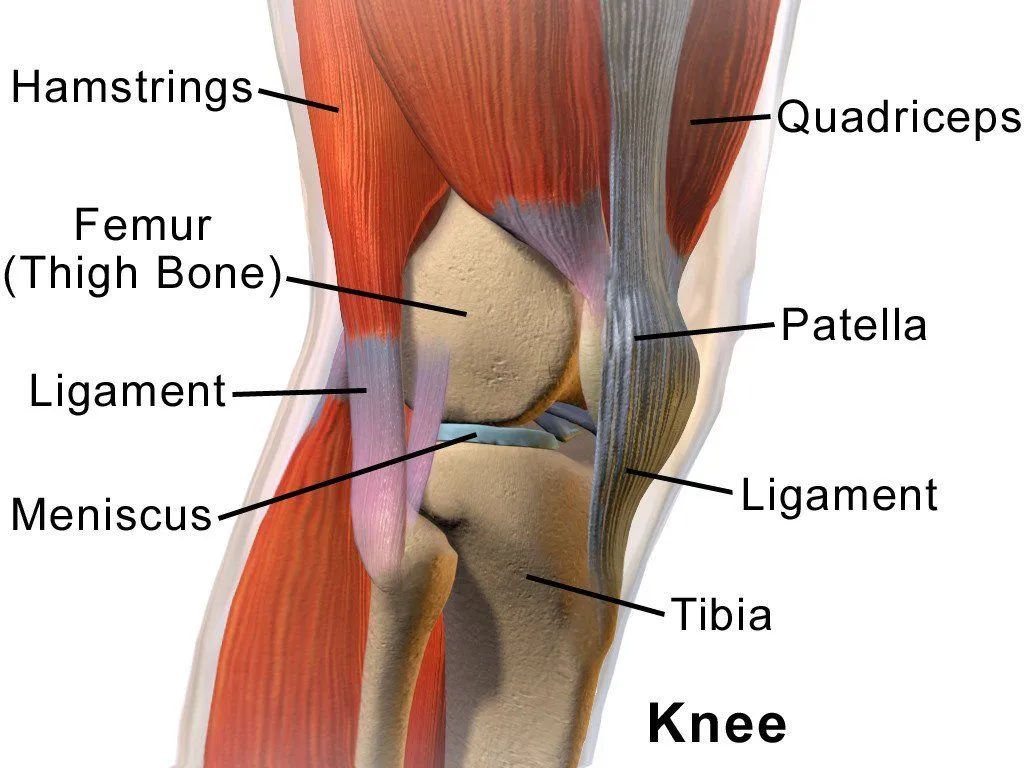
In layman’s terms, the knee is the joint that enables the leg to bend and fold, and with that, helps in performing many leg movements. The knee is the largest joint in the human body and is quite prone to wounds, injuries and certain disorders.
This was a brief outline of the human knee; now, let’s take a look at the ‘bee knee’.
The Bee Knee
Bees have three pairs of legs – the front, middle and rear – which have corresponding sets of tools. A bee leg is made up of five main segments, namely the coxa, trochanter, femur, tibia and tarsus (the foot). The tarsus is itself divided into smaller sub-segments, the first and largest of which is called the basitarsus. With all that in mind, the leg of a bee is clearly more intricate than a human’s, at least in terms of the number of segments it has.
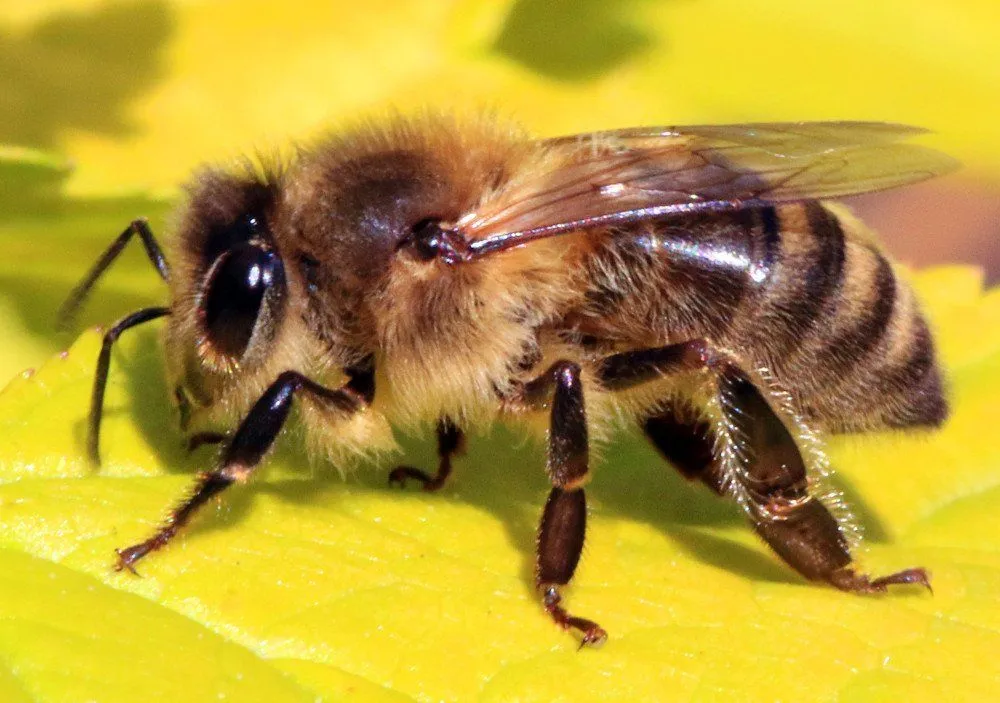
These segments are connected with the help of joints; the one joint that most resembles a human’s knee in terms of its location on the bee leg is the joint that connects the tibia and the femur.
So, if you compare the human leg with a bee’s, it seems that the latter certainly has a joint that bends like a knee. In purely biological terms, this joint is referred to as the femorotibial joint (and, unlike our knee, it has no kneecap, or patella).
Do Bees Have Bones?
If a bee has knees, it is natural to ask whether it also has bones inside those legs. It does not. Bees, like all insects, have no internal bony skeleton at all. Instead they carry their skeleton on the outside, in the form of a tough outer shell called an exoskeleton.

This exoskeleton is built mainly from chitin, a tough, lightweight material reinforced with protein. It does several of the jobs our bones and skin handle, all at once: it forms a protective covering over the body, it walls off the soft insides against water loss and injury, and it gives the muscles something to pull against, because the muscles attach to its inner surface rather than to bones. In effect, a bee wears its skeleton like a suit of armor.
So when a bee bends its “knee”, no bone is doing the bending. The leg flexes because the hard plates of the exoskeleton are separated by thin, flexible patches of cuticle that work like the creases in a drinking straw. The whole leg behaves rather like the jointed legs of the honeycomb builders in why bees love hexagons: rigid sections linked by bendable hinges, with not a bone in sight.
Do Bees Have Elbows Too, Or Just Knees?
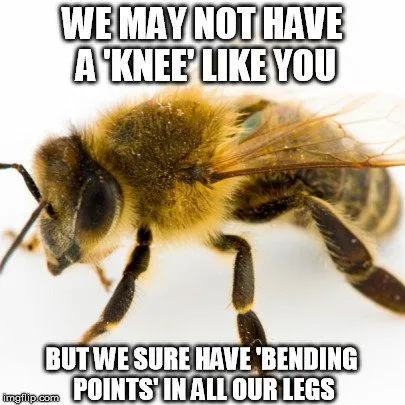
Once you accept that the “knee” is really just a bending point between two leg segments, a fair follow-up is whether bees have elbows as well. The honest answer is that a bee’s leg has several bending points, and none of them is anatomically a knee or an elbow in the way ours are. We simply borrow those familiar words because the joints sit in roughly familiar places.

Remember that each leg is built from five main segments: the coxa, trochanter, femur, tibia and tarsus. These segments articulate with one another through hinge joints, so a single bee leg can bend in more than one place. The joint between the femur and the tibia is the one we nickname the knee. The joints nearer the body, where the coxa and trochanter meet the rest of the leg, are the ones you might loosely picture as an “elbow”, although entomologists do not actually use that label for an insect leg.
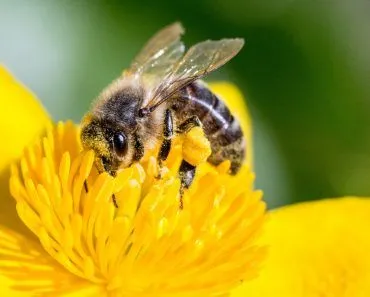
There is one spot where bees genuinely out-elbow us, though: the antennae. A bee’s antenna is famously “elbowed”, with a long first segment and a sharp bend partway along, so it really does look like a tiny bent arm. If you want to find a true elbow on a bee, look at its head, not its legs. On the legs you will find tools instead, including the hairy basket on the hind tibia, called the corbicula, that a worker uses to ferry pollen back to the hive.
Is The Phrase ‘The Bee’s Knees’ Related To Bees At All?
Well, we’re not really sure.
You see, the phrase ‘the bee’s knees’ took off as a term of praise in 1920s America, among the flappers and socialites of the Roaring Twenties. (The earliest print example with the modern, complimentary meaning appears in The Buffalo Times in February 1922.) At that time, there was no scientific importance attached to it; it was simply one of those nonsense phrases that sounded nice (“bee’s” rhymes with “knees”), but didn’t really mean anything.
Back then, a few other nonsensical yet jaunty expressions, like “the kipper’s knickers”, “the snake’s hips”, “the cat’s pajamas/whiskers”, “the monkey’s eyebrows” and so on, were also quite popular.

Interestingly enough, none of these have anything to do with reality, with the exception of “the bee’s knees”.
Explanation Of The Meaning Of “The Bee’s Knees”
As mentioned earlier, “the bee’s knees” is used to refer to something of excellent quality. A likely (but unconfirmed) explanation behind this is related to sacs present on bees’ legs. Bees carry pollen (that they collect from flowers) back to their hive in small, hairy sacs/baskets on their legs.
These sacs appear somewhat large and spectacular, and have ‘goodness’ (i.e., pollen) concentrated in them. As a result, some believe that the idiom “the bee’s knees”, which alludes to something of great quality, refers to the treasure trove of pollen these bees can store near their “knees”.
References (click to expand)
- On Six Legs - www.agriculture.purdue.edu
- Bee Vocabulary - online.sfsu.edu:80
- The meaning and origin of the expression: The bee's knees. phrases.org.uk
- Legs - ENT 425 General Entomology, NC State University
- Exoskeleton - ENT 425 General Entomology, NC State University
- Honey Bee Anatomy - Ask A Biologist, Arizona State University