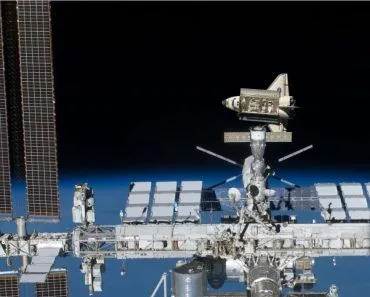
Inside the ISS, the cabin is kept at a comfortable 22–24 °C (about 72–75 °F), and astronauts work in T-shirts. Outside, the hull swings between roughly +121 °C (+250 °F) in direct sunlight and -157 °C (-250 °F) in Earth's shadow, and the cosmic background of deep space itself is just 2.7 K (-270 °C). A small army of insulation blankets, water and ammonia coolant loops, and external radiators keeps the inside steady.
A buddy of mine once showed me a video of an astronaut onboard the ISS talking about the things he and the other members of his team did on a daily basis up there in space, and generally explaining what it’s like to live aboard the ISS.
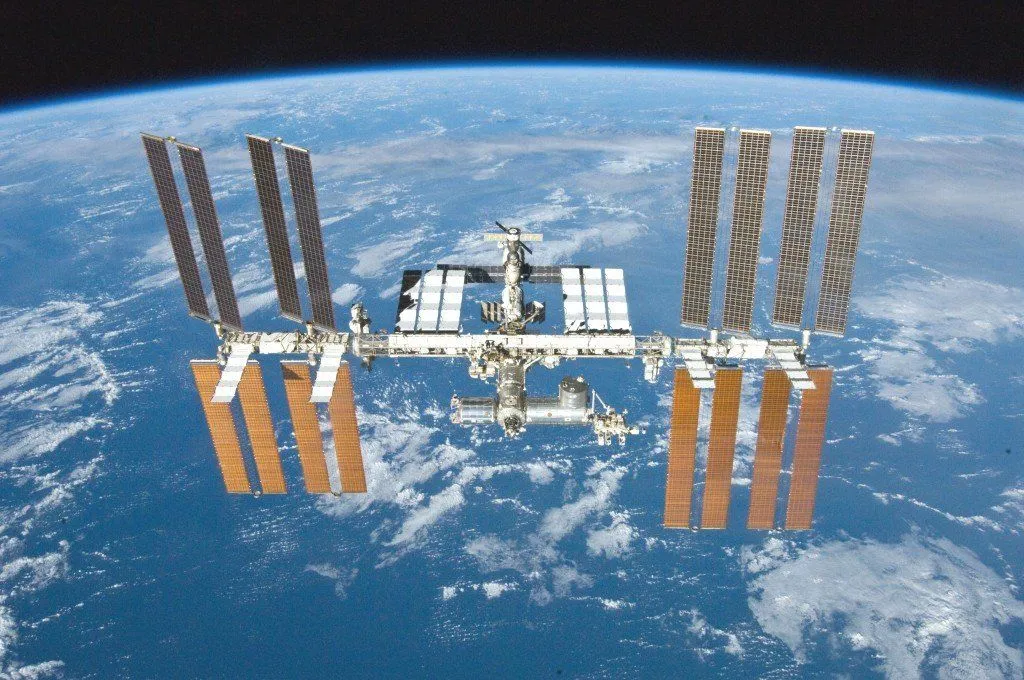
The one thing that my friend noticed, however, was that the astronaut’s face was glistening with sweat. Consequently, he wondered if it was hot up there on the ISS.
What’s The Average Internal Temperature Of The ISS?
Short answer: Inside, the ISS feels like a regular office: NASA holds the cabin at about 22–24 °C (72–75 °F), and the crew floats around in T-shirts. The drama is all on the outside, where the hull bakes and freezes by the hour, and an elaborate system of insulation, coolant loops, and radiators is what keeps the inside boring on purpose.
The ISS Experiences A Wide Range Of Temperatures
Orbiting the planet at an altitude of roughly 410–420 kilometers above Earth’s surface (NASA’s broader operational range is about 370–460 km, with periodic Progress reboosts to keep it from drifting downward), the International Space Station experiences a wide range of temperatures. Since it continuously revolves around the planet, sometimes it’s on the sunlit side of the Earth, while at other times, it’s on the dark side.
When the ISS faces the sun, the (external) temperature it experiences is around 250 degrees Fahrenheit (121 Degrees Celsius). On the other hand, when it’s on the side where our planet completely blocks out the sun, the thermometers plummet to minus 250 degrees Fahrenheit (-157 degrees Celsius). And just beyond the Sun-warmed bubble around Earth, the rest of space sits at the cosmic microwave background temperature of about 2.7 K (-270 °C / -454 °F), the leftover heat from the Big Bang itself.
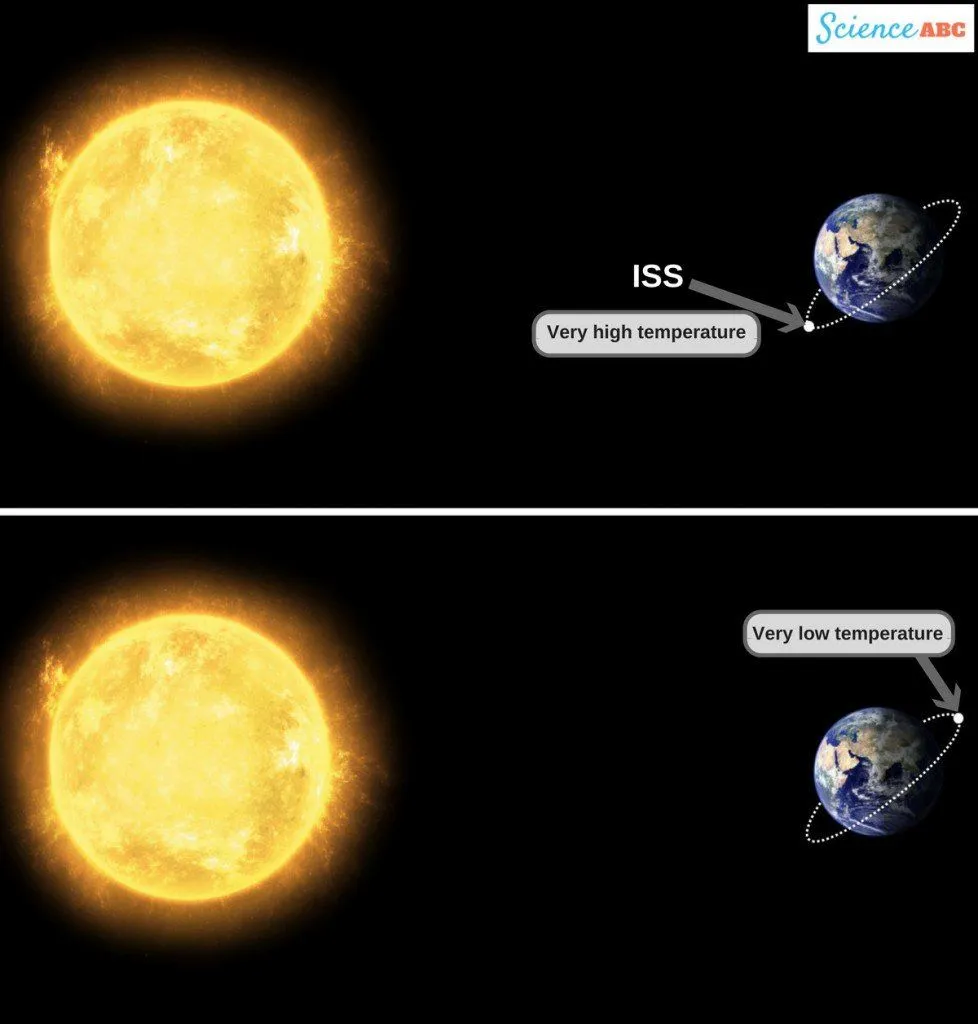
Given the fact that the ISS experiences 16 sunrises and 16 sunsets in a single day, you can imagine the drastic changes in temperature the ISS experiences.
However, of course, you can’t have humans doing their research, calibrating systems, making repairs and doing other important activities in a spaceship when they constantly have to worry about how hot or cold it is going to be every given hour. Moreover, the complex systems and equipment aboard the spaceship can also only handle so much constant temperature variation.
So, you have to make sure that a constant temperature is maintained aboard the ship. The question is… how do you do that?
What Atmospheric Layer Is The ISS In?
Short answer: the thermosphere. The ISS isn’t floating in pure, empty space the way it looks in photographs. At its operating altitude of roughly 410–420 km, it sits squarely inside the thermosphere, the second-to-last layer of Earth’s atmosphere, which stretches from about 90 km up to somewhere between 500 and 1,000 km depending on how active the Sun is.

Here’s the curious part. The thermosphere is, by one measure, scorching. The thin gas up there can be heated by incoming solar radiation to a kinetic temperature of 500 °C (930 °F) on a quiet day, and to 2,000 °C (3,630 °F) or more when the Sun is throwing a tantrum. So why doesn’t the station cook? Because temperature in the everyday sense (how hot something feels) depends not just on how fast molecules are moving, but on how many of them there are to hand off that energy. In the thermosphere the air is so wildly sparse, basically a hard vacuum, that there simply aren’t enough molecules to transfer meaningful heat to the station’s hull. A thermometer parked out there would actually read well below 0 °C in the shade, because it radiates heat away to space faster than the few stray molecules can warm it. The “2,000-degree” number describes the speed of the molecules, not a heat you could feel.
How Cold Is Space Itself?
Step away from the warm bubble of sunlight around Earth, and the rest of the universe settles to a single, astonishingly cold baseline temperature: about 2.7 K, which is roughly -270 °C (-454 °F), only a few degrees above absolute zero (-273.15 °C). That figure isn’t the temperature of “nothing.” A true vacuum with no particles and no radiation in it has no temperature at all, because there’s nothing to measure. What gives deep space its floor temperature is the cosmic microwave background (CMB), a faint glow of radiation that fills every corner of the cosmos.

The CMB is leftover light from the Big Bang. About 380,000 years after the universe began, it had cooled enough for electrons and protons to combine into neutral hydrogen, and the photons that had been bouncing around were suddenly free to stream across space. Nearly 14 billion years of cosmic expansion has stretched (redshifted) those photons until their effective temperature dropped to today’s 2.726 K. It is breathtakingly uniform, varying by only about 1 part in 100,000 across the entire sky. So when people say “how cold is space,” the honest answer is that space itself has no temperature, but the radiation soaking through it sits at 2.7 K, and anything left out there with no Sun to warm it will eventually chill toward that number.
How Does The ISS Deal With The Radiation In Space?
Back on Earth, heat is transferred through the air mainly through either conduction or convection, but since there’s virtually no air up in space, radiation is the only way things heat up.
In order to ensure that the thermal radiation doesn’t raise the internal temperature of the ISS or that heat from within the ISS is not lost to the outside, they use a highly reflective blanket called Multi-Layer Insulation (MLI) to cover basically the entire space station.
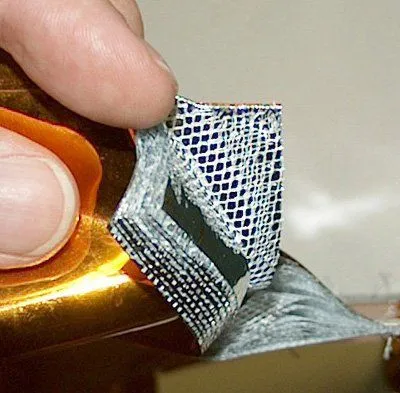
This reflective layer is made of aluminized Mylar – a form of polyester resin used to make heat-resistant plastic films and sheets, as well as dacron. The aluminized Mylar makes sure that the sun’s radiation doesn’t get through the MLI, while layers of dacron are used between the Mylar sheets to keep them separated. This ensures that heat is not transferred through conduction, and that radiation remains the dominant heat transfer method onboard the ISS.
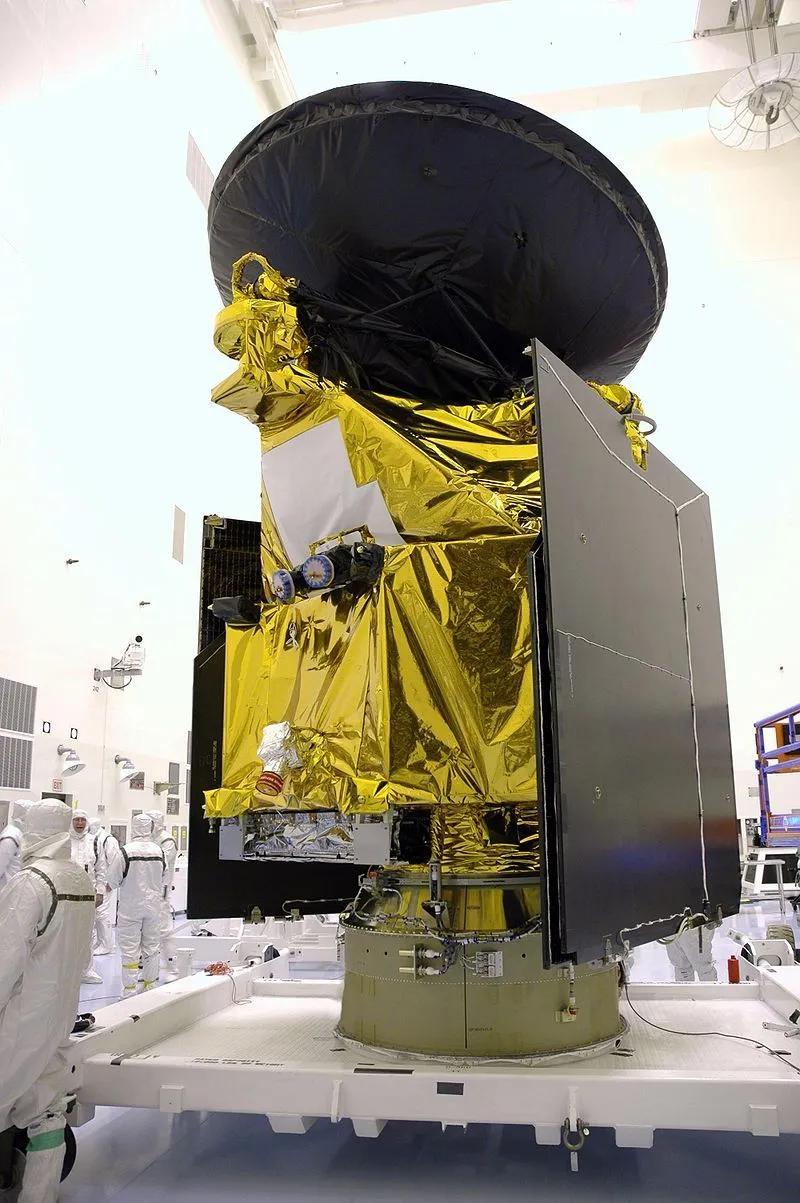
The MLI blanket covers almost all of the ISS, except the windows, as they are used by astronauts for research and ergonomics. This reflective blanket not only keep’s the sun’s radiation at bay, but also shields the ISS from the bitter cold of space.
How Does The ISS Keep Itself From Getting Too Warm?
The MLI blanket does its job of regulating heat transfer so well that the ISS needs to deal with another thermal challenge – with all the technological equipment running and emitting heat, plus the body heat of the crew, how do they keep the ISS from getting too hot?
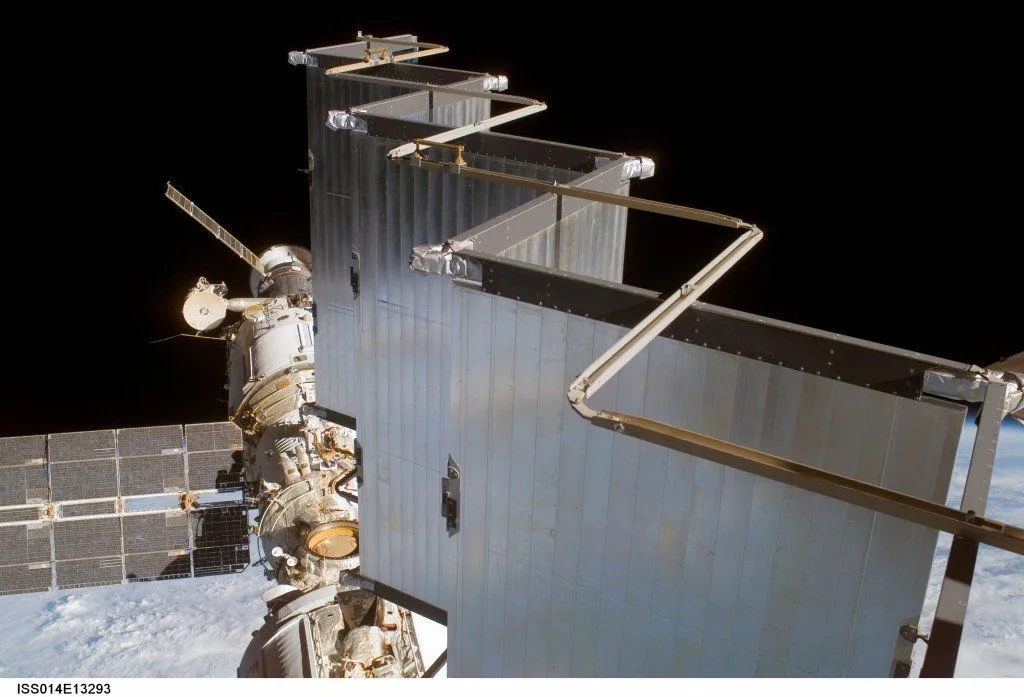
The excess heat generated onboard the ISS is taken care of by a set of heat exchangers, technically known as the Active Thermal Control System (ATCS), which is split into an Internal loop (IATCS) inside the crew modules and an External loop (EATCS) on the outside of the station. Waste heat onboard the ISS is removed in two methods – using cold plates and heat exchangers, both of which depend on a circulating water loop to cool down. Cold water passes through the aforementioned heat-exchanging devices and absorbs the heat energy from them. Subsequently, this energy is sent to the radiators (located on the exterior of the ISS) to be expelled into space.
Use Of Ammonia For Heat Exchange On The ISS
Since the heat-carrying cold water would quickly freeze in the bitter cold of space, the waste heat travels one more time through a loop; only this time, the loop contains liquid ammonia instead of cold water.

The reason behind using liquid ammonia is that it freezes at a much lower temperature than water (about -108 degrees Fahrenheit / -77.7 degrees Celsius), so it doesn’t freeze as easily as water (outside the ISS). The heat-carrying ammonia passes through radiators and “dumps” the heat in space as infrared radiation.
Do Astronauts Feel The Cold On A Spacewalk?
Inside the station the crew never has to think about it, but the moment an astronaut steps outside on a spacewalk, they are personally exposed to that brutal swing between roughly +121 °C (+250 °F) in direct sunlight and -157 °C (-250 °F) in Earth’s shadow, sometimes within a single 90-minute orbit. The reason they don’t freeze on one side and bake on the other is that the spacesuit is, in effect, a tiny one-person spacecraft with its own thermal control system.

Against the cold, the suit works like a thermos. Multiple insulating layers trap the astronaut’s own body heat inside, while the white outer shell reflects away incoming sunlight to keep the suit from overheating on the sunlit side. The bigger day-to-day problem, oddly, is the opposite of cold: an astronaut doing physical work generates a lot of heat with nowhere for it to go in a vacuum. So beneath everything sits a Liquid Cooling and Ventilation Garment, a snug body stocking laced with about 90 metres (roughly 300 feet) of thin tubing through which chilled water is constantly pumped to carry the wearer’s excess body heat away. Between the reflective insulation and that circulating-water system, the suit holds the astronaut at a comfortable temperature for spacewalks that can run up to eight hours, no matter how violently the world outside flips between scorching and freezing.
As for the sweaty astronaut my friend saw in the video, it’s highly likely that the astronaut had simply been doing a vigorous workout session (astronauts onboard the space station have to exercise every day) before filming that video, which caused all that perspiration. Whatever the reason, I’m pretty confident that it wasn’t related to the ISS being too hot… they seem to know pretty darn well how to keep the temperature under control.
And while we’re still riding the ISS, its days are numbered. NASA has committed to operating the station through 2030, after which a SpaceX-built U.S. Deorbit Vehicle (announced in June 2024 under an $843 million contract) will guide it down for a controlled reentry over Point Nemo in the South Pacific. Roscosmos, for its part, plans to step away in 2028 and pivot to its own Russian Orbital Service Station, while Axiom Space is targeting an early-2027 docking of the first commercial module that will eventually break off into its own free-flying station.
References (click to expand)
- International Space Station - Wikipedia. Wikipedia
- BoPET. Wikipedia
- Spacecraft thermal control - Wikipedia. Wikipedia
- Staying Cool on the ISS - NASA Science. The National Aeronautics and Space Administration
- ISS Active Thermal Control System Overview - NASA
- Integrated Truss Structure - NASA. The National Aeronautics and Space Administration
- Themal Control - goes.gsfc.nasa.gov
- Thirsk, R., Kuipers, A., Mukai, C., & Williams, D. (2009, June 1). The space-flight environment: the International Space Station and beyond. Canadian Medical Association Journal. CMA Joule Inc.
- The Thermosphere. UCAR Center for Science Education
- Planck and the cosmic microwave background. European Space Agency (ESA)
- Spacewalk Spacesuit Basics. NASA