Despite looking similar, cabbage and lettuce are different vegetables that serve different purposes in cooking. Cabbage is more packed with various nutrients, but needs to be cooked before it can be eaten. Lettuce contains more water, but is perfectly fine to eat and enjoy raw.
Green cabbages are popular vegetables all around the world. Most stores sell these green round vegetables with large leaves packed in layers, but while selecting the best head of cabbage, we might notice that there is another pile of light-green round heads with similar layers of leaves. This pile in the produce aisle is labelled ‘iceberg lettuce’. Both vegetables look very similar, yet one is labelled cabbage and the other is labelled iceberg lettuce. How do we tell them apart? And how would we tell them apart without any labels?
Green cabbage and iceberg lettuce are distinct vegetables with distinct flavor profiles that fit different recipes. In spite of the their superficial similarities, peel back the layers and you’ll quickly see their differences. By the end of this article, you will know exactly how to distinguish between a cabbage and iceberg lettuce.
Know Thy Vegetables
Let’s start with knowing vegetables and their origins.
Cabbage (Brassica oleracea var. capitata) belongs to the mustard family Brassicaceae and is widely grown around the world. The word ‘capita’ in its scientific name means ‘head’ in Latin.
The Brassicaceae family includes other popular vegetables, such as cauliflower, kale, broccoli and kohl rabi.
Cabbages originated in the region we know today as the Middle East, and there are records that indicate that they were cultivated in India as far back as 3000 BC. Cabbage was used in traditional medicine by the Greeks, Romans, Egyptians, and Chinese. Today, they are grown and consumed around the world because they are affordable and are a rich source of phytonutrients. China is the largest producer of cabbage in the world, followed by India.
Cabbage can also be red or purple, but in this article we are discussing only green cabbages.
Iceberg lettuce (Lactuca sativa) belongs to the sunflower family Asteraceae. Lettuce is one of the most important leafy vegetables around the world. Lettuce was known to the ancient Egyptians and was grown by the Romans. China and the US are the largest producers of lettuce in the world. There are many different types of lettuce: romaine, leaf lettuce, butterhead, batavia, gems and more, but we’re only considering iceberg lettuce in this article.
How Can We Tell Them Apart?
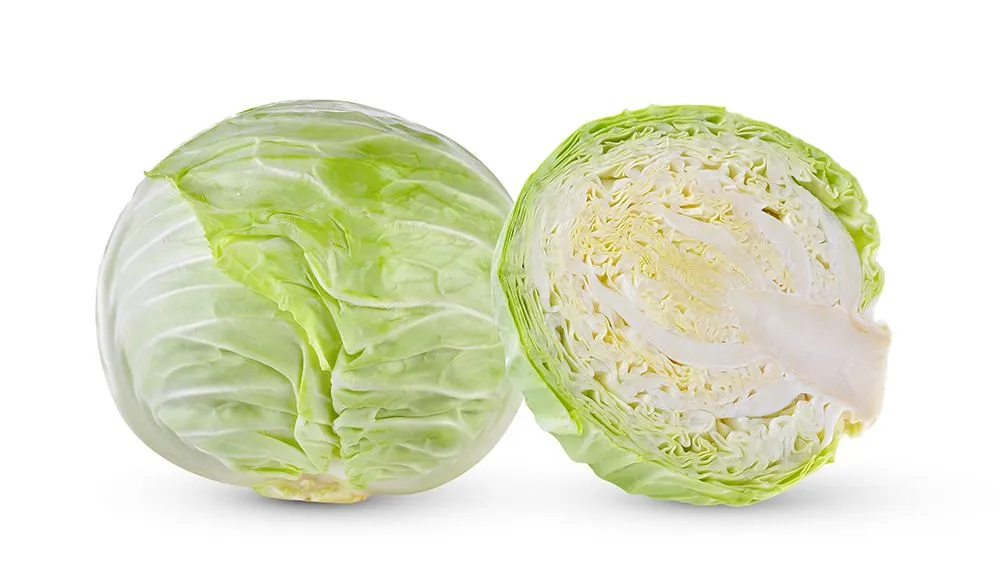
Both cabbage and iceberg lettuce have a round head wrapped with large leaves. Often, there are one or more layers of ‘frame’ leaves protecting the head.
To tell the two vegetables apart, first we need to look closely at the leaves.
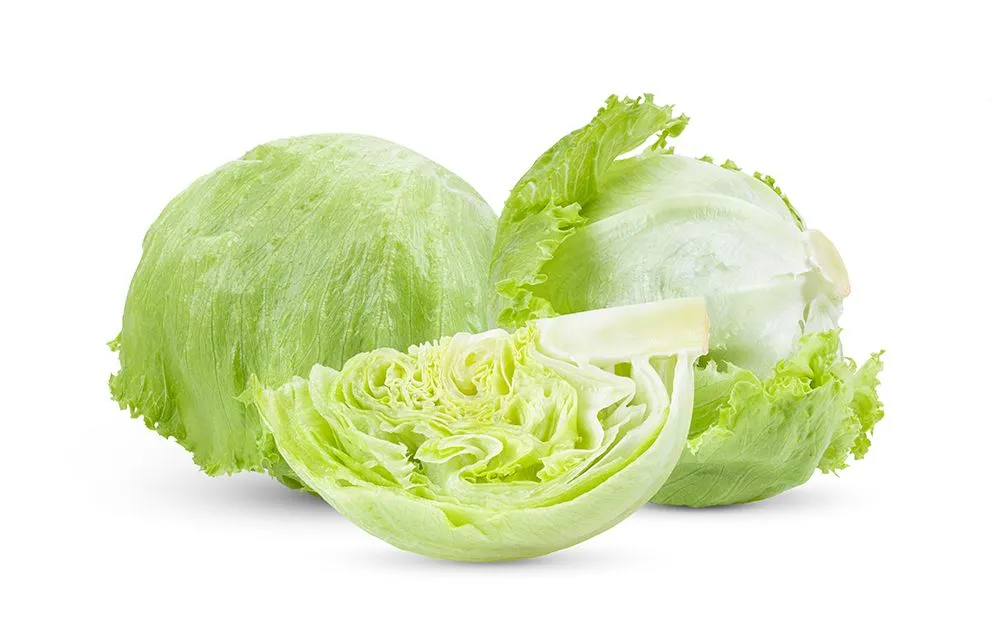
Cabbage leaves are thicker, coarser and almost leathery when raw. This is why cabbage leaves are often cooked to make them soft enough to eat. Iceberg lettuce leaves are thinner, smoother and have a higher water content, which is why they become mushy after cooking.
However, there are exceptions.
Coleslaw salad is made with raw cabbage, and some Asian recipes require blanched iceberg lettuce leaves.
Cabbage also has more white and cream-colored leaves, while iceberg lettuce is greener.
The next difference lies in the taste and smell. Like most Brassicas, cabbage has a peppery taste and a pungent smell. Iceberg lettuce, on the other hand, is watery and bland, and has no smell.
The next step is to look inside. It is best to cut lettuce head in half to see the leaves inside. Cabbage heads are denser, heavier, and more compact than iceberg lettuce. Most commercially available iceberg lettuce have the leaves arranged loosely around the head.
Other Ways They Are Different
When we compare the nutrient profiles of these vegetables, it becomes obvious that cabbage is a much healthier vegetable than iceberg lettuce.
According to USDA data for cabbage and iceberg lettuce, 100 grams of cabbage contains 92.2 g water, 25 kcal energy, 1.28 g protein, and 5.8 g of carbohydrate. On the other hand, 100 grams of iceberg lettuce contains 95.5 g water, 17 kcal energy, 0.74 g protein, and 3.37 g carbohydrate.
Cabbage is a better source of vitamin B6 (0.124 mg in 100 g), vitamin C (36.6 mg in 100 g, 61% Recommended Daily Intake), vitamin A (98 IU in 100 g) and vitamin K (76 mg in 100 g, 96% RDI). On the other hand, 100 grams of iceberg lettuce provides 5% of your RDI of vitamin C and 30% RDI of vitamin K.
Cabbage is also a better source of fiber than iceberg lettuce.
Can You Swap Cabbage For Iceberg Lettuce?
One of the most common kitchen questions is whether you can simply use one in place of the other. The short answer is: sometimes, but not always, and the reason comes straight from the differences we have already seen. It all comes down to water and leaf structure.

Recall that 100 grams of iceberg lettuce holds about 95.5 g of water, while the same amount of cabbage holds about 92.2 g, according to USDA data. That small gap, combined with cabbage's thicker, sturdier leaves, makes a real practical difference. Cabbage shredded finely is a popular stand-in for lettuce in tacos, sandwiches, and wraps, because it stays crisp instead of going limp under warm fillings or a heavy dressing. This is also why coleslaw works so well with raw cabbage.
Going the other way is trickier. Iceberg lettuce can replace cabbage in a fresh, raw salad, but it does not hold up where a recipe relies on cabbage being cooked. Apply heat to lettuce and its thin, water-rich leaves collapse into a mushy texture, so it makes a poor substitute in dishes like stir-fries, braises, or stuffed cabbage rolls. As a rough rule: cabbage can stand in for lettuce in most raw uses, but lettuce rarely stands in for cabbage once a pan or oven is involved. The flavors differ too, since cabbage brings a faint peppery note while iceberg lettuce stays mild and neutral.
What About Chinese Or Napa Cabbage?
Green cabbage and iceberg lettuce are not the only round, leafy vegetables that get mixed up in the produce aisle. Napa cabbage, also sold as Chinese cabbage or celery cabbage, is another frequent source of confusion, partly because its long, pale leaves look a lot like a head of romaine lettuce.

Despite the resemblance, napa cabbage is a true cabbage, not a lettuce. It is Brassica rapa (the Pekinensis Group), and like green cabbage it sits in the mustard family, Brassicaceae. Lettuce, by contrast, belongs to the sunflower family, Asteraceae. So botanically, napa cabbage is closer to the green cabbage we have been discussing than to any lettuce, even though it is a different species from green cabbage (Brassica oleracea).
You can spot napa cabbage by its shape and leaves. Instead of a tight, round ball, it forms an oblong, elongated head of crinkled, pale-green leaves with broad white veins and ribs. Its flavor is milder and a little sweeter than the peppery green cabbage, which is why it is popular both raw in salads and cooked in stir-fries, soups, and Korean kimchi. So if you find a long, loose-leaved head that tastes mild and sweet, you are most likely holding a Chinese cabbage rather than a lettuce.
Conclusion
Thus, although green cabbage and iceberg lettuce look similar, they are distinctly different vegetables with unique uses and nutritional benefits. So, the next time you go to the grocery, don’t forget to pick up a cabbage and an iceberg lettuce to compare the leaf arrangement, texture, color, and smell to see if you can identify them… and then enjoy them in their own specific ways!
References (click to expand)
- Ștefan, Ioana & Ona, Andreea. (2020). Cabbage (Brassica oleracea L.). Overview of the Health Benefits and Therapeutical Uses.
- Foundation Food Search Options - FoodData Central - USDA.
- Foundation Food Search Options - FoodData Central - USDA.
- Noumedem, J. A. K., Djeussi, D. E., Hritcu, L., Mihasan, M., & Kuete, V. (2017). Lactuca sativa. Medicinal Spices and Vegetables from Africa. Elsevier.
- Brassica rapa Pekinensis Group (Chinese Cabbage / Napa Cabbage). NC State Extension Gardener Plant Toolbox.
- Chinese cabbage (Napa Cabbage, Bok Choy & Pak Choi). Encyclopaedia Britannica.