Corn is all four. Each kernel is a caryopsis, a one-seeded dry fruit whose hull is fused to its seed coat, so the kernel is simultaneously a fruit and a seed. Nutritionally, sweet corn on the cob counts as a vegetable, while dried corn (cornmeal, grits, popcorn) counts as a grain.
Nothing makes a summer barbecue complete like a well-buttered ear of corn, and nothing completes a cinematic experience like a salty bucket of popcorn. These are just two of the many ways that corn, a crop prized around the world, makes our lives (and diets) a bit more enjoyable.
However, as with any type of food, people often try to categorize corn, casually calling it a vegetable, but is that the whole story? As it turns out, different parts of the corn plant, in different forms, are also considered grains and fruits. That may seem impossible to some of you readers, so let’s dig in a bit deeper.
What Is A Fruit, Vegetable And Grain?
When you look at a banana, a broccoli crown and a bag of flour, it is quite easy to classify them as a fruit, a vegetable and a grain. However, some foods are a bit trickier to categorize, and some belong to more than one group, so let’s iron out the basic details.
Fruit: Formally, a fruit is the seed-bearing structure of a flowering plant, forming from the ovary of the plant. These can usually be eaten in their raw form, and rely on animals and humans for dispersal of the seeds, after the fruit is consumed.
Vegetable: “Vegetable” isn’t actually a botanical category at all, it’s a culinary one. It refers to edible plant parts (roots, stems, leaves, sometimes flowers, and even certain fruits) that are typically savory rather than sweet. That’s why a tomato is a botanical fruit but a culinary vegetable, while an apple is never called a vegetable in any kitchen.
Grain: In everyday and USDA usage, “grain” specifically means cereal grain, the caryopses produced by grasses in the family Poaceae, like wheat, rice, oats, barley and corn. Legumes (beans, lentils, peas) are also dry edible seeds, but they come from a different plant family (Fabaceae) and are classified separately as pulses, not grains. Dry grains can be milled into flour or pressed for their nutrient-rich oil.
Corn: The Unclassifiable Crop
Now that we understand the formal definitions of fruits, vegetables and grains, let’s take a look at corn, the anomalous plant that defies classification.
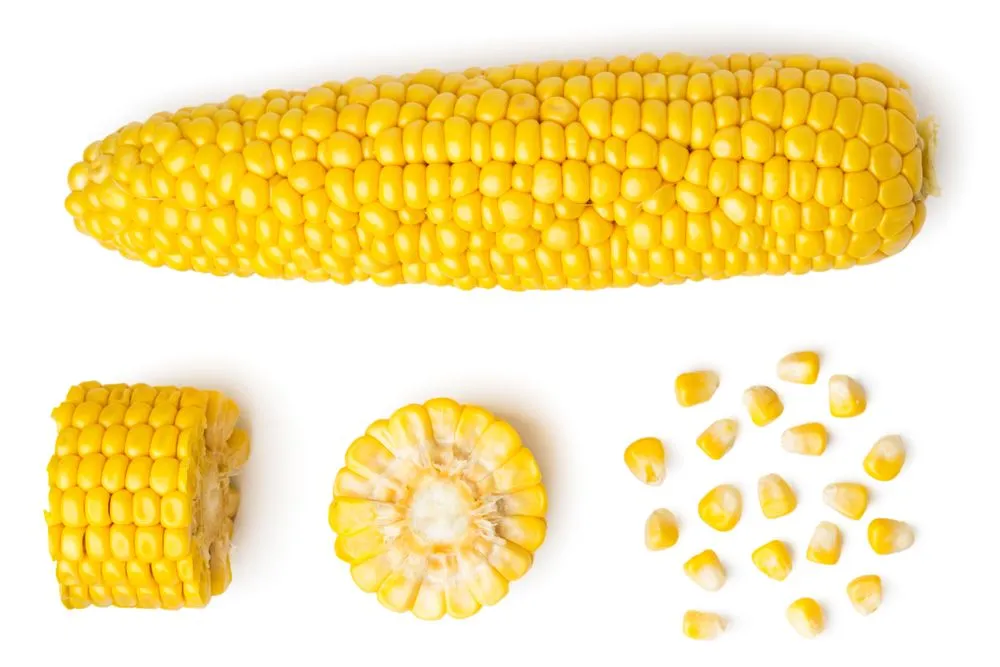
When you look at an ear of corn, right before you slather it in butter and take a bite, you’ll see that it has hundreds of individual “kernels”, each of which has a fruit wall (pericarp) fused to the seed coat inside. That fusion is what makes a corn kernel a caryopsis, the technical name for the type of one-seeded dry fruit produced by grasses (corn, wheat, rice, oats and barley all share this structure). And here’s the twist: because the fruit wall is fused to the seed coat, each kernel is, at the same time, a tiny dry fruit AND the plant’s seed. They aren’t two separate things.

When you hold the whole ear of corn, that is clearly a part of the plant that you are going to consume. You probably won’t eat the hard central cob, but in dietary terms the ear itself is considered a vegetable (USDA MyPlate places fresh sweet corn in the “starchy vegetables” subgroup, alongside potatoes and peas).
Finally, when corn is dried, milled into flour or cooked into popcorn, polenta, grits, cornmeal or tortillas, it is reclassified as a grain. USDA puts all of those forms in the Grains Group rather than the Vegetable Group, since at that point you’re eating the whole dry fruit-and-seed (the caryopsis), not the soft, water-rich vegetable form.
Is A Corn Kernel A Seed?
Here is one of the most common follow-up questions, and the answer is a satisfying yes. Each kernel on a cob is a single grass grain, and a grass grain is a caryopsis, a type of dry fruit in which the fruit wall (the pericarp) is fused directly to the seed coat. Because those two layers are locked together as one unit, botanists treat the kernel as fruit and seed at the same time, and in everyday language we simply call it a seed. (If a plant part being more than one thing at once still feels strange, the coconut runs into the very same identity crisis.) It is the same structure you find in wheat, rice, oats and barley.

If you take a kernel apart, it has four parts. The thin outer skin is the pericarp (the bran). Most of the inside is endosperm, a starchy food reserve. Tucked along one side is the germ, also called the embryo, which is the only living part of the kernel and is literally a tiny preformed plant. The little point where the kernel was attached to the cob is the tip cap. So when people ask "does corn have seeds?", the honest answer is that the kernels are the seeds. Plant one in warm, moist soil and the germ wakes up, draws energy from the endosperm, and pushes out the first shoot of a brand-new corn plant. That is exactly how a farmer turns last year's harvest into this year's field.
What Corn Is Not: Legume, Berry Or Just A Cereal?
Plenty of searches ask whether corn is a legume, a berry or simply a cereal, so let's clear those up. Corn is not a legume. Legumes (beans, peas, lentils, peanuts) belong to the plant family Fabaceae and carry their seeds inside a pod. Corn belongs to the grass family Poaceae, and its seeds ride on a cob, not in a pod. The two families even behave differently in a field: legumes pull nitrogen out of the air to enrich the soil, which is why farmers often rotate corn with a legume crop.

Is corn a berry? No. In botany, a berry is a fleshy fruit that develops from a single ovary with its seeds buried in the pulp, like a grape, a tomato or a banana. A corn kernel is a dry fruit with a hard, papery wall, so it fails the "fleshy" test and is never a berry. What about cereal? "Cereal grain" is simply the food-and-farming term for the edible caryopsis of a grass, so calling corn a cereal is correct, it just describes the same kernel from the grain side rather than naming a separate category. And yes, corn is a flowering plant (an angiosperm), since every grass produces flowers, even if corn's flowers are the tassel and the silks rather than showy petals. This is also why corn produces a fruit at all: the kernel is the seed-bearing structure that grows from a pollinated flower.
A Final Word
Depending on where you are in the world, and what type of corn product you are cooking with, this versatile plant may be called any number of things, but it technically fits into all three categories outlined above. Our one piece of advice is not to put any cream corn in your next fruit salad! However, while corn exists as a vegetable product, when it is consumed (i.e., when the kernels are eaten), you are more specifically snacking on fruits and grains!
References (click to expand)
- Corn | Description, History, Cultivation, Pests, Products & Facts. Encyclopaedia Britannica.
- Is corn a grain or a vegetable? Ask USDA.
- Grains. MyPlate, U.S. Department of Agriculture.
- Beadle, G. W. (1980). The Ancestry of Corn. Scientific American, 242(1), 112–119.
- Sandhu, K. S., Singh, N., & Malhi, N. S. (2007). Some properties of corn grains and their flours I. Food Chemistry, 101(3), 938–946. Elsevier.
- Caryopsis. Wikipedia (the pericarp is fused with the thin seed coat; the fruit typical of Poaceae).
- Corn kernel: pericarp, endosperm, germ and tip cap. Wikipedia.
- Nielsen, R. L. Corn & Corn Production. Corny News Network, Purdue University (each ovule on the cob is a potential kernel, fertilized to develop a seed).
- There Is More to Corn than Popcorn and Corn on the Cob! Frontiers for Young Minds (Zea mays is part of the grass family, Poaceae).
- Berry (botany): a fleshy fruit produced from a single ovary. Wikipedia.