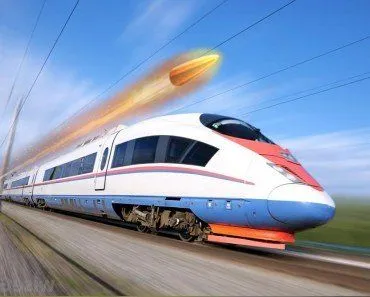
No. A US penny weighs about 2.5 grams while a typical diesel-electric locomotive weighs around 200 short tons (roughly 180 metric tonnes), so the coin carries less than a millionth of the train's momentum. The penny either gets flattened against the rail or kicked aside; MythBusters confirmed this in 2004 (Season 2, “Penny Drop”), classifying the myth as BUSTED.
As a child, I remember there being a lot of talk about the magical powers of the train and its tracks. Some people said that a train could convert a coin into a magnet. While this is false, it was an innocent and comparatively healthy notion.
Another popular adage, however, was that a penny placed on the tracks of a train could actually derail the train, which would cause massive destruction! Now that I’ve grown up, it’s time to explore and investigate the truth of this statement.
What Is Derailment?
We say that a derailment has occurred when a train runs off its rails. But it does not always mean that it has gone off the track completely. Derailment can happen for various reasons such as collision with another object, an operational error, the mechanical failure of tracks, and the mechanical failure of the wheels. At times derailment has been caused on purpose to prevent more serious issues.
The Facts
The issue is very straightforward. Essentially, there is a belief that an average penny, with a weight of no more than a few grams, can derail an entire train, which is more or less in the range of 200 short tons (roughly 180 metric tonnes) (now, count the number of zeroes after converting 200 tons to grams). By the sheer numbers, it seems utterly childish to even consider that such a small piece of metal could affect a high-speed locomotive. However, since we are scientifically intrigued by the matter, let’s look at the odds.
Derailing can happen to trains and does happen for a number of causes. It may be caused by a technical issue, such as a faulty rail, cracks or gaps in the rails, or even human error. What happens is that the locomotive moves off the rails on which it is moving, leading to an accident – and sometimes a catastrophe.
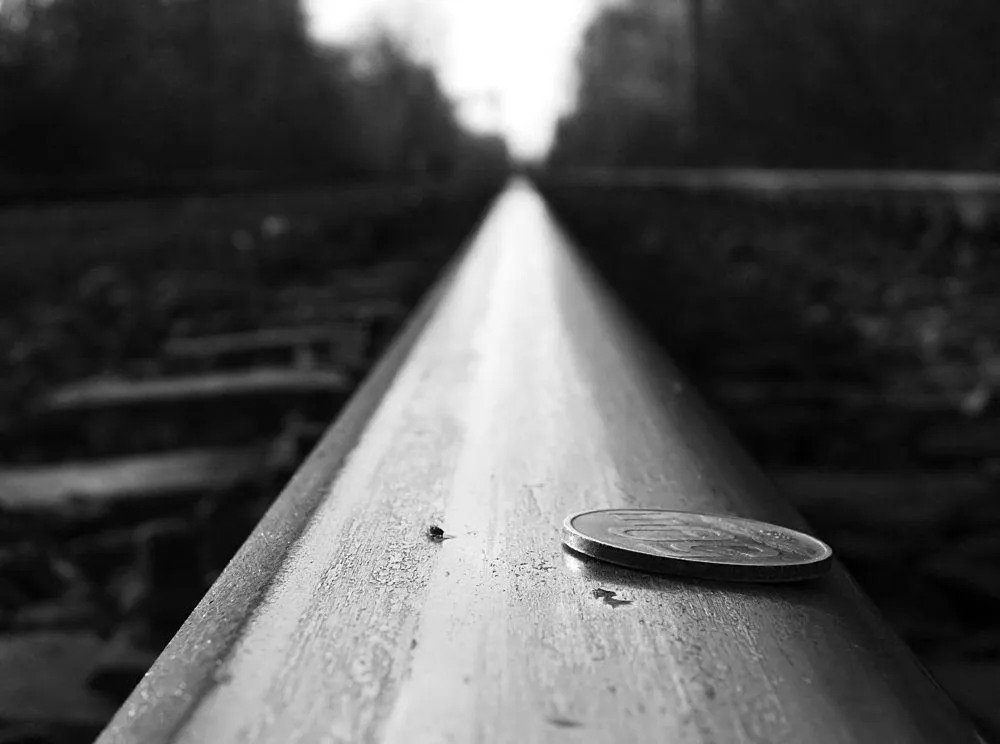
Obstructions lying on the railway tracks can also cause derailing. Some of the most common derailing incidents caused by an obstruction on the tracks involve snow, fallen trees (or thick branches), or vehicles.
Can A Penny Derail A Train?
As far as a penny is concerned, its size is not nearly significant enough to cause a train to run off the rails. This certainty is based in mass and momentum. The principle of conservation of momentum comes into play. The principle basically argues that when two bodies with masses interact, the total momentum remains conserved.
In this case, the two bodies involved are the train and the penny. Now, as we saw, a train is thousands of kilograms and a penny is merely a few grams. Also, the train (the heavier of the two objects) is moving at a high velocity, while the penny is stationary. Therefore, the momentum of the moving train is much more than the penny. The penny is too light to impart any momentum of its own on the train – at least nowhere nearly enough to cause any change in the path of the train.
In short, the penny will have no effect at all.
This is not just an armchair calculation, either. In 2004, the Discovery Channel show MythBusters tested the myth on camera (Season 2, “Penny Drop”) by laying a US penny across the rail in front of a moving train. The train rolled right over it, the coin got flattened, and the locomotive kept going. The verdict on the show was unambiguous: BUSTED.
What Actually Happens?
As you might expect, the penny wouldn’t be of much use after a locomotive runs over it. In fact, the coin-crushing person would be lucky if they were able to detach the penny from the tracks, as the penny will often be flattened and stick to the track. In other cases, the penny is nowhere to be seen; it gets stuck to the wheels and simply gets taken away.
Still, people believe in trying things out, but we would argue that you sit this particular experiment out. There have been many unfortunate incidents when people tried to place a penny on the tracks and were injured or even killed. It’s better to stand at a safe distance and not go anywhere near the tracks to try this old myth out. The result will never change, but your life certainly can!
Why Does A Penny Flatten Instead Of Stopping The Train?
If the coin can't win the fight, what does it actually look like afterwards? The answer is a thin, stretched oval of metal that barely resembles a coin at all. The reason comes down to what a modern penny is made of. Since 1982, a US one-cent coin is roughly 97.5% zinc with a thin 2.5% copper plating, and it weighs just 2.5 grams. Zinc is a soft, easily deformed metal, so when a steel locomotive wheel rolls over it, the coin doesn't shatter or fly off; it simply gives way.

What's happening here is plastic deformation. The enormous load of the wheel squeezes the soft metal sideways until it spreads out, leaving a smooth, elongated disc with only the faintest ghost of Lincoln's portrait. Because all of that weight is concentrated on a tiny contact patch, the pressure is more than enough to reshape the coin, yet nowhere near enough for the coin to push back on a vehicle weighing roughly 180 metric tonnes (200 short tons).
Funnily enough, people have prized these squashed discs for well over a century. The "elongated coin" hobby is usually traced to the 1893 World's Columbian Exposition in Chicago, and souvenir penny-press machines now sit in museums, zoos, and amusement parks around the world. Those machines roll the coin between engraved steel rollers to do safely, and legally, what curious kids once tried to do on live railway tracks.
Is It Illegal To Put Coins On Train Tracks?
Here's the part the childhood dare always left out: walking up to a railway line to lay down a coin is not a harmless prank. In the United States, railroad tracks and the strip of land around them, the right-of-way, are private property. Stepping onto them anywhere other than a marked crossing is trespassing, and that alone can mean a misdemeanor charge.

Federal law takes the issue seriously enough to name it directly. Title 49 of the US Code (§ 20151) directs the government to develop model laws and outreach aimed at preventing both trespassing on railroad rights-of-way and vandalism of railroad property. Many states have since adopted statutes carrying civil or criminal penalties, and placing an object on the rails can be treated far more harshly than a simple shortcut across the tracks, since it can be read as interfering with the railroad.
The bigger reason to stay away, though, is survival, not the statute book. According to the Federal Railroad Administration, trespassing is the leading cause of rail-related deaths in the country, and the rail-safety group Operation Lifesaver notes that grade-crossing collisions and pedestrian trespass together account for more than 95% of all railroad fatalities. A train can take more than a kilometre to stop and is often far quieter and faster than it looks. So by all means enjoy a pressed-penny souvenir from a machine at the local museum, but leave the live tracks well alone.
References (click to expand)
- Derailment - Wikipedia. Wikipedia
- Liu, X., Saat, M. R., & Barkan, C. P. L. (2012, January). Analysis of Causes of Major Train Derailment and Their Effect on Accident Rates. Transportation Research Record: Journal of the Transportation Research Board. SAGE Publications.
- Baird, C. S. How does a penny left on the track derail a train? Science Questions with Surprising Answers. West Texas A&M University.
- Penny. United States Mint.
- 49 U.S. Code § 20151 - Railroad Trespassing and Vandalism Prevention Strategy. Legal Information Institute, Cornell Law School.
- Trespass Prevention. Federal Railroad Administration, U.S. Department of Transportation.
- Track Statistics. Operation Lifesaver.
- Elongated coin - Wikipedia. Wikipedia