In a Wall of Death (also called a Well of Death), the rider stays pinned to the vertical wall because the wall pushes inward on the bike, providing the centripetal force, while static friction between the tires and the wall pushes upward and cancels gravity. Setting friction = weight gives the minimum speed condition: v ≥ √(gR/μ), where R is the radius of the wall, g is 9.8 m/s², and μ is the coefficient of static friction. For a typical 5-meter Wall of Death with rubber-on-wood μ ≈ 0.7, that works out to roughly 8–9 m/s (about 30 km/h). Riders go much faster for a margin of safety.
If you’ve ever been to a carnival boasting a number of death-defying stunts with vehicles, such as a motorbike rider jumping over an array of trucks parked next to each other, or another daredevil jumping through a circle of fire, then you probably know (or have at least heard of) The Wall of Death. To fully understand this amazing spectacle, let’s take a look at the science behind this wild stunt that is often performed by motorcyclists.
What Is A Wall Of Death?
A Wall of Death is a carnival show featuring a wooden cylinder that is 20 – 36 feet in diameter. Inside the cylinder, a motorcyclist (or a driver with any other automobile, like a car) rides along the vertical wall of the cylinder and performs various stunts while doing so. A Wall of Death is known by many other names too, such as a motordrome, silodrome or Well of Death.

The most obvious appeal of this stunt is the fact that the rider is speeding around on a vertical path without falling. People who have a phobia of two-wheeled vehicles know precisely how difficult it is to ride a bike on a flat road, let alone one that is perpendicular to the ground. In other words, this stunt makes for a thrilling display.
Science Behind The Wall Of Death
Now, put your physics caps on so that we can delve deeper into this cylindrical mystery.
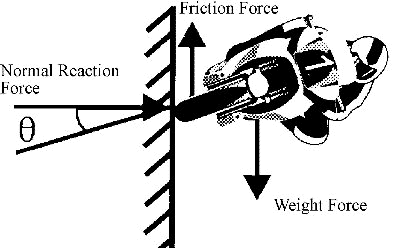
When a bike moves on the walls, there are a number of forces in play. These include the gravitational force, which acts downward from the bike to the walls, the frictional force that the walls exert against the tires of the bike, and the normal reaction force, a perpendicular push back by the wall surface when it receives a force. There is also centripetal force, which is directed towards the center of the circular path that the bike traces.
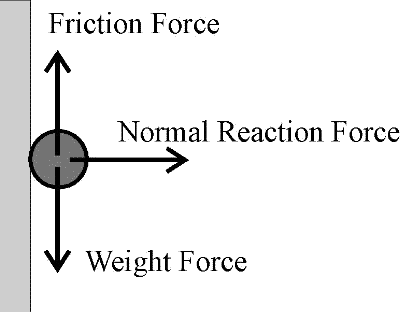
For a bike moving in a horizontal circle on a vertical wall, the normal reaction (N) is the factor that supplies enough force to sustain motion in a circle. Also, the fact that the bike does not slide down the wall signifies that the forces of friction and gravitation balance each other out (as shown in the figure above).
In short, the two forces, the gravitational force and the force of friction, act in opposite directions and compensate each other, while the normal reaction from the wall is what keeps the bike moving.
However, it’s not that simple. The frictional force exerted on the tires of the bike depends on the speed of the bike as it moves along the circle. This means that there has to be a minimum velocity of the bike that produces the maximum frictional force, effectively balancing out the gravitational force. This is crucial, because if the gravitational force is greater, then the bike will slide down and the rider will fall off. The friction becomes stronger as the speed increases, but with increasing speed, it becomes more and more difficult for the rider to steer the vehicle safely.
A Point Missed
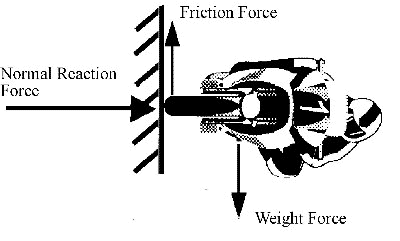
The above system of forces holds true and stays in equilibrium if we’re talking about a point mass, or rather, an object whose entire mass is concentrated in a single point. In such a case, all the forces are acting on that single point. This, however, is not the case with a motorbike. The frictional force is acting on the tires, but the gravitational force is acting through the center of mass of the system consisting of both the bike and the rider. Since the three forces are balanced, but do not lie in the same line, the bike will tend to rotate, producing a turning effect that will eventually lead to it fall off. This anomaly has to be compensated for in order to keep these brave riders safe!
What Is The Formula For The Wall Of Death?
Now, let's put a number on all of this, because only two equations are doing the real work. Horizontally, the only thing pushing the bike toward the middle of the cylinder is the wall, so the centripetal force is supplied entirely by the normal reaction: N = mv2/R, where m is the combined mass of bike and rider, v is the speed, and R is the radius of the drum. Vertically, the bike does not slide down because static friction points straight up and supports the weight, so friction = mg, and that friction can never be larger than μN, where μ is the coefficient of friction.

Put those two conditions together. Friction has to be at least as large as the weight, so mg ≤ μN = μmv2/R. Notice that the mass m appears on both sides and cancels out, which is the surprising part: the minimum speed does not depend on how heavy the bike and rider are. Rearranging what is left gives a clean result for the slowest safe speed: v ≥ √(gR/μ).
Try some real numbers. For a drum of radius R = 5 m, with rubber-on-wood friction of μ ≈ 0.7 and g = 9.8 m/s2, the minimum speed is √(9.8 × 5 ÷ 0.7) = √70 ≈ 8.4 m/s, or about 30 km/h (19 mph). That is only the floor. Riders deliberately go much faster for a safety margin, and in 2016 stunt rider Guy Martin set a world record of 125.77 km/h (78.15 mph) on a giant wall roughly 37 m across. Slip below the minimum speed, though, and friction can no longer hold up the weight, so the rider simply slides down the wall.
Leaning Is The Secret
In order to counter this dangerous turning effect, the rider has to lean at an angle away from the vertical. This will make the normal reaction from the wall produce a tendency to rotate (a torque) in the opposite direction. If the rider bends at the correct angle, the torques will be perfectly balanced out; therefore, there will be no rotating or turning effect on the bike and the impressive display can continue.
However, if the rider leans at an angle other than the correct one, then the unbalanced torques will cause the bike to rotate and fall. Therefore, the rider will have to push harder in the opposite direction to supply extra torque and maintain his balance.
After hearing all that, you may have a very different experience next time you’re at a carnival or a motorbike show. What looks like an impossible, death-defying stunt is actually a complex set of forces and torques working together in harmony. Of course, the skill and guts of the rider flying around that cylindrical ride plays a big part too!
Globe Of Death Vs Wall Of Death: What's The Difference?
People often mix up the Wall of Death with the Globe of Death (you may also have seen it searched as the "dome of death"), but they are two different rides. The Wall of Death is a cylinder, so its riders can only trace flat, horizontal circles around the inside. It grew out of American board-track motordrome racing: the first carnival motordrome appeared at Coney Island in 1911, and by 1915 vertical-walled versions were touring fairgrounds as the "Wall of Death".

The Globe of Death (rebranded the "Globe of Steel" by some shows) is a fully enclosed sphere of riveted steel mesh. Because it is a sphere rather than an open-topped drum, riders can loop vertically and right over the top as well as circle horizontally, and several motorcyclists can ride at once, crisscrossing within a whisker of one another. It is actually the older act: it evolved from the "cycle whirl" around 1901, and Arthur Rosenthal of Grand Rapids, Michigan patented his "Bicyclist's Globe" in 1904. The Guinness World Record stands at six riders plus one person standing in the center, set by the Infernal Varanne team in Milan on 13 April 2011.
The underlying physics is identical in both: the wall supplies the centripetal force while friction fights gravity. The same trick powers the spinning "Rotor" (or Gravitron) fairground ride, where the floor drops away and riders are pinned to the wall of a rotating cylinder by exactly this balance of normal force and friction.