Heavy water, formally deuterium oxide (D2O), is water in which both ordinary hydrogen atoms (protium, 1H) are replaced by the heavier hydrogen isotope deuterium (2H or D). It has a molecular weight of about 20 g/mol versus 18 g/mol for ordinary H2O, is roughly 11% denser, and is non-radioactive. Its main industrial use is as a neutron moderator in heavy-water nuclear reactors such as CANDU reactors.
Everyone has heard of water or H2O, but far fewer people are aware of naturally occurring heavy water, D2O.
What Is Heavy Water?
In order to decipher the mystery of heavy water, one must first understand the concept of isotopes. When atoms of an element differ by the number of neutrons in their nucleus, they are known as isotopes. Hydrogen has the following isotopes.
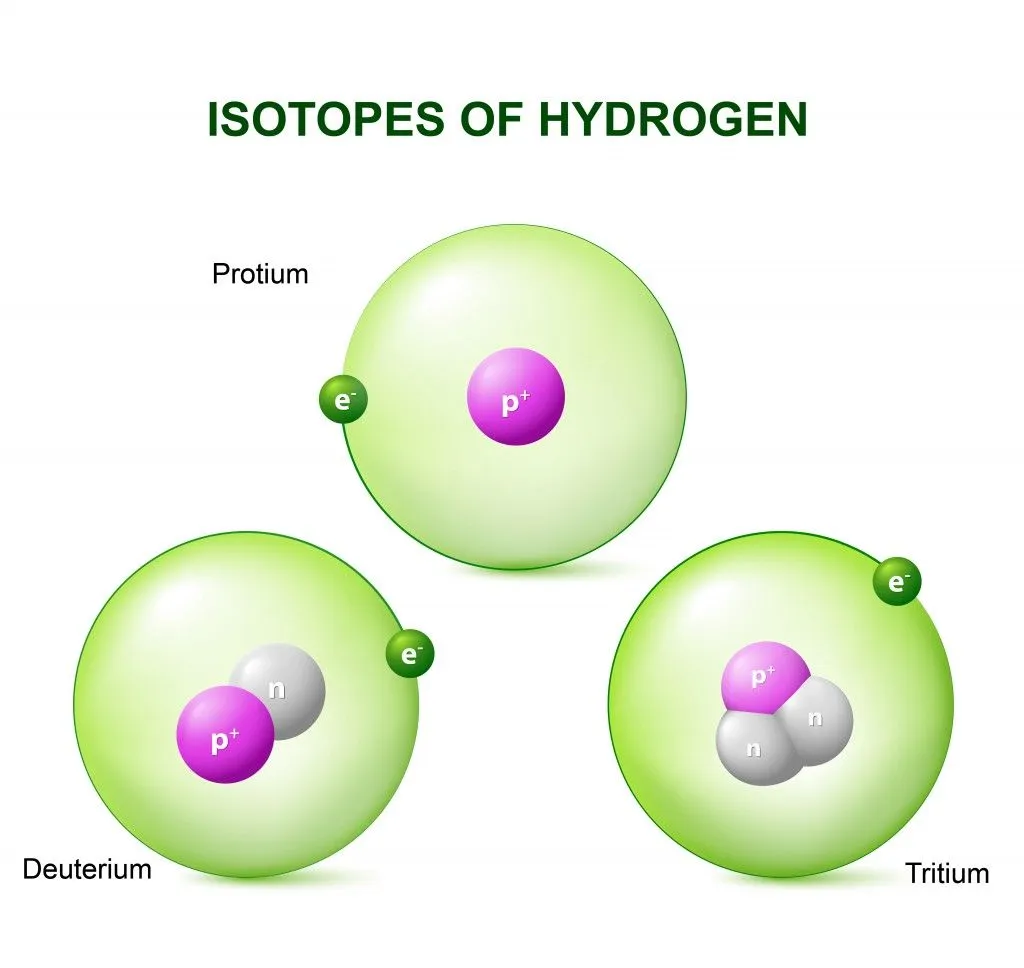
Deuterium is an isotope of hydrogen that contains one neutron more than a standard hydrogen atom. Due to this additional neutron in each deuterium atom, it essentially weighs twice that of a normal hydrogen atom.
Just like ordinary water (H2O), heavy water or deuterium oxide (D2O) has two hydrogen-isotope atoms attached to one oxygen atom. The difference is that, instead of two ordinary protium atoms, heavy water carries two deuterium atoms.
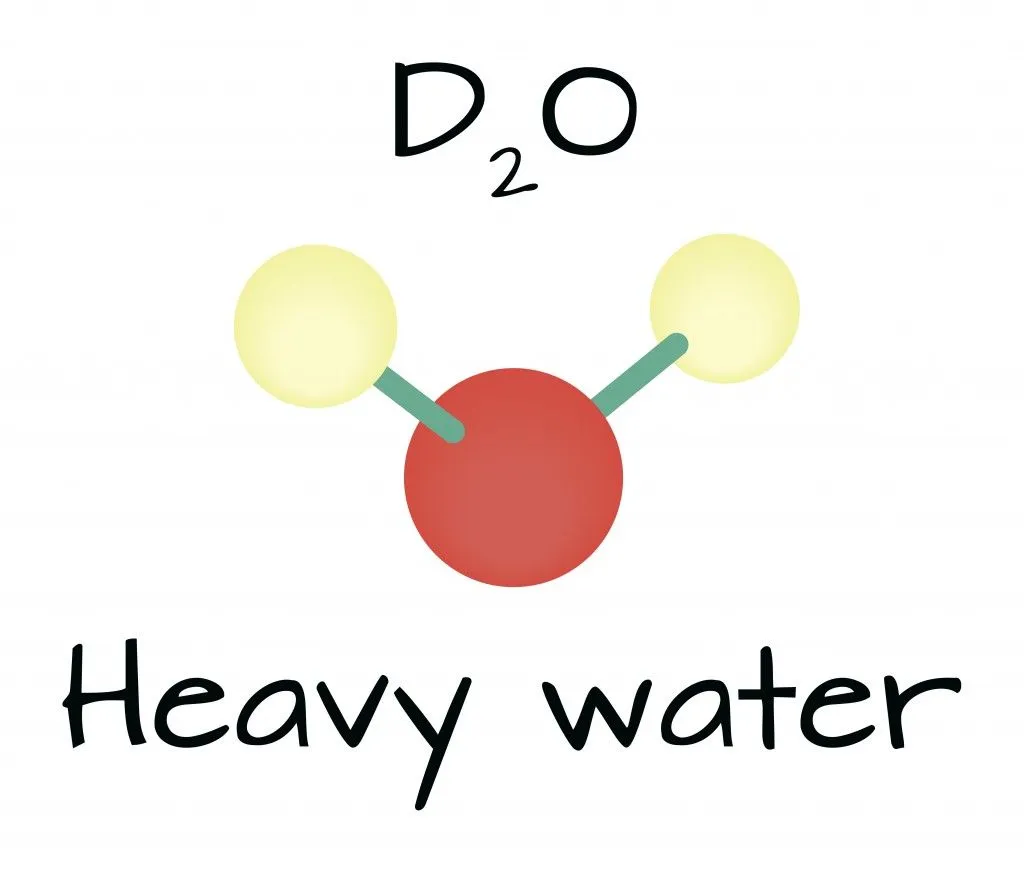
Like normal water, heavy water is an odorless liquid at room temperature. Moreover, deuterium, tantamount to protium, is also a stable isotope. This ensures that heavy water is not radioactive. D2O has a molecular weight of about 20 g/mol, whereas H2O has a molecular weight of just 18 g/mol. Due to its higher weight, deuterium is more dense than water. In a solid state, a block of D2O will sink in water, rather than float.

This is different to the how a block of ice (H2O) would behave. An easy way to differentiate between D2O and H2O is the weight and density of the two compounds. Heavy water does occur naturally, but it is nowhere near as common as ordinary water. Of every roughly 6,420 hydrogen atoms in seawater, only one is deuterium (per IUPAC), which means a pure D2O molecule (both hydrogens being deuterium) shows up in roughly one out of every 20 million water molecules.
What Is Heavy Water Used For?
Heavy water can be used in the preparation of certain compounds, such as deuterium and tritium. Heavy water is also utilized in nuclear reactors. A fission reaction with Uranium-235 must occur in these reactors. A fission reaction is when a neutron is fired at a large nuclei, which subsequently splits apart. A large amount of energy is released as a result of this splitting.
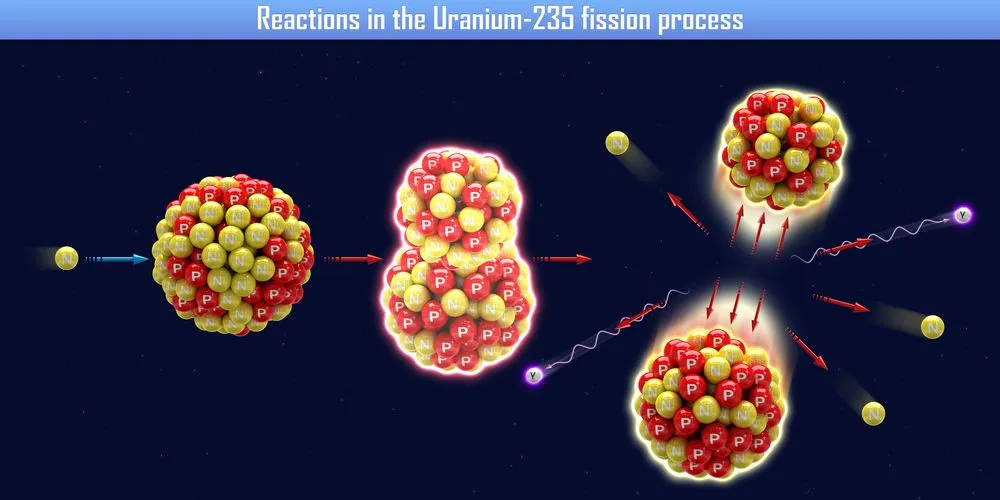
In these reactors, neutrons move at an incredibly fast pace and must be slowed down. Slower neutron movement in the reactor ensures that the fission reaction materializes efficiently. Heavy water acts as a neutron moderator in this reaction, as it is able to slow down the neutron. This allows the fission chain reaction to work with Uranium-235.
Heavy water can also be used as a tracer compound. An isotopic tracer is any atom that can identified when added to another mixture. Such an atom allows scientists to ‘trace’ the progress of a mixture. An isotopic tracer must be compatible with a mixture, but it can also be differentiated in the mixture; heavy water provides this unique combination.
How Is Heavy Water Made?
Because heavy water already exists in nature, it is not built from scratch in a laboratory; it is patiently concentrated out of ordinary water. As mentioned earlier, only about one hydrogen atom in every 6,420 in seawater is deuterium (per IUPAC), so a fully formed D2O molecule turns up in roughly one out of every 20 million water molecules. Separating that tiny fraction from all the surrounding H2O is the entire challenge, and it is exactly why heavy water is so costly.

The earliest producers relied on electrolysis. When water is split by an electric current, the lighter H2O molecules break apart slightly faster than the heavier D2O molecules, so deuterium gradually builds up in the leftover liquid. Norway's Vemork plant near Rjukan, run by Norsk Hydro, used precisely this effect, harvesting heavy water as a by-product of its hydrogen electrolysis. From 1934 it became the first plant in the world to make heavy water on an industrial scale, albeit at a modest rate of around 1.2 tonnes per year.
Electrolysis is enormously power-hungry, so modern plants favor the Girdler sulfide (GS) process, invented in 1943 and named after the company that built the first American plant to use it. It is a dual-temperature exchange method in which hydrogen sulfide gas and water are circulated past each other in tall towers. In a "cold" tower held near 30°C (86°F), deuterium tends to migrate into the liquid water, while in a "hot" tower near 130°C (266°F) it shifts back into the gas. Cycling water through these stages enriches it to roughly 15 to 20 percent D2O. A final vacuum distillation step then lifts the concentration above 99 percent, the purity needed for a nuclear reactor.
Whichever route is used, the numbers are daunting. Because the starting material is so dilute, a plant may need to process hundreds of thousands of tonnes of feed water to yield a single tonne of reactor-grade heavy water, all while consuming vast amounts of energy. That combination of scale and power is why D2O remains an expensive, specialized product.
What Was Heavy Water's Role In World War II?
Heavy water's most dramatic chapter belongs not to chemistry but to history. During World War II, that same Vemork plant became the target of one of the most celebrated sabotage missions ever carried out, precisely because of its ability to produce heavy water.

After Nazi Germany occupied Norway in 1940, its scientists eyed Vemork's heavy water as a neutron moderator for an experimental nuclear reactor, a possible stepping stone toward an atomic bomb. Denying them that supply became an Allied priority. On the night of 27–28 February 1943, a small team of Norwegian commandos trained by Britain's Special Operations Executive carried out Operation Gunnerside. Led by Joachim Rønneberg, they slipped into the heavily guarded plant, placed explosives on the electrolysis cells, and destroyed over 500 kg of heavy water. Remarkably, they escaped without firing a shot or losing a single man, and the raid is often described as the most successful act of sabotage of the war.
The Germans repaired the plant and resumed production, prompting a massive United States daylight bombing raid in November 1943. Rather than rebuild yet again, the occupiers decided to move their remaining heavy water to Germany. The Norwegian resistance struck one final time, sinking the railway ferry Hydro as it crossed Lake Tinn (Tinnsjø) around midnight on 20 February 1944. The sabotage sent the shipment to the bottom of the lake, though it came at a heavy cost, as 18 people died, most of them Norwegian passengers and crew. With that, Germany's access to heavy water was effectively ended, and its faltering nuclear effort lost a resource it never managed to replace.
Can You Drink Heavy Water?
In limited quantities, yes.
In small quantities, drinking heavy water won’t affect you in any way. Consuming D2O won’t harm you because deuterium isn’t radioactive, so you don’t need to worry about radiation poisoning. Deuterium atoms occur naturally in small proportions. There is roughly one deuterium atom for every 6,400 hydrogen atoms in natural water (per IUPAC), making it quite a rare occurrence. In these proportions, consuming D2O won’t cause any bodily harm to humans. In terms of taste, heavy water has a somewhat sweeter taste than regular water.

If you consume a significant amount of heavy water, you may feel some uneasiness due to the change in the density of the liquid. You might feel a slight change in the pressure in the fluids present in your ears. However, this amount should still not cause any major damage to your body, and it’s rare that one would be able to consume enough heavy water to cause any major distress. However, if one does consume heavy water in large proportions, it will be very injurious to your health.

The greater mass of the deuterium atoms, as compared to the hydrogen atoms, will affect chemical reactions that occur in the body. The heavier D2O molecules will slow down naturally occurring chemical reactions that regularly happen in the human body. If the amount of heavy water reaches a point of 20% of the total water present in your body, it could prove fatal. Certain types of heavy water include tritium atoms, instead of deuterium atoms. This variety is even more harmful, since tritium is heavier and, more importantly, radioactive. Any intake of such liquids will cause bodily harm and can affect the DNA integrity of humans.
Thankfully, we rarely hear of people overdosing on any type of heavy water, mainly because obtaining D2O is very difficult and expensive. By using electrolysis, one can obtain pure heavy water, but most people don’t have access to these resources. Purchasing D2O is also expensive, with research-grade prices typically upwards of $1 per gram (roughly $100 for 100 g) from isotope suppliers.
References (click to expand)
- Berry, D., Mader, E., Lee, T. K., Woebken, D., Wang, Y., Zhu, D., … Wagner, M. (2014, December 30). Tracking heavy water (D 2 O) incorporation for identifying and sorting active microbial cells. Proceedings of the National Academy of Sciences. Proceedings of the National Academy of Sciences.
- Heavy Water (D2O) | NRC.gov. The Nuclear Regulatory Commission
- Water Density | U.S. Geological Survey. The United States Geological Survey
- Heavy water - Encyclopaedia Britannica
- Deuterium oxide. PubChem. National Library of Medicine
- Girdler sulfide process - Wikipedia
- Operation Gunnerside - Atomic Heritage Foundation
- Norwegian heavy water sabotage - Wikipedia