Table of Contents (click to expand)
- What Is Ultimate Tensile Strength?
- What Is The Formula And Symbol For Ultimate Tensile Strength?
- What Unit Is Tensile Strength Measured In?
- How Ductile Materials Behave When Stress Is Applied
- Tensile Testing
- Tensile Strength vs Yield Strength vs Breaking Strength
- Ultimate Tensile Strength Of Some Common Materials
- Which Material Has The Highest Tensile Strength?
Ultimate tensile strength (UTS), often shortened to “tensile strength,” is the maximum stress a material can withstand while being pulled or stretched before it starts to neck and ultimately fracture. It is the peak of the stress-strain curve, measured in pascals (Pa), usually megapascals (MPa) or, in the U.S., pounds per square inch (psi). Examples: concrete ~2–5 MPa, structural steel ~400–550 MPa, Kevlar ~3,000 MPa, and graphene ~130,000 MPa (130 GPa), currently the highest measured tensile strength of any known material.
What Is Ultimate Tensile Strength?
Tensile properties of a material indicate how it will react to forces applied on it in tension. As you can imagine, some materials break when a great deal of force is applied to them, while others get elongated or physically deformed in some other way. Materials that break very sharply are said to undergo a ‘brittle failure’.
On the other hand, there are some materials that can handle/withstand a great deal of stress while being pulled or stretched before breaking. The term ‘ultimate tensile strength’ (or UTS) is used to refer to the maximum stress that a material can withstand while being stretched in tension, the peak point on the stress-strain curve, just before the material starts to “neck” (its cross-section narrowing locally) and then fracture.
Ultimate Tensile Strength Unit
Tensile strength is defined as a measurement of stress, which, in turn, is measured as force per unit area. The SI unit of UTS is Pascal or Pa. It’s usually expressed in megaPascals, so the UTS is commonly expressed in megaPascals (or MPa). In the US, the UTS is often expressed in pounds per square inch (or psi).
What Is The Formula And Symbol For Ultimate Tensile Strength?
Ultimate tensile strength is just a stress, so it uses the same simple formula as any other stress: force divided by area. During a tensile test you record the largest pulling force the sample carries (Fmax), then divide it by the sample’s original cross-sectional area (A0), measured before any stretching:
UTS = Fmax / A0

Using the original area gives what engineers call engineering stress, which is the value normally quoted as the tensile strength. (Dividing by the smaller, instantaneous area at each moment instead gives true stress, which keeps climbing even as the sample necks. Engineers use engineering stress because it matches the dimensions a designer actually specifies.)
There is no single agreed symbol. The UTS is variously written as σu (sigma-u, since σ is the standard symbol for stress), Su or Stu in many engineering texts, and Rm in European steel standards. You will also simply see it spelled out as UTS or TS.
A quick worked example: suppose a round steel rod 10 mm in diameter (radius 5 mm) carries a maximum pull of 31.4 kN before fracturing. Its original area is A0 = πr² = π × (5 mm)² ≈ 78.5 mm². The UTS is then 31,400 N ÷ 78.5 mm² ≈ 400 N/mm², which is the same as 400 MPa (about 58,000 psi) – right in the range for ordinary structural steel.
What Unit Is Tensile Strength Measured In?
Because tensile strength is a stress (force per unit area), its SI unit is the pascal (Pa), where 1 Pa equals 1 newton per square meter (N/m²). A pascal is tiny for engineering purposes, so real materials are almost always quoted in megapascals (MPa), and the very strongest in gigapascals (GPa).
Two conversions are worth memorizing:
- 1 MPa = 1 N/mm². This is exact and very handy, because forces in newtons and areas in square millimeters are what you usually measure in the lab.
- 1 MPa ≈ 145 psi (more precisely 145.04 psi, since 1 psi = 6,895 Pa). So US-customary values in pounds per square inch are roughly 145 times the metric figure.
To put the scale in context: 1 GPa = 1,000 MPa = 1,000 N/mm² ≈ 145,000 psi. So when graphene is quoted at 130 GPa, that is about 18.9 million psi. You may also see strengths in ksi (kilopounds per square inch, where 1 ksi = 1,000 psi) in American datasheets, and occasionally in kgf/mm² in older references, where 1 kgf/mm² ≈ 9.81 MPa.
How Ductile Materials Behave When Stress Is Applied
Many materials exhibit a linear elastic behavior, which means they become deformed (temporarily) when forces are applied on them, but return to their original shape once forces are no longer applied. This elastic behavior of materials usually extends to a certain point (called the ‘yield point’), up to which all deformations are reversible upon removal of the load.
 Beyond the yield point, the deformations of ductile materials (like steel) are ‘plastic’. A plastically deformed sample does not completely return to its original shape and size when the load or stress is removed.
Tensile Testing
The ultimate tensile strength or UTS is therefore used for quality control (due to its ease of testing), to roughly determine material types for unknown samples.
Determining the UTS of a sample (i.e., a tensile test) is fairly simple. It involves using a small sample with a fixed cross-sectional area and then pulling it with a tensometer at a constant strain rate until the sample breaks. The highest point in the stress-strain curve (refer to the graph given above) is the ultimate tensile strength.
Since the UTS is an intensive property, its value is independent of the size of the test specimen; however, it depends on certain other factors, like the temperature of the material and the test environment, the presence of surface defects on the test specimen, preparation of the specimen etc.

Tensile Strength vs Yield Strength vs Breaking Strength
People often use “tensile strength,” “yield strength” and “breaking strength” loosely, but on the stress-strain curve they sit at three different points, and mixing them up is a common source of confusion.
- Yield strength is where the material stops behaving elastically and starts to deform permanently (plastically). Load it below the yield point and it springs back; push past it and the change is permanent. This is the value designers usually work to, because a part that has yielded is already ruined even though it has not broken.
- Ultimate tensile strength is the very top of the curve – the maximum stress the material reaches at all. For ductile metals it sits well above the yield point, and the gap between the two reflects how much the material hardens as it is stretched (a behavior called strain hardening). After this peak, the sample begins to neck.
- Breaking (or fracture) strength is the stress at the moment the sample actually snaps. For a ductile material this is counter-intuitively lower than the UTS, because once necking starts the cross-section shrinks rapidly and the curve droops down to the break.
So is “tensile strength” the same as “ultimate tensile strength”? In everyday usage, yes – “tensile strength” is almost always shorthand for the ultimate value, the peak of the curve. It is not the same as yield strength or breaking strength, which are distinct points. For a deeper look at where plastic deformation begins, see our companion piece on yield strength. Brittle materials such as glass and ceramics are the exception: they have almost no plastic region, so their yield, ultimate and breaking points essentially coincide and they shatter with little warning.
Ultimate Tensile Strength Of Some Common Materials
The ultimate tensile strength of a material is its maximum resistance to fracture. As you can imagine, the tensile strength of a material is a crucial measurement of its ability to perform in an application, which is why the UTS is widely used while describing the properties of alloys and metals.
Given below are the values of the UTS of a few materials:
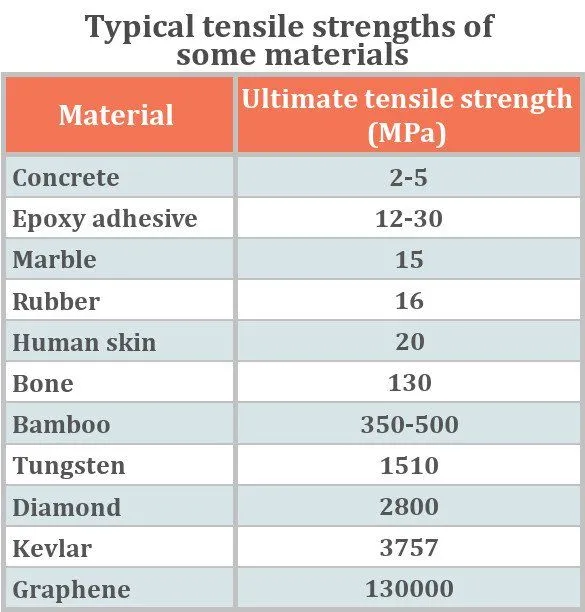
As you can see in the table, concrete (a ‘hard’ object) has a lower UTS value than rubber, marble and even human skin. Diamond, quite predictably, appears near the bottom, and graphene, an allotrope of carbon, sits at the very bottom with the highest UTS value (in the table).
To make those numbers easier to compare, here are representative ultimate tensile strengths for some everyday and engineering materials, sorted from weakest to strongest (values vary with grade, alloy and treatment, so treat them as ballpark figures):
- Concrete: ~2–5 MPa (290–725 psi) in tension – which is exactly why it is reinforced with steel.
- Human skin: ~20 MPa (2,900 psi)
- Glass (annealed): ~41 MPa (5,900 psi)
- Bone (limb, cortical): ~130 MPa (18,900 psi)
- Copper (pure, annealed): ~220 MPa (32,000 psi)
- Aluminum 6061-T6: ~310 MPa (45,000 psi)
- Structural (A36) steel: ~400–550 MPa (58,000–80,000 psi)
- Titanium alloy (Ti-6Al-4V): ~1,170 MPa (170,000 psi)
- Kevlar fiber: ~3,000 MPa (435,000 psi)
- Carbon fiber: ~4,100 MPa (595,000 psi)
- Carbon nanotube: ~63 GPa (9.1 million psi)
- Graphene: ~130 GPa (18.9 million psi)
Which Material Has The Highest Tensile Strength?
The material with the highest measured tensile strength is graphene, a one-atom-thick sheet of carbon arranged in a hexagonal honeycomb. In a landmark 2008 study published in Science, researchers at Columbia University pressed an atomic-force-microscope tip into free-standing graphene membranes and measured an intrinsic strength of roughly 130 GPa (about 18.9 million psi). That is the highest value ever recorded for any real material, making graphene the benchmark against which other “super-strong” materials are compared.

Close behind are individual carbon nanotubes, the rolled-up cylindrical cousins of graphene. Tests on individual multi-walled nanotubes (also reported in Science, in 2000) gave tensile strengths around 63 GPa – tens of times stronger than steel for a fraction of the weight. Among everyday engineering fibers, carbon fiber and Kevlar top the list at roughly 4,100 MPa and 3,000 MPa respectively, which is why they show up in everything from bulletproof vests to aircraft and racing bikes.
One important caveat: these record numbers are intrinsic strengths measured on tiny, near-perfect samples. Real bulk materials and fibers are full of defects that act as crack-starters, so a macroscopic graphene or nanotube product is far weaker than a single flawless sheet or tube. That is why structural steel, despite a UTS of only a few hundred MPa, still does most of the world’s heavy lifting.
References (click to expand)
- nglos324 - UTS. Princeton University
- Tensile strength - Soft-Matter. This result comes from soft-matter.seas.harvard.edu
- Tensile Strength - srjcstaff.santarosa.edu
- Tensile Properties - Materials - NDE-Ed.org. nde-ed.org
- nglos324 - UTS. Princeton University
- Mechanical Properties of Materials. MechaniCalc
- Lee et al. Measurement of the Elastic Properties and Intrinsic Strength of Monolayer Graphene. Science, 321, 385-388 (2008)
- Yu et al. Strength and Breaking Mechanism of Multiwalled Carbon Nanotubes Under Tensile Load. Science, 287, 637-640 (2000)
- Strength of Titanium Alloys - UTS, Yield Strength, Modulus. Material Properties
- Gallagher et al. Dynamic Tensile Properties of Human Skin. IRCOBI Conference Proceedings (2012)