Personality is a way to describe someone’s different characteristics. There are five main traits that make up personality: openness, conscientiousness, extroversion, agreeableness, and neuroticism. These five traits can be used to describe someone’s personality in a general way. However, it is important to note that these traits don’t encompass everything that makes up someone’s personality.
Personality is a funny and strange concept. We commonly use words like ‘friendly’, ‘bubbly’, ‘shy’, ‘spontaneous’, ‘easy-going’, ‘risk taker’ and others to describe someone’s personality.
Our personality is who we are, consisting of our physical and emotional reactions to different things and our attitudes. It is what separates us from other people and makes us uniquely… us! Understanding it explains why we are the way we are and why we do the things we do.
There is an abundance of tests and questionnaires available to help a person identify and describe their personality type. One of the most popular personality tests and a modern model for describing personality is the Big 5.
The Big 5
This is often also known as the OCEAN model or the Five Factor Model (FFM). This model arises from the concept that personality can be described by its constituting traits. The very first attempt at identifying these traits resulted in 200 of them being identified. Over time, and by different people, this number was narrowed down. The Big Five, as the name suggests, talks of 5 core traits whose varying degrees can be used to describe someone’s personality.
The name OCEAN comes from the acronym for the 5 traits: Openness, Conscientiousness, Extroversion, Agreeableness and Neuroticism.
Where a person lies on the scale for each of these traits describes their personality. It is also proposed that these traits are independent of each other. Simply put, knowing how agreeable a person is will not predict their level of any of the other 4 traits.
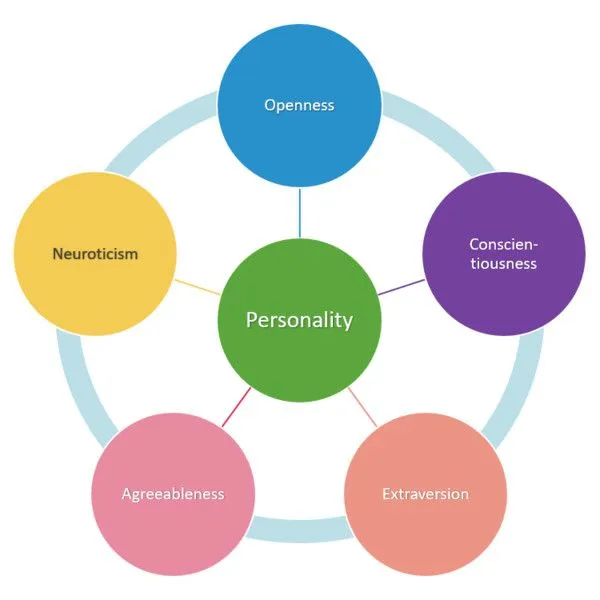
The Five Traits Of OCEAN Model
Openness
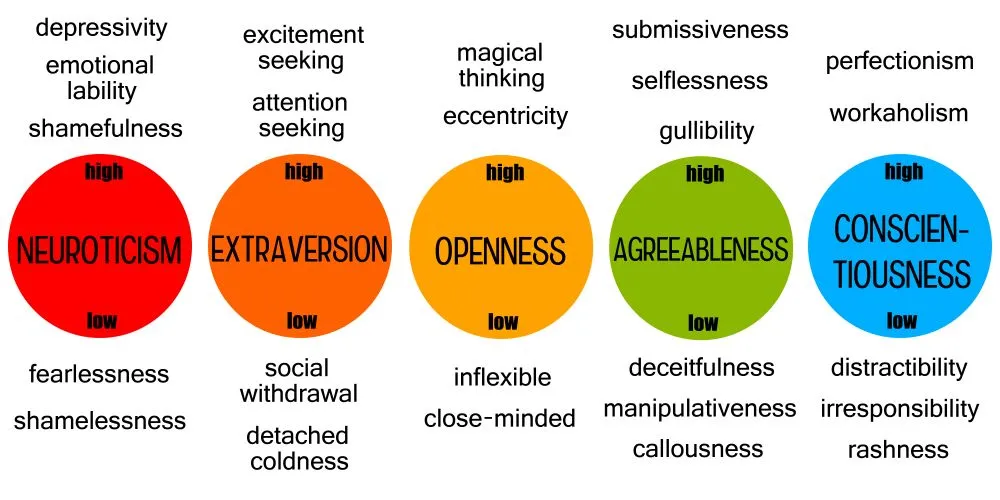
As the name suggests, this trait is about how open and willing a person is to new experiences. These can include cultural, adventurous, aesthetic and other experiences. A person who is willing to try these will have a higher rating of openness, whereas a person who doesn’t like to try new things and prefers the status quo will rate lower on this trait.
Practical people are less open to experiences, whereas more imaginative people are more open.
Conscientiousness
This trait is about how particular, meticulous and organized a person is. People with a high rating in this area tend to be on time, be very meticulous with their work, be more disciplined and so on. On the other hand, people with a lower rating in this category will be the opposite.
Extroversion
This is a commonly heard term. Extroversion is a measure of how social and outgoing a person is. We have often heard of the terms extroverts and introverts. Extroverts rate high for this trait. Some of the words associated with them include enthusiastic, social, and at the center of attention. Introverts, on the other hand, are comparatively more reserved, quiet and don’t like being around other people as much.
Agreeableness
How cooperative and unselfish a person is describes their agreeableness. People with a higher rating tend to be more cooperative, pleasant, positive and selfless in their actions. Whereas their counterparts are usually more independent, not as cooperative, overly critical, and can be rude or selfish. They are usually harder to get along with than people who are more agreeable.
Neuroticism
This trait refers to the emotional stability of a person. People who have a high rating for this metric are not very emotionally stable. They may be anxious, moody and temperamental, very insecure, self-conscious and they may be worriers. They are also more prone to being psychologically distressed. Alternatively, people with a low rating for this trait are more calm, collected, secure and stable. They tend to be resilient and relaxed.
Who Came Up With The Big Five?
The Big Five didn't spring from a single scientist's notebook. It grew, slowly, out of a clever idea called the lexical hypothesis: if a personality trait really matters in everyday life, people will have invented a word for it. So the place to look for the building blocks of personality is the dictionary.
Back in 1936, two American psychologists, Gordon Allport and Henry Odbert, took that idea literally and combed through an English dictionary, pulling out roughly 4,500 words that describe stable personality traits. That is a lot of words to work with. In the 1940s, psychologist Raymond Cattell used a statistical tool called factor analysis (a method that spots which words tend to cluster together because they measure the same underlying thing) to shrink that pile down to 16 traits.
Even 16 turned out to be more than the data needed. When later researchers re-analyzed personality ratings, the same five broad groupings kept reappearing, no matter who was doing the rating. Psychologist Lewis Goldberg championed these recurring five and gave them the now-famous nickname the “Big Five.” Robert McCrae and Paul Costa then built questionnaires to measure them and confirmed the model held up across different samples, turning the Big Five into the standard psychologists still reach for today.
How Is The Big Five Measured?
Here is the part that surprises a lot of people: there is no single official “Big Five test.” Instead, the model is a framework, and several different questionnaires have been built to score you on the same five dimensions. You don't get sorted into a personality “type.” Each of the five traits is a spectrum, and the test simply tells you roughly where you fall along each one, somewhere between the two extremes.

Most of these tests work the same way. You read a series of short statements (“I make plans and stick to them,” “I worry about things”) and rate how much you agree with each on a scale from strongly disagree to strongly agree. Your answers are then totted up into a score for each of the five traits.
The best-known instruments are the NEO Personality Inventory-Revised (NEO-PI-R), developed by Costa and McCrae, which uses 240 items and breaks each of the five traits into six narrower facets (30 facets in all); the Big Five Inventory (BFI), a shorter 44-item questionnaire created by Oliver John that measures just the five broad traits; and the International Personality Item Pool (IPIP), a freely available, public-domain bank of items assembled by Lewis Goldberg so that researchers don't have to pay to use a personality test.
What Can The Big Five Predict?
The Big Five wouldn't have survived this long if it were only good for cocktail-party labels. Researchers keep returning to it because where you land on these five scales genuinely relates to how your life tends to unfold, from the classroom to the workplace.

One trait stands out above the rest: conscientiousness. A 2022 review that pooled 54 separate meta-analyses (covering more than 550,000 people) found conscientiousness was the strongest Big Five predictor of performance overall, and it mattered even more for academic results than for the job itself. In plain terms, the disciplined, organized, follow-through end of that scale tends to line up with doing well at school and at work.
The other four traits pull their weight too, just in narrower ways. Higher extroversion is handy in roles that revolve around people and persuasion, agreeableness smooths teamwork, openness helps with learning and creative problem-solving, and lower neuroticism (more emotional stability) tends to track with steadier performance under pressure. No single trait is “good” or “bad,” though. The right mix depends entirely on what you are trying to do.
Accuracy And Universal Application
It is often argued that these 5 factors cannot provide a complete description of someone’s personality. Supporters of this model respond with the claim that although these factors do not provide an exhaustive list of personality describers, they give an overview of the person and their most important traits.
The model and its traits have been translated into a number of languages and tested for reliability and accuracy. While there is some conflicting evidence, for the most part, the literature shows that this model is universally applicable and transcends culture, age, gender and other common differences. However, it would be remiss not to mention that when translated in other languages, some of these traits, particularly openness, can have different meanings.
Overall, the Five Factor Model is still one of the most widely accepted personality models.
Personality is an extremely intriguing concept. As one can make out from the words and traits mentioned above, we apply and use this concept in our lives every day, from describing people to predicting their behavior. Although our personalities can change from childhood to adulthood, these changes are usually not drastic or sudden. They are also affected by external factors, including education, culture, upbringing, and more!
References (click to expand)
- Gurven, M., von Rueden, C., Massenkoff, M., Kaplan, H., & Lero Vie, M. (2013, February). How universal is the Big Five? Testing the five-factor model of personality variation among forager–farmers in the Bolivian Amazon. Journal of Personality and Social Psychology. American Psychological Association (APA).
- Lead Your Team with the Big Five Model. michiganstateuniversityonline.com
- Big Five Personality Traits - Explore SEL. Harvard University
- Measuring the Big Five Personality Domains |. The University of Oregon
- Ciccarelli S.,& White J. N. (2016). Psychology. Pearson
- McCrae, R. R., & John, O. P. (1992). An introduction to the five-factor model and its applications. Journal of Personality. PubMed.
- Zell, E., & Lesick, T. L. (2022). Big five personality traits and performance: A quantitative synthesis of 50+ meta-analyses. Journal of Personality. PubMed.
- Big Five Personality Traits: The 5-Factor Model of Personality. Simply Psychology.