Yes — but not for the reasons most people assume. Modern athletes really do run faster, jump higher, and throw further than their predecessors (Usain Bolt’s 9.58 s 100 m, Yaroslava Mahuchikh’s 2.10 m high jump in 2024, Mykolas Alekna’s 75.56 m discus in 2025), but a large share of that gain is due to better tracks, shoes, equipment, nutrition, video and biomechanical analysis, sports science, and — at the dark end of the spectrum — performance-enhancing drugs, rather than to dramatic changes in the human body itself.
“Citius Altius Fortius” interpreted into English as “Faster, Higher, Stronger” is the Olympic motto that has inspired and motivated athletes over the years.
Today’s world of professional and Olympic-level sports has produced athletes that seem to be stronger, faster and bigger than those from only a century ago. Modern-day athletes like Usain Bolt, Michael Phelps and Ryan Crouser have broken all previously set bars and have emerged as the best this century has ever seen.
All these amazing performances at the very highest level lead us to an important question – are athletes really getting better? Has technology helped athletes push past their brain’s natural barriers, allowing them to access their untapped potential?
It has been argued that the bodies of athletes haven’t changed much over this period, and that the improved performances are mostly the result of technological advances. Let’s take a closer look.
What Do The Statistics Say?
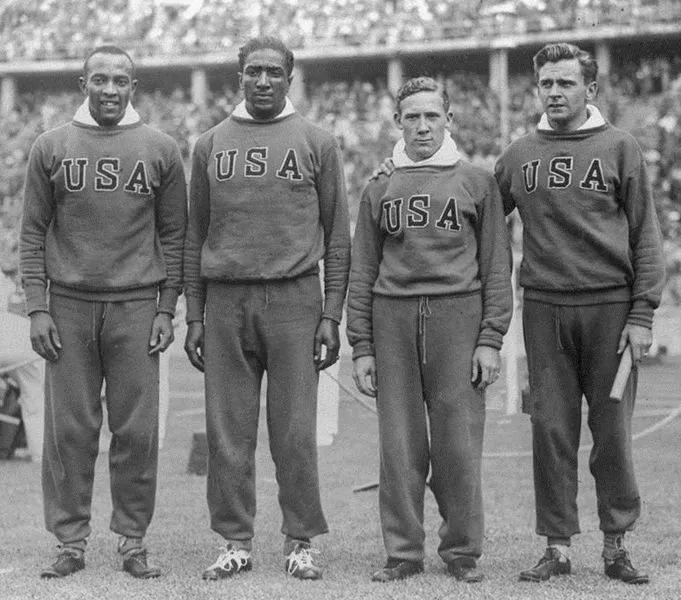
Jesse Owens won the 100 m dash at the 1936 Berlin Olympics in 10.3 seconds — an Olympic record at the time. He would have come up well short against Usain Bolt, whose 9.58-second run at the 2009 World Championships in Berlin still stands as the world record more than 15 years later.
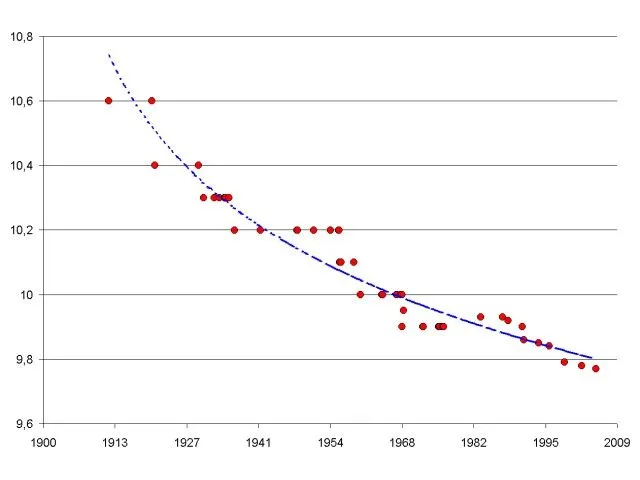
The men’s high jump has been present on the Olympic athletics lineup since the very first Summer Olympics in 1896, while the women’s high jump was one of five events to feature on the first women’s athletics lineup in 1928. The men’s world record — Javier Sotomayor’s 2.45 m, cleared in Salamanca in July 1993 — has now stood for more than three decades. Stefka Kostadinova’s women’s mark of 2.09 m, set in Rome in 1987, finally fell on 7 July 2024 when Ukraine’s Yaroslava Mahuchikh cleared 2.10 m at the Paris Diamond League meeting.
In the men’s discus, Martin Sheridan’s gold-medal throw at the 1906 Intercalated Games in Athens measured 41.46 m. Eighty years later, Jürgen Schult of East Germany set a world record of 74.08 m — a leap of roughly 33 m within the same weight category that captured how much the athletes themselves, the training, and the implement technology had evolved. That long-standing record finally fell in April 2024, when 21-year-old Lithuanian Mykolas Alekna threw 74.35 m in Oklahoma, and Alekna pushed it out to 75.56 m at the same venue in 2025.
What Changed?
Looking at the statistics, one might believe that the performance and efficiency of the human body have improved over the years, which is why we are now witnessing these all-time high records. However, there’s more to it than meets the eye.
The track that Jesse Owens ran on was a soft surface made of wood ash, whereas Usain Bolt ran on an ergonomically engineered carpet. The start of the race also varied significantly; Jesse Owens had to dig himself small holes in the ground, whereas Usain Bold had standard starting blocks. Jesse Owens was at a significant disadvantage for these reasons, and when analyzing these parameters, one may estimate that Owens’ would have been within a foot of Bolt, rather than 14 feet behind him.
Similarly, when the high jump was first invented, athletes would jump in their bare feet or regular runners. Modern high-jumping shoes consist of sharp protrusions usually made of metal that provide appropriate friction and minimize the likelihood of slipping, especially in the heel.
Also, the surface that the high jump is performed on has likely improved the height of the jumps. The high jump was performed on grass up until the 1950s, when tartan was first introduced. Tartan gives jumpers extra spring and friction so they can approach a leap with a more powerful technique.
What Role Has Technology Played?
Data collection and feedback – The video camera became commonplace in the 1980s and provided coaches with a way to capture and analyze sporting performances like never before. The video camera is perhaps the single-most important development in coaching in the modern era of sports.
Information collected during games gives coaches and managers more to work with during training sessions and even during competitions. For example, a camera on a cricket batsman’s helmet or on a tennis court sends data to a processor that translates it into useful information for coaches and managers to use during and after the competition. You can formulate better strategies, backed by reliable data, and improve your overall performance.

Research in sports – New research has significantly enhanced training methods for players. There are now specific techniques in every sport that focus on maximizing productive output and minimizing the risk of injuries. Practicing the right thing is much better than exercising the wrong thing. Learning correct form and technique leads to fewer injuries and greater effectiveness.
Virtual Reality – Until recently, coaches used video footage to train and prepare for matches and study athletic performance, but VR offers a unique analytical approach and enables coaches to visualize games before actually playing in them. Using 3D simulators, athletes can look at various tactical options and essentially face their opponents before the actual game takes place. The technology also helps to deal with the mental and emotional pressure generated on the field, preparing players for what it could be like on Game Day!

What About Performance Enhancers?
The average weight of throwing athletes at the 1896 Athens Olympics was about 63 kg (139 lb), as opposed to roughly 141 kg (311 lb) at the 2016 Rio Olympics. The diet of athletes has improved at a tremendous rate, as have the supplements that they take to improve their performance.
Performance-enhancing drugs were banned by the International Olympic Committee (IOC) for the 1968 Games in Mexico City. The only athlete to be banned back then was Swedish pentathlete Hans-Gunnar Liljenwall, who was stripped of his bronze medal.
Since then, more than 200 athletes (procon) have been banned for taking performance-enhancing drugs at the Olympics. What did all these athletes have in common? Most of them were podium finishers, meaning that their performance enhancers clearly played a part in the outcome of the contest.

How Have Athletes’ Bodies Actually Changed?
If technology and training explain so much, does that mean the human body itself has barely moved? Not quite. Sports journalist David Epstein, author of The Sports Gene, argues that elite bodies have in fact changed dramatically, just not in the way most people imagine. Rather than everyone becoming a little fitter, each sport has quietly selected for the one physique that suits it best. Epstein calls this the “big bang of body types”: as the money and fame on offer grew, “the large got larger, the small got smaller, and the weird got weirder.”

The numbers are striking. In the 1920s, a shot putter and a high jumper tended to share the same medium build. Today the average elite shot putter is much taller and roughly 59 kg (130 lb) heavier than the high jumper standing beside them. The average elite female gymnast has shrunk from about 1.60 m (5 ft 3 in) to 1.45 m (4 ft 9 in) over a few decades, because a smaller, more compact frame rotates faster and resists less. Distance running has gone the other way, favoring light, lean runners with long, thin lower legs (the Kalenjin runners of Kenya’s Rift Valley are the classic example of this efficient build).
This helps explain a statistic from earlier in this article: the average weight of throwing athletes rose from about 63 kg (139 lb) at the 1896 Athens Olympics to roughly 141 kg (311 lb) at the 2016 Rio Games. The sport did not make ordinary people enormous; it increasingly recruited and developed enormous people. The same selective pressure shapes the tall, long-striding sprinters who now dominate the 100 m. So athletes’ bodies really have transformed, but largely through specialization rather than a wholesale upgrade of human biology.
Is There A Limit To How Fast Humans Can Run?
Every time a sprint record falls, the same question returns: how low can it go? Usain Bolt’s 9.58-second 100 m involved a peak speed of about 44.7 km/h (roughly 12.4 m/s), reached in the 60-80 m stretch of the race. That is astonishingly fast, but biologists think the human body is closing in on a hard floor.

In a 2008 study in the Journal of Experimental Biology, Stanford biologist Mark Denny applied extreme-value statistics to more than a century of results and estimated that the fastest a man will ever run 100 m is about 9.48 seconds, only a tenth of a second below Bolt’s record. Denny found the same flattening in thoroughbred and greyhound racing, where winning times have barely improved since the mid-20th century, a sign that breeding and training eventually run into biology.
So what sets the ceiling? Research led by Peter Weyand (published in the Journal of Applied Physiology in 2010) showed that top speed is limited not by how hard a sprinter’s legs can push, but by how little time the foot spends on the ground (under a tenth of a second at full tilt) to deliver that push. The muscles can actually generate far more force than they use while sprinting forward; if they could contract fast enough to apply near-maximum force in that tiny window, the researchers calculated that humans could in theory run 35 to 40 mph (about 56 to 64 km/h). In other words, there is some headroom left, but the easy gains are gone, which is part of why we will never match a cheetah. For a deeper look at the upper bound, see our breakdown of the fastest a human can run.
What Does The Future Hold?
Professional sports are much more popular as a profession than they were in earlier decades. This has not only increased the opportunities to play different games, but also raised the level of competition. With billions of dollars swirling in the ether for talented athletes, it’s a seriously big business, with millions aspiring to join the elite ranks of legendary athletes.
Sports Training for children has also become a major industry. Most kids like sports and most parents put their children in them. The reasoning is clear…. why not see if your kid is the next Tiger Woods?
A Final Word
Over the last few decades, we have learned to push beyond what we had once considered our physical limits, through rigorous training and challenging ourselves. However, we cannot overlook the role that has been played by technological advancements.
In combination, human adaptation, sports innovation and unlocking the mind have truly led to athletes becoming faster, better and stronger, just as the Olympics mantra states. Given our constant drive for improvement, I wouldn’t be surprised to see all the athletic records that currently stand get broken in the next few decades!
References (click to expand)
- David Epstein: Are athletes really getting faster, better, stronger? | TED Summaries - tedsummaries.com
- Olympic Games Records - World Athletics. World Athletics
- Are Athletes Getting Better or Are We Learning How to Push .... infofit.ca
- How athletes are faster, better, stronger: David Epstein at TED2014 - TED Blog
- Limits to running speed in dogs, horses and humans - Journal of Experimental Biology
- Human running speeds of 35 to 40 mph may be biologically possible - ScienceDaily