F1 drivers sit in a reclined, almost lying-down position (backs tilted roughly 30 to 40 degrees, feet up near the front wheels) so the cockpit can be made very low. This shrinks the car's frontal area to cut drag, lowers the center of gravity for better cornering, and lets the driver fit under an ultra-low chassis.
Formula One, commonly referred to as F1, is the pinnacle of a global motorsport. This racing-based sport consists of drivers competing in multiple tracks found in major cities around the world. Each race (known as a Grand Prix) consists of drivers aiming to get around the track in the quickest possible time.
During the races, all the drivers appear to be in almost a sleeping position whilst driving. There is a particular science behind why teams in F1 (e.g., Mercedes and Ferrari) adopt this driver position, and it relates to drag, downforce and maintaining a low center of gravity.
What Is ‘Drag’?
Drag refers to the air resistance faced by any moving object, which is the car itself in the case of Formula One. Teams in this contest aim to reduce the air resistance experienced by the vehicle in order to increase acceleration and top speed. In other words, Formula One teams aim to make their cars more aerodynamic by reducing air resistance.
One of the simplest ways to do that is to make the car smaller as it punches through the air. The less frontal area the car (and the driver) presents to the oncoming air, the less drag it creates. That’s a big reason the driver is tucked down low and reclined rather than sitting bolt upright like in a road car. A tall, upright driver would push the cockpit higher and widen the car’s silhouette, costing precious speed on every straight.
Keep It Down!
When moving at such a fast pace, the Formula One car experiences “lift”. This is due to the difference in pressure below and above the car. The diagram below illustrates the lift faced by a moving object as a result of the difference in pressure created by fast airflow.
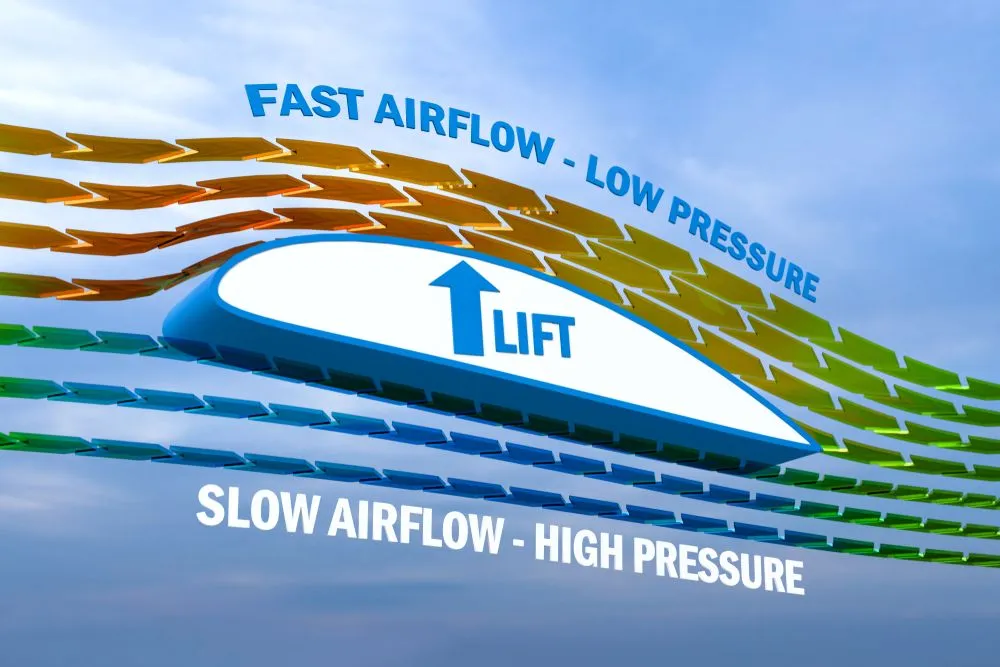
To avoid this lift, Formula One mechanics create certain downforce measures. These measures include the use large wings at the front and rear of the vehicle, creating negative lift (or downforce), which can be up to 3.5 times the car’s own weight. These measures achieve the opposite effect of what an airplane’s wings are designed to do. Rather than helping the vehicle lift off the ground, the wings of a Formula One car help keep the car firmly on the ground. Having a low height helps create less lift and keeps the car grounded as it gains speed.
Center Of Gravity
Apart from being more aerodynamic, another reason for the car being so close to the ground is to obtain a lower center of gravity. The lower the mass sits, the better balanced the car is when cornering, braking and accelerating.
Think about times you’ve been sitting in a car. When the car accelerates, you’re pushed back into your seat; when it brakes hard, you’re thrown forward against the belt. That same shift happens to the car’s weight, loading the rear under acceleration and the front under braking. The higher the center of gravity, the more weight pitches around, and weight that piles onto one end is grip taken away from the other. Keeping the mass low (the chassis, the engine and the reclined driver all sit barely above the track) keeps the load far steadier across all four tires.
With a lower center of gravity, the car resists rolling over in fast corners and changes direction far more sharply, which lets the driver carry more speed and complete laps quicker.
This matters because F1 tracks are long and twisty, and require drivers to thread sharp, high-speed corners if they want any chance at winning!
Driver Position
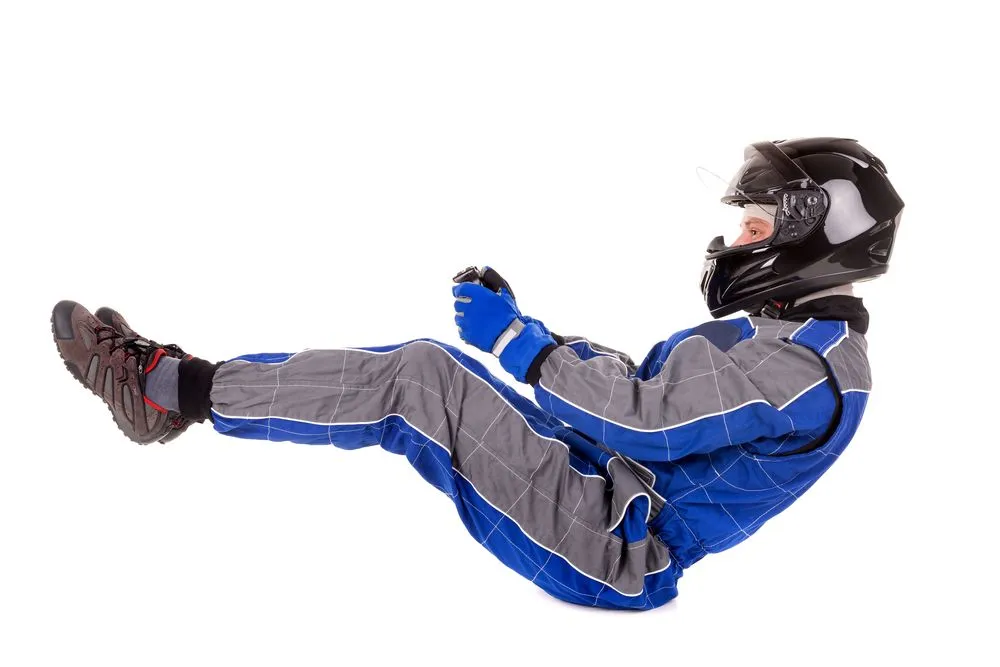
Drivers don’t lie down completely, but instead adopt a reclined, semi-lying position. Their backs are tilted roughly 30 to 40 degrees, their hips sit as low in the car as possible, and their legs stretch out ahead of them so that their feet end up higher than their hips, close to the front axle. This position allows them to reach the pedals with their feet while keeping their whole body tucked inside the aerodynamic shell of the Formula One car, as shown in the following image.
Each bucket seat is molded to perfectly suit the driver’s body shape, ensuring there is barely any movement to the sides during the race. That tight fit matters because the forces involved are brutal: F1 drivers routinely endure 4 to 6 g under heavy braking and through high-speed corners (up to roughly 6.5 g in the most extreme cases), so the seat has to hold the body rigidly in place rather than letting it slide around.
Bucket seats are also vital because drivers must stay in them for long periods. The low, reclined position leaves drivers seeing only a sliver above the steering wheel, so Formula One drivers train their instincts and reflexes to make the most of the limited track view they have. Since 2018, that view has also been framed by the halo, a curved bar of grade 5 titanium fixed over the cockpit that shields the driver’s head from flying debris and other cars without forcing the driver to sit any higher.
Like any sport, Formula One is often treated as a business. Leading teams, such as the Scuderia Ferrari, are estimated to be valued at $1.3 billion (Forbes, 2014). Although the driver is important in this sport, the mechanics and ability of the car itself can often change results, which explains why certain teams that invest heavily in the research and development of their car tend to maintain a winning streak over the years, even when their drivers change. For example, the Mercedes AMG Petronas F1 team won eight consecutive Constructors’ Championships (the title for the best-performing F1 team) from 2014 to 2021, even though their drivers changed over that span. This example highlights the importance of the car’s fundamental design in one’s victory or defeat in this sport!
How Is An F1 Seat Molded To The Driver?
If the reclined position looks awkward, the seat itself is anything but generic. Every Formula One seat is built around one specific driver, and the fitting is a hands-on job rather than something ordered off a shelf. The driver climbs into the bare carbon-fibre chassis and sits back onto plastic bags filled with expanding foam. As the foam swells, it flows into every gap and hardens, taking the exact shape of the driver’s back, hips and thighs as well as the internal shape of the tub. While the foam is still setting, the driver runs through the movements they will make on track, such as turning the steering wheel, so the mold captures a true driving posture rather than a stiff, posed one.

That foam shell is only the pattern. The team uses it to lay up the finished seat from carbon fibre, which is then cured in an autoclave (a high-pressure oven) to produce a rigid shell that weighs only around 3 kilograms. The whole fitting can take a few hours, and it is time well spent, because the seat sets how far the driver has to reach for the pedals and where the steering wheel falls to hand. Teams say the only way to truly confirm a good fit is to send the driver out on track and see how the body holds up over a full run.
Can Very Tall Drivers Fit In An F1 Car?
A cockpit that snug raises an obvious question: what if the driver is very tall? There is no official height limit in Formula One, and the current grid is far from short. Alex Albon and Esteban Ocon both stand about 1.86 metres, with George Russell (1.85 metres) and Nico Hülkenberg (1.84 metres) close behind, while the shortest driver, Yuki Tsunoda, measures 1.59 metres. That is a wide spread of body shapes folded into cars built to almost identical dimensions.
Historically, height could end a career before it began. Hans-Joachim Stuck, at 1.94 metres one of the tallest drivers ever, struggled to fit the cramped cockpits of the late 1970s. More recently, Justin Wilson (1.93 metres) initially could not fit a Minardi because of his long legs, and the car needed significant cockpit changes before he could squeeze in.
Taller, heavier drivers also used to carry a hidden penalty. A lighter driver let the team place more ballast low in the car for better balance, so a lanky driver was effectively racing overweight. To level that out, in 2019 the FIA set a minimum combined weight for the driver plus seat (originally 80 kilograms, raised to 82 kilograms for 2025). Any shortfall is now made up with ballast bolted low around the seat, so being light no longer buys an advantage.
How Do Drivers Get In And Out Of An F1 Car?
A seat molded that tightly around the body, tucked under a low chassis, raises a practical question: how does the driver even climb in? There are no doors, so the driver enters from the top, stepping into the cockpit and lowering themselves feet-first until their legs stretch out toward the pedals and their hips settle into the molded seat. The fit is so snug that the steering wheel has to come off first. Every F1 wheel uses a quick-release mechanism, and the rules require that a driver be able to get in and out of the cockpit without any adjustment to the car other than removing that wheel.

Getting out in a hurry is treated as a safety test in its own right. Under the FIA’s regulations (Article 13.1.4), a driver has to prove they can climb out of the cockpit within 5 seconds and then refit the steering wheel within another 10 seconds, all while starting fully strapped in and wearing their complete race kit and helmet. Every driver must pass this test before they are cleared to race.
If a driver is hurt and cannot move, the seat itself becomes the rescue tool. Since 1999 the FIA has required an “extractable” seat, so medics can lift the driver out still strapped to the molded shell rather than pulling on the body. That keeps the spine and neck supported, turning the same custom seat that holds the driver in place at 6 g into a makeshift stretcher.
References (click to expand)
- Taking the Lid Off F1 - Autosport. Autosport
- "F1 Firsts: Aerodynamic wings". Formula One
- Centre Of Gravity - Formula 1 Dictionary. formula1-dictionary.net
- Formula One's Most Valuable Teams: Red Bull, Mercedes On The Rise. Forbes
- G-Force and Formula One: Explained. Mercedes-AMG PETRONAS F1 Team
- Insight: Introducing the Halo. Mercedes-AMG PETRONAS F1 Team
- The seven-step guide to the perfect F1 seat fit. Aston Martin Aramco F1 Team
- F1 seat fitting. Motorsport Technology
- F1 driver heights: Who are the shortest and tallest drivers? Motorsport.com
- FIA working on setting F1 driver weight limit for 2019. Autosport
- Sainz and Ricciardo hope increasing driver weight rule will be fairer on taller rivals. RaceFans
- Robert Kubica passes FIA F1 cockpit extraction test in Hungary. Autosport
- Formula One regulations. Wikipedia
- History of Formula One regulations. Wikipedia