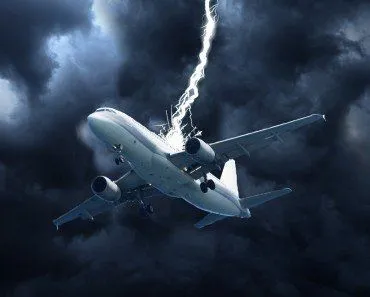
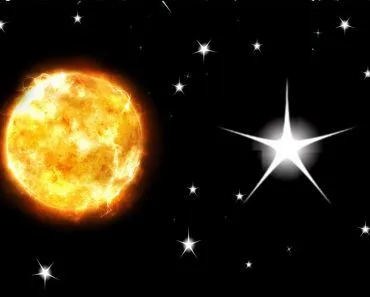
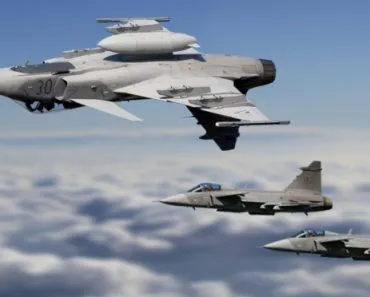
Flying birds and airplanes do cast shadows. The Sun lights them and the ground is below, so a shadow has to exist. We just can’t usually see it: at a cruising altitude of 35,000–40,000 feet, the shadow is tiny and so diffused by the Sun’s angular width that it blends into the ambient light. When a plane is only a few dozen feet up (at takeoff and landing), its shadow is clearly visible on the runway.
Some of the most common things around us, the things we see, observe and interact with almost every day, hide a lot of science within them.
Have you ever noticed that when you put a pencil in a glass full of water, its shape distorts and it looks as if it’s bent? Or have you realized that lightning is always in a zig-zag shape? How about the fact that submarines are always painted black?
Similarly, another everyday phenomenon that caught my attention recently while watching a movie was that airplanes never seem to cast a shadow, right? You may not have thought of this, but if you have, do you know why? The same is true of birds.
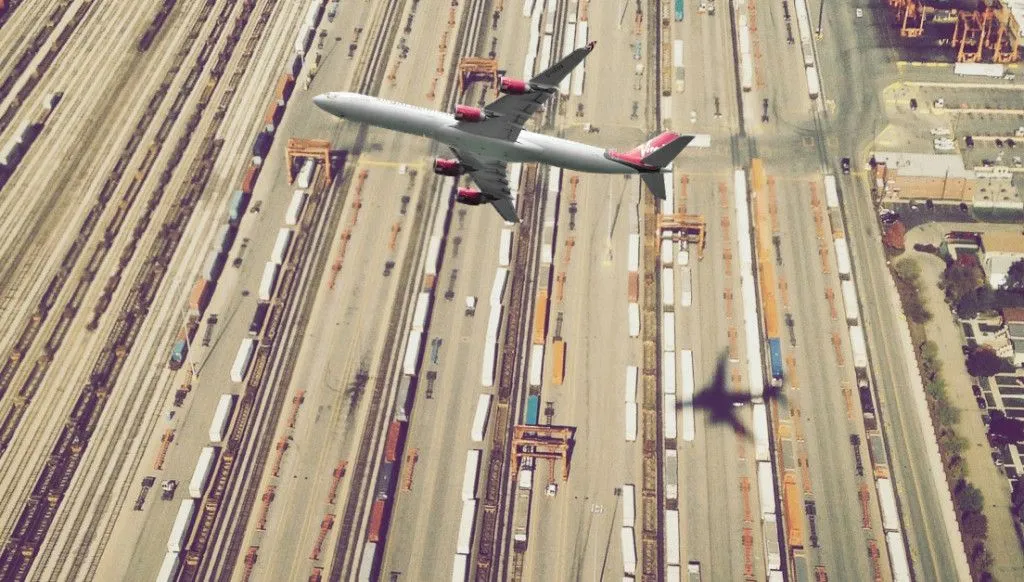
So… why don’t we see their shadows on the ground?
How Are Shadows Formed?
This is fairly straightforward. A shadow is created when an opaque object (an object that doesn’t let light pass through) is placed in the path of light. Since light always travels in a straight line (in the same medium), you always get a shadow when you place something in front of a light source.
This is one of those ultra-simple experiments that you CAN and should try at home: Get a light source, your smartphone’s flashlight will do, and place a piece of paper around a meter away from the light source.
Now, bring a pencil between the light source and the paper, so that it’s right in the middle of the path of the light rays.
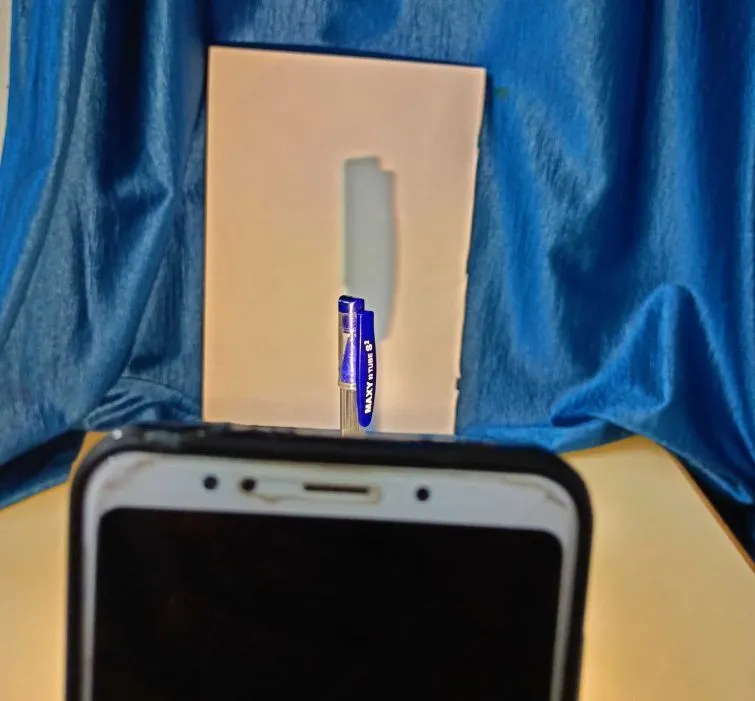
As you move the pencil closer to the paper, its shadow becomes darker, more prominent and very well-defined. However, if you move the pencil towards the light source (or away from the paper), the shadow becomes diffuse and less defined, to the point where it appears to have disappeared entirely.
This is exactly what happens with airplanes and birds in flight.
Why Can’t We See The Shadow Of Flying Airplanes And Birds?
Any opaque object that stands between a light source and a ‘screen’, in this case the ground, always creates a shadow. So, the question of “Why don’t airplanes cast a shadow on the ground?” is inherently inaccurate.
Airplanes DO cast shadows, as do flying birds.
The right question would be: “Why don’t we see the shadow of an airplane in flight on the ground?”

There are two reasons that explain why we don’t see the shadows of flying airplanes.
Airplanes Fly At A Very High Altitude
A commercial airplane cruises at an altitude of 35,000-40,000 feet. At this altitude, you won’t even be able to see the airplane, let alone its shadow on the ground. Even if the same airplane flies much lower, say, at an altitude of just a few hundred feet above the ground, you still won’t be able to see its shadow.
However, if the plane is flying just a few dozen feet off the ground, then you will certainly see its shadow. That’s why an airplane’s shadow is visible during takeoff and landing.
Airplanes Are Too Small
The phrase “airplanes are too small” may sound strange, but if you look at the size of an airplane in relation to the light source, which in this case is the sun, and how far it is from the earth’s surface, you will understand why an airplane is too measly an object to cast a distinctive shadow on the ground.
The same applies to birds, which are far too puny to cast a well-defined shadow on the ground.
However, if a massive asteroid were to pass by Earth, you, along with millions of other people on the planet, would definitely see its shadow on the ground. Indeed, this is the principle by which a solar eclipse and lunar eclipse work. A solar eclipse is the Moon’s shadow falling on Earth; a lunar eclipse is the Earth’s shadow falling on the Moon.
So, flying airplanes do cast shadows on the ground, but at cruising altitude those shadows are so faint and diffused (because the Sun is not a point source, and its angular width spreads the edges of the shadow into a wide penumbra) that they’re virtually invisible to ordinary earthbound humans.
Why Does A Shadow Blur And Fade As The Object Rises?
Here is the part that the simple “it’s too small, it’s too high” answer skips over, and it’s genuinely the heart of the matter. A shadow isn’t a single thing. It has two parts: a dark core called the umbra, where the object blocks the entire light source, and a soft fringe around it called the penumbra, where the object blocks only part of the source so some light still leaks in (West Texas A&M University).

The reason that fringe exists at all is that the Sun is not a pinpoint. It’s a disk, and from where we stand it spans about 0.5° of sky, roughly half a degree wide. So sunlight doesn’t arrive as perfectly parallel rays. It fans out by that same half a degree, which means light from one edge of the solar disk sneaks into the region that the opposite edge has shadowed (Atmospheric Optics).
Now watch what that does as the object climbs. The fully dark umbra is a cone that tapers as it stretches away from the object, and it pinches off to nothing at a distance of roughly the object’s width divided by the tangent of 0.5°, which works out to about 110 times the object’s width. A pencil 1 cm across runs out of true umbra after only about 1 m. Beyond that point, no part of the ground sits in complete darkness; all that survives is the ever-widening penumbral smudge, and it keeps spreading and softening with every extra meter of height.
Run the numbers on a jet and it’s startling. A typical narrow-body airliner like a Boeing 737 has a wingspan of about 36 m (118 ft). Even using its widest dimension, its umbra reaches at most about 36 m × 110 ≈ 4 km (roughly 13,000 ft). A plane cruising at 35,000 ft (about 10.7 km) is more than twice past that limit, so it casts no fully dark shadow at all on the ground. Only a faint, hugely spread-out penumbra reaches the surface, and it’s so washed into the surrounding daylight that your eye can’t pick it out. That, not the plane being “small,” is the real reason the shadow vanishes.
What Is The Glory, The Rainbow Ring Around A Plane’s Shadow?
Here’s a reward for anyone with a window seat. While you can’t spot a jet’s shadow on the ground, you absolutely can see it on the clouds. When a plane flies over a deck of cloud with the Sun directly behind it, a small, sharp shadow of the aircraft falls on the cloud tops, and very often it’s wrapped in a set of softly glowing colored rings. Pilots have long called this the glory, or the “glory of the pilot.”

It looks like a circular, miniature rainbow, but it is not a rainbow. A rainbow comes from sunlight refracting and reflecting inside falling raindrops. A glory comes from sunlight being diffracted and scattered straight back toward you by the tiny cloud droplets, which are far smaller than raindrops (NASA Earth Observatory). The rings run bright red on the outside to blue toward the center, the reverse of what you might expect, and smaller droplets make wider, more vivid rings.
Two details make the glory especially fun. First, it always sits exactly on the point in the sky directly opposite the Sun, the antisolar point, which is precisely where the plane’s shadow lands, so the rings are perfectly centered on that shadow. Second, the glory hugs your line of sight: in a photo taken from a plane, the center of the rings marks the seat of the person who took the picture (EarthSky). The same effect ringing the shadow of a person’s head, cast on mist from a mountaintop, is the famous “Brocken spectre,” first described scientifically by the French scientist Pierre Bouguer and the Spanish naval officer Antonio de Ulloa, who saw it ringing their own head-shadows on cloud during the French Geodesic Mission to the Andes in the 1730s. So the next time you fly above a cloud layer with the Sun at your back, glance at the shadow below: the plane is casting one, ringed in color, just for you.
References (click to expand)
- The Physics of Light -- Shadows. The University of Kentucky
- Can air make shadows?. West Texas A&M University
- Measuring the Earth's Curvature Background. Princeton University
- How Does Diffraction Make A Tree's Shadow Blurry?. West Texas A&M University
- Shrinking Heads And Sharper Sundials. Atmospheric Optics
- A Slice Of Glory. NASA Earth Observatory
- What Is An Airplane Glory?. EarthSky
- Glory (Optical Phenomenon). Wikipedia