Table of Contents (click to expand)
There are a few reasons why rockets are launched from areas near the equator. One reason is that launching a rocket from the east coast gives it an additional boost due to the rotational speed of Earth. Another reason is that if something goes wrong during the ascent, the debris will fall into an ocean instead of a densely populated area. Additionally, most launch sites are located near the equator because rockets launched from these sites get an additional natural boost that helps save on fuel and boosters.
Here’s a quick question: what do Florida (US), Sriharikota (India) and Kourou (French Guiana) all have in common?
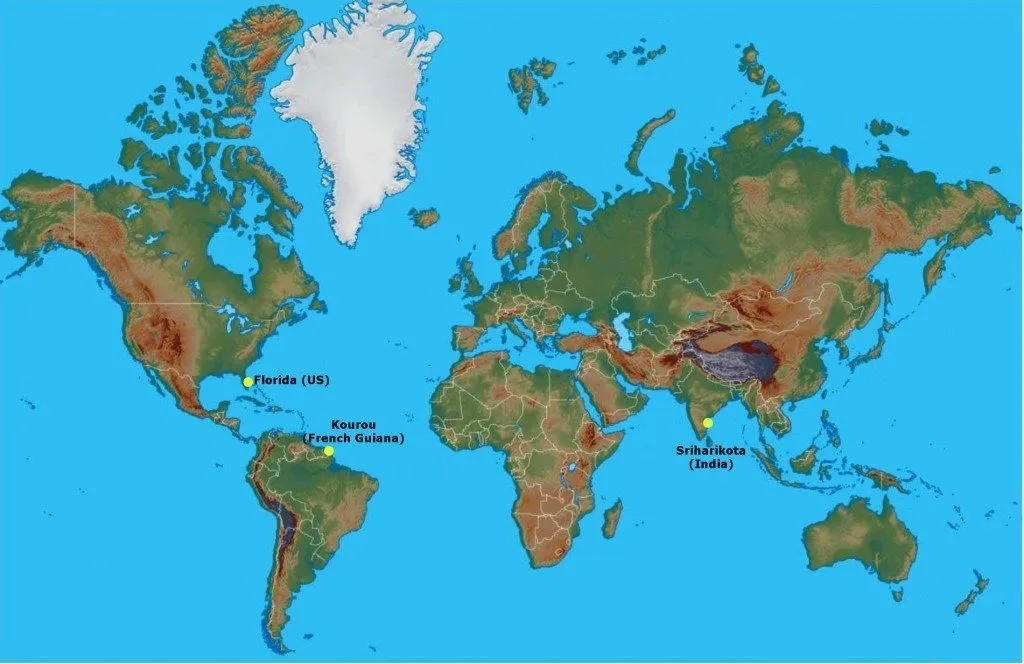
All these locations hold spaceports where rockets are launched into space!
Do you know why these sites are preferred over others for launching rockets? Why is Florida, which is located in the southeast United States and known to be prone to hurricanes and other weather-related events, chosen to be a launch site for so many rockets?
Why Are Most Rockets Launched From The East Coast Of Countries?
Short answer: Launching a rocket from the east coast gives an additional boost to the rocket, due to the rotational speed of Earth. Also, these rockets travel eastward, so if anything goes wrong during their ascent, the debris would essentially fall into an ocean’s waters, far away from densely populated areas.
How Does A Launch Site For A Rocket Get Chosen?
The choice of the perfect launch site for spacecraft, quite predictably, involves the study and analysis of many different parameters. One of the primary concerns of space engineers and scientists is to ensure that the satellite in question gets as much natural ‘push’ as possible during its initial ascent.
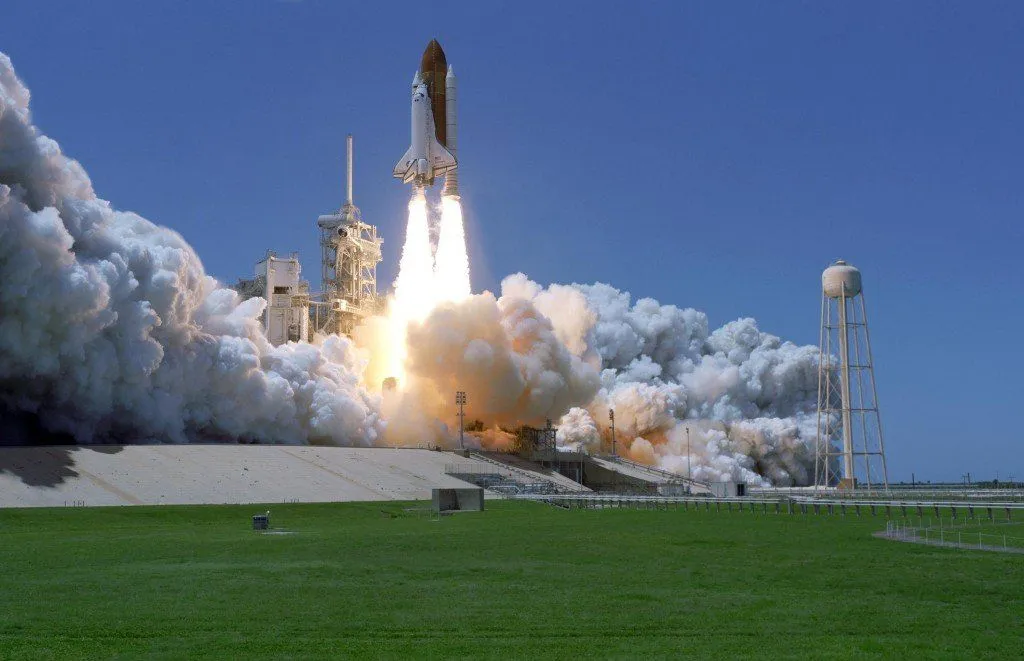
How Do Satellites Benefit From Earth’s Revolution And Rotation During Their Ascent?
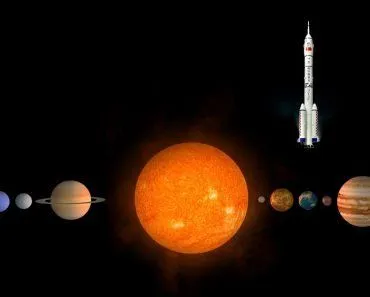
Hopefully you know that our planet revolves around the sun, and the speed with which it does that, the orbital speed of Earth, is about 107,000 km/h (roughly 67,000 mph, or close to 30 km/s). It’s pretty evident that our planet moves very fast around the sun. If a rocket is launched in the same direction in which the planet is moving, the former therefore gets a good head start.
Benefit Of Earth’s Rotation For A Rocket Launch
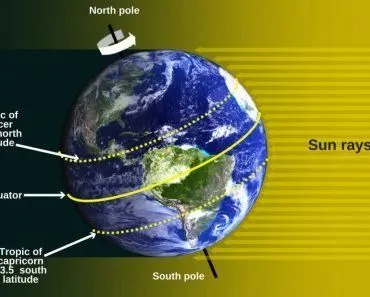
The other kind of motion that our planet has is rotational, i.e., it continuously rotates on its axis. Quite interestingly, this rotational speed is not the same everywhere on the planet. It is at a maximum in those areas lying on the Equator (average equatorial speed: 1,040 mph or 1,674 kmph), but is virtually non-existent in the polar regions.
Now, given that Earth rotates from west to east, and you want to launch a rocket that is also supposed to go eastward, which place would you choose to launch your rocket so that you could benefit from the rotation of Earth?
If you took your Science classes seriously back in school, I’m pretty sure you’d choose a location where the rotational speed from west to east was the highest. That’s precisely what rocket scientists do as well. Keeping in mind that Earth’s rotational speed is the highest at the Equator, take a look at the most commonly used launch sites in the world:
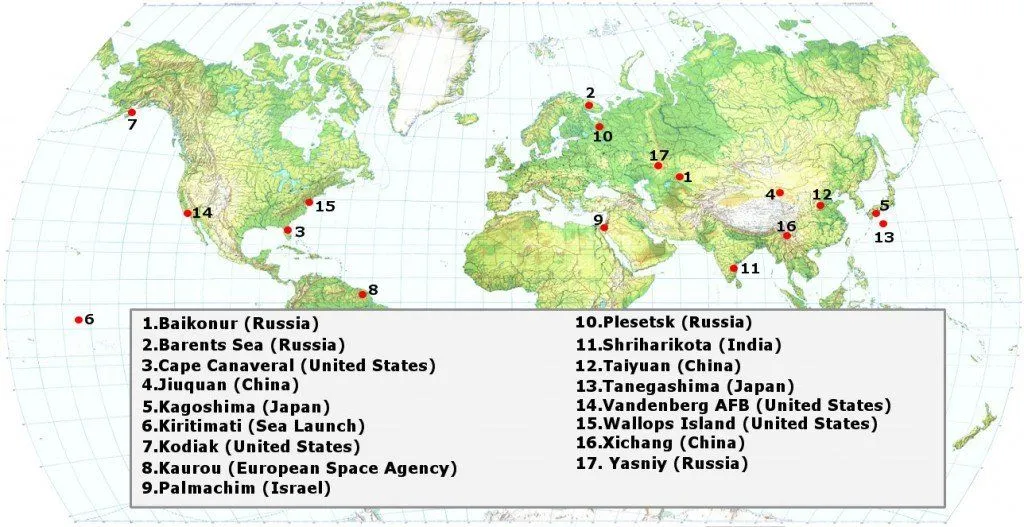
It’s easy to notice that most launch sites are located close to the Equator. This is because rockets launched from sites near the Equator get an additional natural boost that helps save the cost of putting in extra fuel and boosters.
It’s Preferred To Establish A Launch Site In A Coastal Region
Rockets are complex machines weighing a couple hundred thousand pounds that are blasted off from a launch site. Needless to say, there are dozens of things that can go wrong during the launch, so scientists and space engineers must take countless contingencies into account to minimize the risks associated with rocket launches.
Probably the most hazardous situation pertaining to a rocket launch is failure in mid-flight, i.e., a scenario where something goes wrong in the rocket while it’s still in the sky. This could have many outcomes (some of which might not even adversely affect the flight too much), but those that involve a drastic fallout (like burning debris falling out of the sky and landing over inhabited areas) need to be addressed.
Now, take another look at the locations of launch sites on the world map:
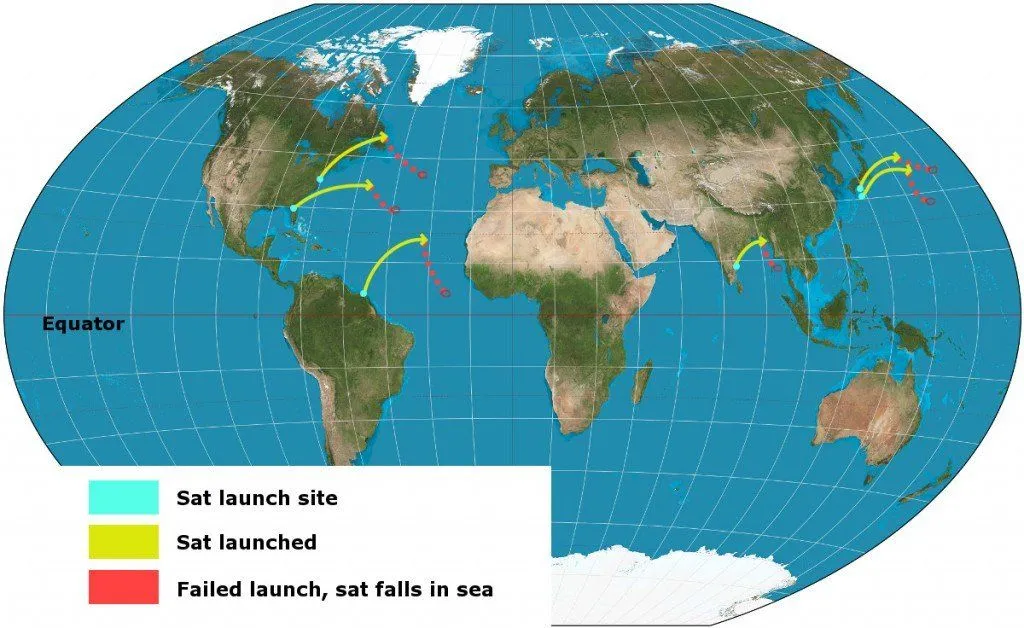
You can see that quite a few of them, including the Kennedy Space Center in Florida (which conducts most of the rocket launches in the US) and the Satish Dhawan Space Center in Sriharikota (the most used space center in India), are located next to an open sea. Such a location for a launch site is chosen in an effort to minimize (if not completely eliminate) the risk to human life in the case of a failure during the initial ascent of a rocket.
However, as you can see, not all launch sites are adjacent to a sea, as there are also a number of other factors at play, such as the accessibility of a given location (it must be easily accessible from land, air and sea). Furthermore, there are a number of geopolitical constraints on the availability of such locations.
Another reason they launch rockets from places near the Equator (such as the southeast coast of the US) is that the satellites intended to attain a geostationary orbit (e.g., communication satellites) must have zero inclination with respect to the equatorial plane. If not, then they have to make complex course corrections and burn a lot of fuel to attain the proper orbit.
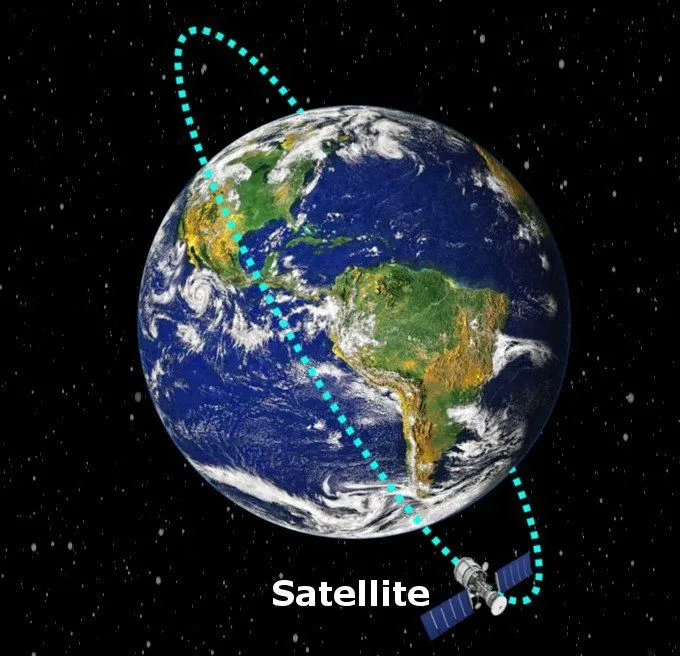
Note that not all satellites are launched from equatorial regions; satellites that need to achieve a polar orbit around Earth won’t have any use for the natural boost from earth’s rotation, as they are headed either in a northern or southern direction.
Why Do So Many Rockets Launch From Florida?
Florida turns up again and again, and the reasons all trace back to the two ideas we have already met: get as close to the Equator as you reasonably can, and fire out over open water. Cape Canaveral and the adjoining Kennedy Space Center sit at roughly 28.5° N, one of the southernmost stretches of the US mainland coast that opens eastward onto open ocean. Latitude matters because the closer you are to the Equator, the faster the ground is already moving thanks to Earth’s rotation: at Cape Canaveral the surface sweeps eastward at about 1,470 km/h (914 mph), compared with the full 1,674 km/h (1,040 mph) you would get right on the Equator. A pad up in Maine or Alaska would hand a rocket far less of that free head start.

The coastline does the rest of the work. Florida’s Atlantic shore faces east, so a rocket launched in the direction of Earth’s spin heads straight out over the ocean. If a vehicle fails during the climb, the falling debris drops into the Atlantic rather than onto a populated area. (The west-coast counterpart, Vandenberg in California, plays the same role for missions that need to head south over the empty Pacific.)
Finally, history piles on. The Cape has served as a rocket and missile testing range since the early 1950s, so tracking stations, assembly buildings and decades of launch experience all accumulated in one convenient, low-latitude, ocean-facing spot.
Where Are The World’s Major Rocket Launch Sites?
If you plotted the busiest spaceports on a globe, a clear pattern jumps out: the ones built to lob satellites into geostationary orbit crowd toward low latitudes, while the high-latitude sites tend to specialise in polar launches. Here are the major orbital launch sites, ordered by how far each sits from the Equator:
- Guiana Space Centre, Kourou (French Guiana, ESA), about 5° N. The closest major spaceport to the Equator and Europe’s prime site for geostationary missions; ESA notes that its near-equatorial position gives a launcher a ‘slingshot’ boost of roughly 460 m/s from Earth’s rotation.
- Satish Dhawan Space Centre, Sriharikota (India), about 14° N. India’s main launch base, on a barrier island off the Bay of Bengal.
- Wenchang (China), about 20° N. China’s newest and lowest-latitude launch centre, on the island of Hainan.
- Cape Canaveral / Kennedy Space Center (USA), about 28.5° N. The busiest American spaceport, on Florida’s Atlantic coast.
- Tanegashima (Japan), about 30° N. Japan’s largest launch site, on an island south of Kyushu.
- Vandenberg (USA, California), about 35° N. A west-coast base used mainly for polar and Sun-synchronous orbits sent south over the Pacific.
- Jiuquan (China), about 41° N. China’s oldest launch centre and the one that flies its crewed missions.
- Baikonur Cosmodrome (Kazakhstan), about 46° N. The world’s first spaceport, from which Sputnik 1 and Yuri Gagarin both flew, and still the departure point for crewed Soyuz flights to the International Space Station.
- Plesetsk (Russia), about 63° N. A far-northern site geared toward polar and military launches.

Notice the split: the equator-hugging sites such as Kourou, Sriharikota and Wenchang are exactly the ones prized for communications satellites, while Vandenberg and Plesetsk, sitting well to the north, earn their keep on polar orbits that have no use for the rotational boost.
References (click to expand)
- Kennedy Space Center - Wikipedia. Wikipedia
- Guiana Space Centre - Wikipedia. Wikipedia
- Satish Dhawan Space Centre - Wikipedia. Wikipedia
- Launch a rocket from a spinning planet | NASA Space Place. The National Aeronautics and Space Administration
- Launch Sites | NASA. The National Aeronautics and Space Administration
- Europe’s Spaceport. European Space Agency (ESA)
- List of rocket launch sites - Wikipedia