Babies have a tight grip because it is a bodily reflex known as the Palmar Grasp Reflex (or simply the grasp reflex), which is typically observed in infants. You can elicit the grasp reflex by stroking your finger, or any other object, in a baby’s palms.
Here’s a question for you: what is as strong as a nail?
Depending on whether you dig history, have a thing for poetry, or just love superhero stuff, your answers may include a Spartan’s courage, a Samurai sword, Iron Man’s armor, Captain America’s shield, or simply the strongest naturally occurring substance – diamond.
All of these are right in their own sense, but why don’t we consider something that’s not long dead or non-existent, and can be found more easily than Cap’s shield or a chunk of diamond?
What would you say about a newborn baby’s grip?
Palmar Grasp Reflex
Infants have a common and mysterious habit of clenching their hands, either around an object (say, a finger) or just by forming a tight ball with their own fists. As it turns out, this is not coincidental, but does have some scientific basis to it. It’s actually a bodily reflex known as the Palmar Grasp Reflex (or simply the grasp reflex), which is typically observed in infants. You can elicit the grasp reflex by stroking your finger, or any other object, in a baby’s palms.
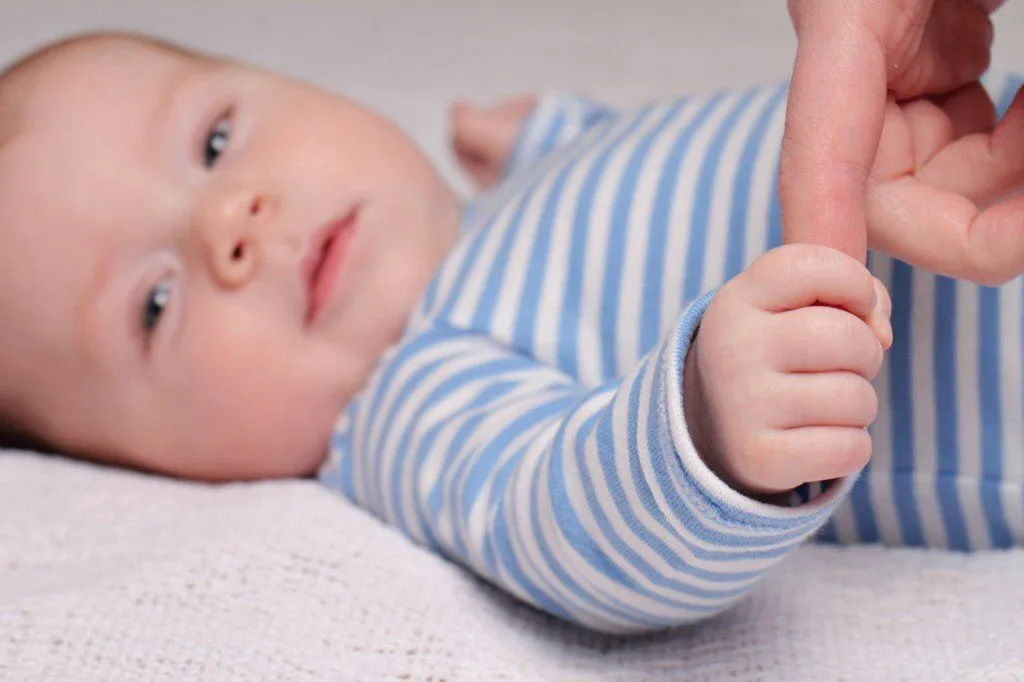
This reflex appears in the baby before it’s even born; it first occurs when the baby is 16 weeks old in the womb and can be observed until almost 5-6 months after birth. The most noteworthy characteristic of their grip is that it’s incredibly strong; you wouldn’t normally expect such a solid, firm grip from a baby that small. In fact, the grip is so strong and resolute that it could help the baby support its own body weight!
Sometimes, babies make a tight ball of their own fists (due to the same grasp reflex) in the absence of a foreign object in their palm. However, after some time, they realize that it’s their own body part they are clutching so tightly. All of this information inevitably brings us to the question we posed in the title of this article; why do babies clutch things so tightly in the first place?
Just How Strong Is A Baby’s Grip?
If you’ve ever offered a newborn your finger and felt those tiny fingers clamp down, you already know the grip is shockingly firm. So why is a baby’s grip so strong? The honest answer is that it isn’t powered by bulky muscle, it’s powered by a clever bit of mechanics. When something presses against the palm, the pressure tugs on the tendons running to the fingers, and that traction is what pulls the fingers shut and keeps them clamped. The response actually unfolds in two stages: finger closure, where the fingers flex to wrap around the object, followed by clinging, where the continued pressure on the palm locks the grip in place. The thumb, interestingly, mostly sits this one out. And because it’s a reflex rather than a conscious effort, the baby isn’t even trying.

And we’re not talking about a feeble little squeeze. As far back as 1891, a researcher named Louis Robinson tested this directly. He had more than 60 infants under a month old grip a horizontal rod, and nearly all of them could hang from their own hands for at least 10 seconds. One determined newborn held on for a full 2 minutes and 35 seconds, comfortably supporting its entire body weight. So when people ask whether a baby’s grip is genuinely strong, the answer is a clear yes: a few-day-old infant can briefly do a dead hang that would test plenty of adults. The crucial catch is that it’s a reflex, not a decision, so a baby cannot choose to let go, which is exactly why you should never actually dangle one to test it.
Why Do Babies Keep Their Fists Clenched All The Time?
Much of the grip only shows up when you touch the palm. But what about the rest of the time, when a baby just keeps both hands balled into tight little fists with nothing in them at all? That comes down to flexor tone. A healthy full-term newborn is born in a flexed, curled-up posture, with arms and legs tucked in and hands closed, mirroring the cramped position it held in the womb. The muscles that bend the joints (the flexors) are simply more dominant than the muscles that straighten them, and this flexor tone gradually wins out over extensor tone as the nervous system matures. Doctors actually read this flexed posture as a marker of how far along a newborn’s brain development has come.
The other reason is plain immaturity. A newborn’s brain hasn’t yet learned to send the steady, deliberate signals needed to hold the hands open and relaxed, so the resting default is closed. As those motor pathways develop, the fists start to loosen. Most babies’ hands begin opening up by around 2 to 3 months, and by roughly 4 months a baby can deliberately reach out, grab a toy, and let it go again. If the fists stay tightly clenched well past 6 months, or come paired with stiff arms and delays in other movement milestones, it is worth raising with a pediatrician, since a grasp reflex that persists too long can point to an underlying neurological issue. But for the first few months, a permanently clenched fist is one of the most normal things a newborn can do.
A Baby’s Strong Grip Has An Evolutionary Advantage
It seems that the habit of grasping things tightly can provide an evolutionary advantage. You see, as newborn monkeys (so to speak), we had to grab onto our mother’s fur so we didn’t tumble, fall off, or be separated in any way from our mother while she was traveling or jumping off tree branches to look for food! There’s no way that our mothers could cradle us all the time AND perform those jumps and leaps. Not to mention, a mother had to be wary of the risk of predators.
When we put all these potential challenges together, infants would have had no option but to hold on to their mothers as tightly as possible, from birth until the time they are capable of fending for themselves. Young apes and monkeys can still be seen holding on to their mothers while they are on the move.

Babies, as cute and innocent as they are, don’t really have any idea about the world around them or what is specifically going on. Therefore, they try to stay on the safe side by clutching anything and everything with a tight grip. Therefore, next time you’re prying a toddler’s fingers from an object, be a bit more gentle.
Or perhaps you can just teach them a lesson on human evolution!
References (click to expand)
- Neonatal Reflexes (course material). University of Massachusetts Amherst
- Grasp Reflex - StatPearls. NCBI Bookshelf
- Palmar Grasp Reflex - StatPearls. NCBI Bookshelf
- Futagi et al. The Grasp Reflex and Moro Reflex in Infants. International Journal of Pediatrics. PMC.
- Neonatal Muscle Tone (flexor and extensor tone). Ballard Score.