Yes, stress and anxiety can make you pee more. When you are nervous or scared, the fight-or-flight response fires up your sympathetic nervous system, and the stress hormone CRF makes your bladder muscle more twitchy. The result is a sudden, hard-to-ignore urge to pee, even when your bladder is not full.
Imagine you have an important exam about to start in five minutes. Ideally, you’d like to look through your notes one last time, or maybe talk to a close friend and wish them luck.
Instead, you find yourself sprinting to the bathroom. You, like millions of other people, find yourself in a peculiar pattern. Whenever you’re nervous or stressed, you run to the bathroom. Why? Because you really, really have to pee!
The urge for sudden, repeated, and excessive urination is called OAB. OAB refers to an overactive bladder. Most of us may think of OAB as an unexplainable weird urge or maybe as a personal quirk we can’t seem to get over. As it turns out, it’s quite a common urge. In fact, in the US alone, up to 33 million adults have been reported to experience OAB. There are many causes that result in OAB. Diabetes mellitus, a range of neurological disorders, multiple sclerosis (MS), and even fluctuating hormone levels have all been recognized as contributors to OAB.
However, an understudied and lesser acknowledged cause of OAB is actually stress, nervousness, and anxiety. Stress and anxiety have always been called silent killers or silent diseases, and for good reason.
How Harmful Is Stress And Anxiety?
Chronic stress has been linked with increased blood pressure levels, tachycardia or elevated heart rates, and even heart attacks and strokes.
Anxiety, on the other hand, has also been positively linked with heart palpitations, hyperventilation, fatigue, and random unexplainable pain.
A sizable share of people who experience OAB have also been diagnosed with generalized anxiety disorder, or GAD. In fact, studies have shown a clear correlation between anxiety and OAB, with the two often feeding into each other. A controlled study run at Vanderbilt found that OAB patients with anxiety reported markedly worse urinary urgency than those without it. Anxiety appears to not only travel alongside OAB but also worsen its symptoms.
Women, in particular, tend to report more pronounced OAB symptoms. Researchers note that women often show greater physiological reactivity when exposed to physical and psychological stress, which may help explain the difference.
So, What Is The Link Between Stress And Pee?
The link between urination and stress isn’t just a human trait. It’s been observed all across the animal kingdom. In fact, researchers have observed and studied this behavior under both natural conditions and experimental conditions.
In controlled lab settings, researchers used rats to determine a link or correlation between bladder sensitivity and stress. They exposed a group of male rats to chronic stress for extended periods of time. The rats were treated to chronic stress for seven whole days. What did they find?
The researchers found that after seven days of chronic stress, the rats had both a reduced bladder storage capacity and a higher voiding frequency. In plain terms, they passed smaller amounts of urine but had to go far more often, meaning they simply couldn’t hold their pee the way they normally would.
The same thing is observed in the wild. Think of a deer sprinting away from a tiger at full speed. During the chase, the deer (the prey species) often wets itself while running away.
You’d be surprised to know how common this is. At the start of or midway through a chase, prey species frequently wet themselves when hit with the sudden, unexpected stress of being hunted.
What Purpose Does This Link Serve, If Any?
When exposed to stress, animal bodies react by launching into a fight-or-flight response. This is driven by the sympathetic branch of the autonomic nervous system, and it kicks in with a wide range of sweeping physiological changes: increased perspiration, a surge of adrenaline, a rise in blood pressure, and a rapid increase in heart rate. Blood is shunted away from the gut and skin and toward the large muscles you’d need to fight or run.
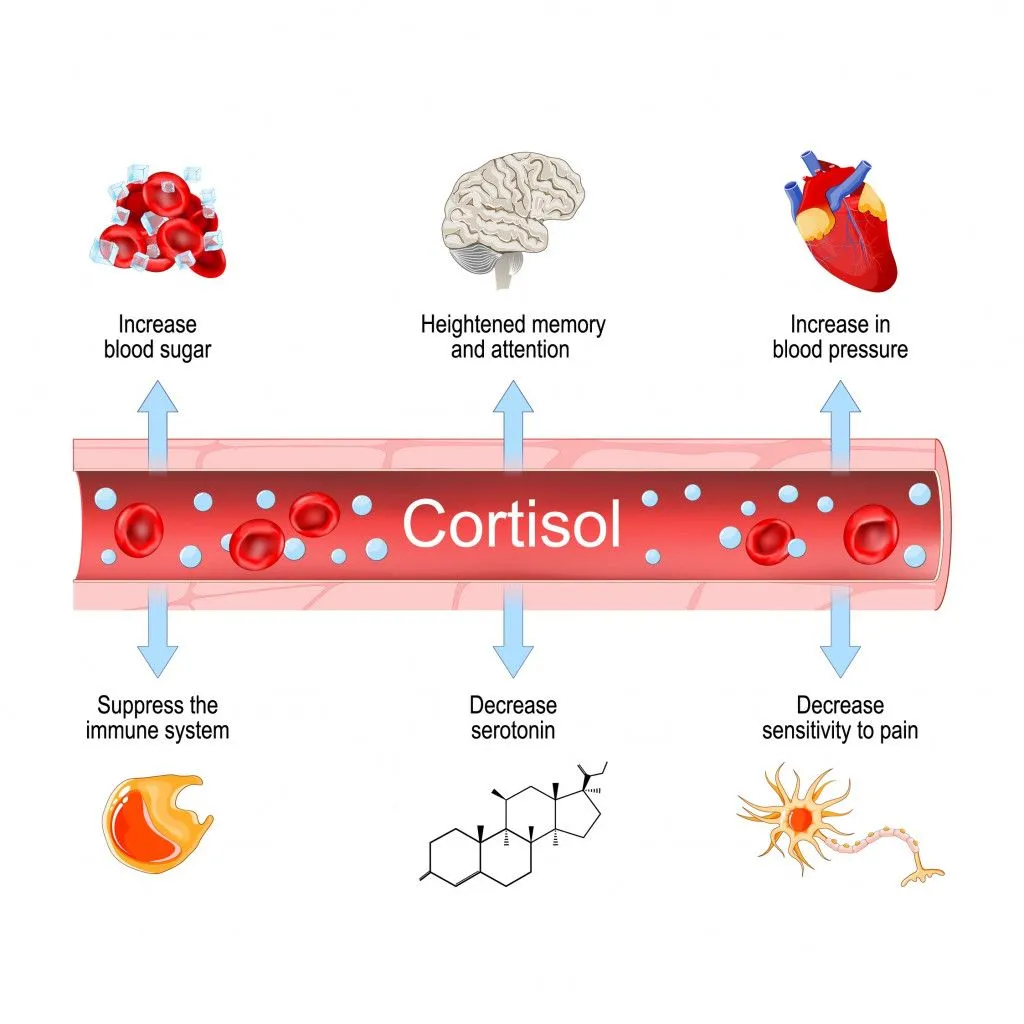
Essentially, the fight-or-flight response concentrates the body’s energies on one task: dealing with a stressor (threat). At the same time, the body actively shuts down any non-essential tasks, such as securely storing urine.
When exposed to a stressor, think about the previous example of a deer being chased down by a tiger. The brain releases a substance known as Corticotropin-releasing hormone/factor or CRH/CRF.
The release of CRF from the hypothalamus is the first step of a stress response that yields the eventual synthesis and release of glucocorticoids, such as cortisol.
How Does CRF Contribute To OAB In Response To Stress?
In a stable setting, the bladder’s main muscle (the detrusor) stays relaxed as the bladder fills, while the sphincters stay tightly shut to hold urine in. The parasympathetic nervous system drives the detrusor to contract when it’s time to actually pee, while the sympathetic system keeps the bladder relaxed and the sphincters closed during storage. Even when the bladder is full, this balance normally lets us control when we go.
This system of control gets shaken up when we are exposed to stress. The bladder carries its own CRF and CRF receptors (chiefly the CRF-R1 type), and stress ramps both of them up. Importantly, CRF doesn’t squeeze the bladder on its own. Instead, it makes the muscle far more responsive to the everyday signal that triggers contraction, the neurotransmitter acetylcholine, which acts on muscarinic (M2 and M3) receptors in the bladder wall.
So when stress floods the system with CRF, the detrusor muscle becomes trigger-happy: it contracts harder and more readily than it should, even before the bladder is full. That over-eager contraction is what you feel as the strong, sometimes overwhelming urge to pee.
Conclusion
The fight-or-flight response is activated when an animal’s body is exposed to internal or external stress or trauma. This response prepares us and focuses our capacities on the problem or threat at hand, but can also have some unintended consequences. The urge to pee (or micturate, as scholars say) is one of them. This urge is further heightened in people who are prone or sensitive to increased stress reactivity, or who are known to suffer from OAB.
References (click to expand)
- Fight-or-flight response | Definition, Hormones, & Facts. britannica.com
- Stress effects on the body - American Psychological Association. The American Psychological Association
- Overactive bladder - Symptoms and causes - Mayo Clinic. The Mayo Clinic
- Seki, M., Zha, X.-M., Inamura, S., Taga, M., Matsuta, Y., Aoki, Y., … Yokoyama, O. (2019, July 8). Role of corticotropin-releasing factor on bladder function in rats with psychological stress. Scientific Reports. Springer Science and Business Media LLC.
- Backström, T., & Winberg, S. (2013). Central corticotropin releasing factor and social stress. Frontiers in Neuroscience. Frontiers Media SA.
- Physiology, Urination. StatPearls. NCBI Bookshelf.