A spacecraft can reach Jupiter in roughly 13 months to 2 years on a fast flyby trajectory, and Pioneer 10 took 641 days, and New Horizons made the trip in just 405 days using a high-energy direct route. A mission that has to enter Jupiter’s orbit, like Galileo (~6 years) or NASA’s Europa Clipper (launched October 2024, arriving April 2030), takes much longer because it must loop through inner-planet gravity assists and then slow down on arrival.
Personally, I’d prefer to visit Saturn, but yes, if you had to flee Earth for some reason, a cost-benefit analysis would tell you that Jupiter is a much more feasible option.
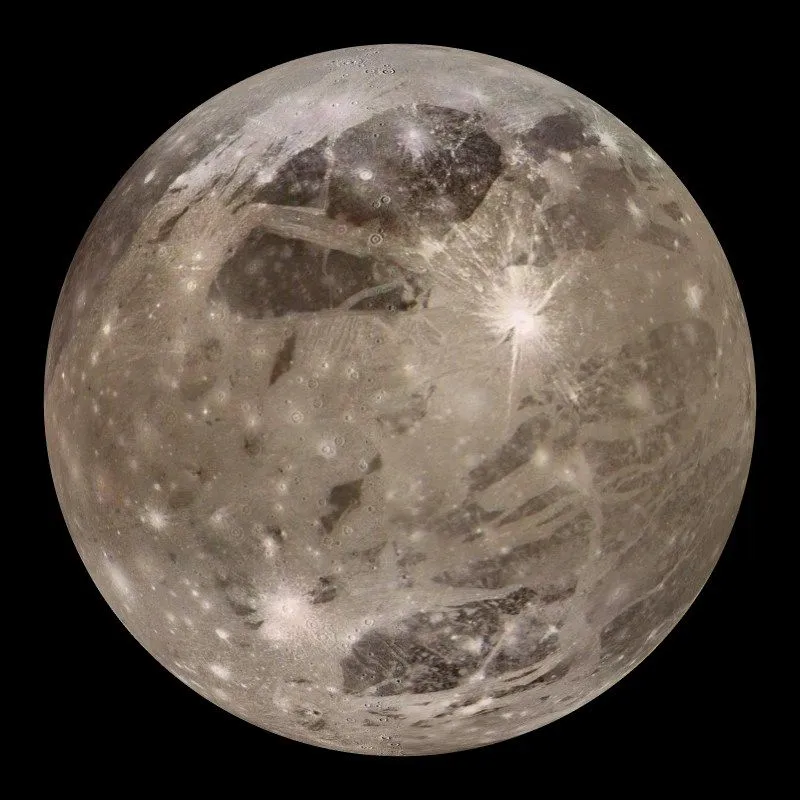
Cosmologists aren’t planning to embark on any such illustrious journey to Jupiter, but not because they don’t want to! In fact, there are many reasons to travel there; the most compelling of which is that some of Jupiter’s moons, namely Europa, Callisto, and Ganymede, might contain vast amounts of liquid water beneath their icy shells, making them one of the best places to look for life in our entire solar system.
The Constraints
Distance
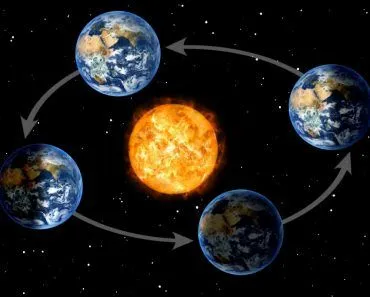
The journey to the King of all Roman gods isn’t like a visit to the store, or another country, or even the moon. Earth and Jupiter resemble sprinters racing on a clay track in the sweltering heat of the Sun. Since they revolve around the Sun at different velocities, the distance between them continually changes. At their closest point, the distance between them is around 365 million miles, whereas the farthest they can get from one another is 601 million miles. The average distance between the two celestial bodies is around 483 million miles.
Therefore, before heading off, scientists must consider the trade-off between burning more fuel or the large financial expenditure and time it would take to reach the destination. The time it takes to reach a faraway planet depends not only on technological leaps in propulsion systems, but also on how all the planets are aligned.

Time
The first spacecraft to reach Jupiter was NASA’s Pioneer 10. It took a direct route, completing its journey in only 640 days, just under 2 years. Even so, it only came within 130,000 km of Jupiter. Faster routes are taken by a spacecraft when it has the intention of only superficially observing the planet. Basically, the Pioneer 10 spacecraft just clicked a few pictures of Jupiter and continued on its way further into the solar system. Pioneer 11 reached Jupiter in about 606 days and passed within roughly 42,500 km of the cloud tops. The Voyagers took longer than the Pioneers: Voyager 1 made the trip in about 546 days and came within 349,000 km of Jupiter’s center, while Voyager 2 took about 688 days and got within 650,000 km of the cloud tops. All four were flybys, and they grabbed their pictures and slingshot off to the outer solar system.
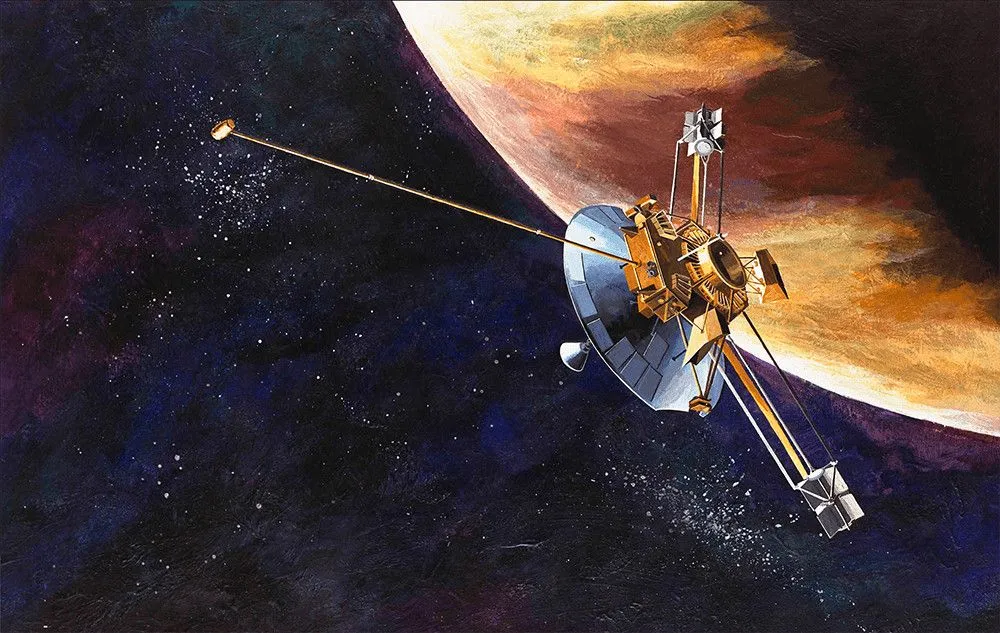
NASA’s Galileo mission was launched with a dedicated intention of studying Jupiter and its moons. It is the first space mission that stuck around the planet for few years. To stick around the planet, a spacecraft needs to go slow and take a more circuitous route so that it can get into the orbit of Jupiter and then can carry out its investigation. Otherwise, a “too fast” spacecraft would just fly past the planet without coming under its orbit. The Galileo mission took 2,242 days, almost 6 years, to reach Jupiter, but most importantly, it did so with exactly the right velocity.
The Route
A spacecraft can take a direct route (like the Pioneers or Voyagers) or longer, more circuitous ones (like Galileo or Juno). A longer route requires them to travel a path just behind a planet, near its orbit. This is why their alignment with respect to each other is of critical importance. The planet’s gravitational pull lures a spacecraft inside when traveling towards it and then slingshots it on its way around and back out.
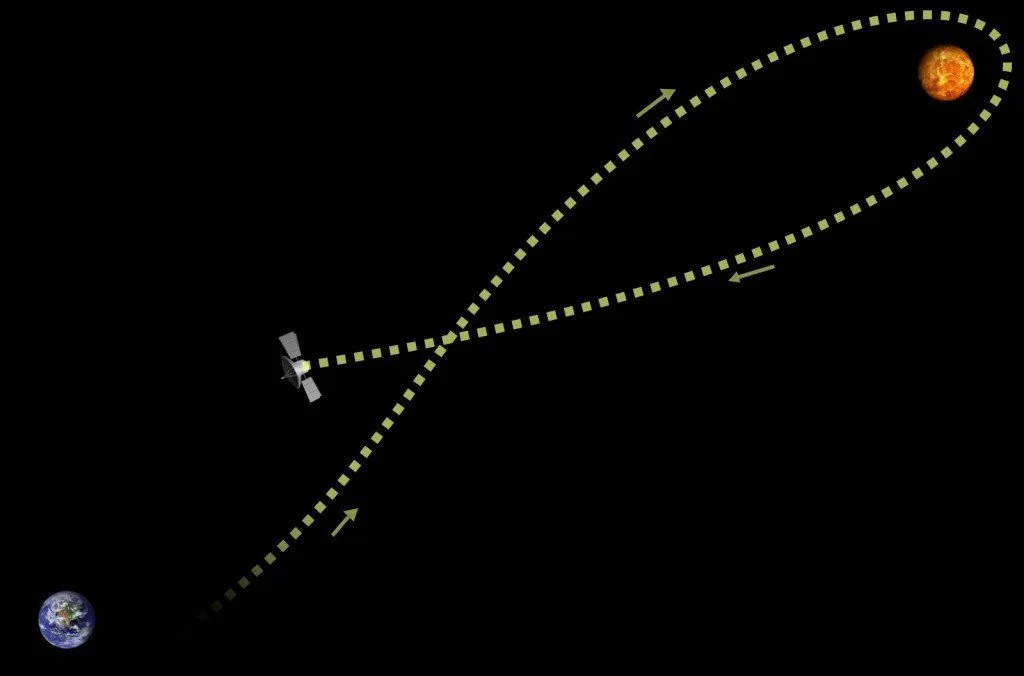
A spacecraft relies on taking a part of the planet’s orbital energy to achieve this feat. The loss of energy is so small that even though the planet has lost some amount of its energy, the retardation in its motion isn’t noticeable.
Flyby
Burning fuel rapidly will certainly bring you to Jupiter faster and will take a lot less time, but a more fuel-efficient way would save a ton of money and other important resources. Moreover, money isn’t the only constraint here. Satellites traveling at very high speeds find it equally difficult to slow down to just the right velocity and settle into a celestial body’s orbit.
However, like any standard ride through a low-lit planetarium giving you a tour of the solar system, spaceships are also designed to whiz past planets with the intention of just rudimentarily glancing at the planet and capturing a few photos before flying off to explore the unknown ahead. Technically, this is called a flyby.
Galileo, the first spacecraft to remain inside Jupiter’s orbit for a couple of years, followed a VEEGA (Venus-Earth-Earth Gravity Assist) trajectory. The spacecraft underwent a close encounter with Venus once, followed by two cycles around Earth, and was then finally thrown off like a disc towards our solar system’s giant planet.
Fastest To Jupiter
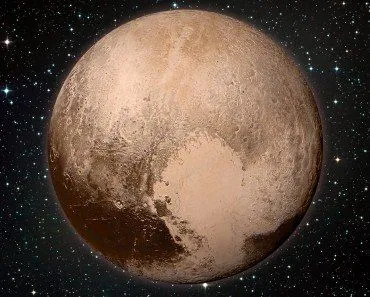
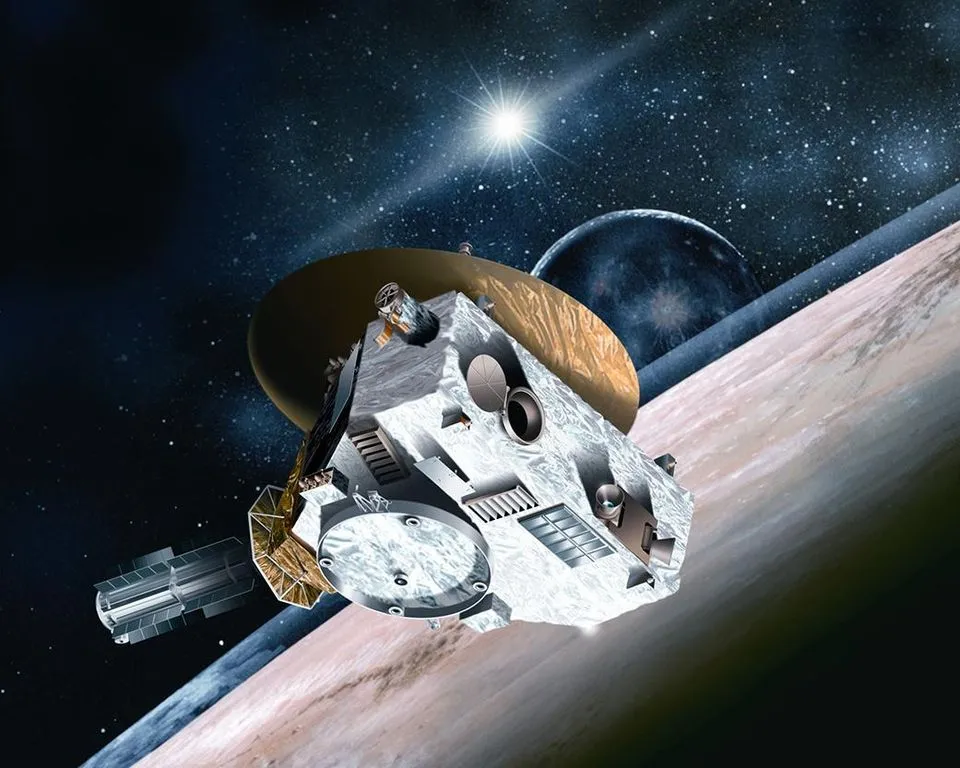
New Horizons was the fastest spacecraft ever designed, at the time of its launch, and reached Jupiter in just over 13 months or 405 days. This space probe performed a different type of flyby on its way to Pluto and other dwarf planets. It leveraged Jupiter’s powerful gravity to bolster its speed and optimize its course towards the dwarf planet, Pluto. The gravity assist from Jupiter helped New Horizons increase the probe’s velocity by approximately 9,000 miles per hour. This helped in truncating its trip to our solar system’s beloved dwarf planet by 3 years!
Are We Going To Jupiter Again?
Jupiter is one of the happening places in our solar systems. Moons of Jupiter with vast oceans beneath thick ice shells might just provide suitable ambience for life to thrive. Fortunately, we have two big space missions lined up to reach Jupiter’s moons. First is NASA’s Europa Clipper, which is dedicated to studying Europa, one of Jupiter’s 115 confirmed moons as of 2026. It actually launched on October 14, 2024 aboard a Falcon Heavy, completed a Mars gravity assist in March 2025, and is set for an Earth gravity assist in December 2026 before settling into Jupiter’s orbit in April 2030. From there it will execute nearly 50 close flybys of Europa over several years. As discussed earlier, to stick around Jupiter the spacecraft has to take a long circuitous path with less arrival velocity so it can be captured rather than fly past.
The European Space Agency’s Jupiter Icy Moons Explorer (JUICE) is already on its way too. It launched on April 14, 2023 atop an Ariane 5, completed a Venus gravity assist in August 2025, and is currently in cold-cruise phase. JUICE is scheduled to enter Jupiter’s orbit in July 2031 and will eventually settle into orbit around Ganymede, becoming the first spacecraft ever to orbit a moon other than our own.
How Long Would It Take To Walk, Drive Or Fly To Jupiter?
Spacecraft are all well and good, but what if you ditched the rocket and tried to reach Jupiter the way you would reach the next town over? It is a wonderfully silly question, and the numbers are even sillier. Let us use Jupiter’s closest approach to Earth, around 588 million km (365 million miles), to give every traveler the best possible head start.

Set out on foot at a steady 5 km/h (3.1 mph) and never stop to sleep, eat or complain, and you would still be walking for roughly 13,400 years. The pyramids would crumble to dust several times over before you arrived. Swap your shoes for a car cruising down an imaginary interstate at 100 km/h (62 mph), and the trip shrinks to about 670 years, enough that a few dozen generations of drivers would have to take shifts. Even a commercial jet screaming along at 900 km/h (560 mph) would need close to 75 years of nonstop flying, longer than most human lifetimes. For perspective, the farthest any human has ever traveled from Earth is only about 400,000 km, out near the Moon, a rounding error next to Jupiter.
And these are the optimistic figures. When Earth and Jupiter swing to opposite sides of the Sun, the gap balloons to 968 million km (601 million miles), and every one of those travel times stretches by well over half. The only commuter that makes the journey feel quick is light itself: zipping along at 299,792 km per second, a beam of light covers the closest-approach distance in about 33 minutes, and roughly 43 minutes when the planets sit at their average separation. That, by the way, is why an event on Jupiter would take the better part of an hour to even become visible from Earth.
How Far Is Jupiter From The Sun, And How Long Is A Year There?
It is easy to mix up two very different distances. Everything above measures the gap between Earth and Jupiter, which keeps changing as both planets race around the Sun. Jupiter’s distance from the Sun, on the other hand, stays far steadier. On average it orbits about 778 million km (484 million miles) out, or 5.2 astronomical units (one AU being the Earth-Sun distance). Its slightly squashed orbit carries it from 741 million km (460 million miles) at its closest to 817 million km (508 million miles) at its farthest.

That enormous radius has a lovely consequence: sunlight, which reaches Earth in about 8 minutes, needs roughly 43 minutes to crawl all the way out to Jupiter. The giant planet basks in light that left the Sun the better part of an hour earlier.
Because Jupiter has so much more track to cover, and because it moves more slowly the farther out it sits, a single lap around the Sun, one Jovian year, takes about 12 Earth years (roughly 4,333 Earth days). A child born the last time Jupiter sat in its current spot would be partway through middle school by the time it returns. Curiously, the days fly by even as the years drag: Jupiter spins so fast that it completes a full rotation in just 9.9 hours, the shortest day of any planet in the solar system. If you are curious how these gulfs compare with the outer reaches, see how far Pluto sits from Earth.
Conclusion
In short, a really fast spaceship like New Horizons can reach Jupiter in just over a year, but on average, it would take around 550-650 days, if the intent of the space mission is just to get past Jupiter. However, to investigate the planet and its moons by getting inside its orbit, a spacecraft would need to be slow enough to enter Jupiter’s orbit at precisely the right speed, allowing itself to be “captured” by the gas giant.
References (click to expand)
- How many days does it take to go from Earth to Jupiter?. The University of California, Santa Barbara
- Why did the Pioneer and Voyager take only 2 years to reach Jupiter .... Cornell University
- How Far Away is Jupiter? - Space.com. Space.com
- Jupiter Facts. NASA Science
- Outdoor Walking Speeds of Apparently Healthy Adults: A Systematic Review and Meta-analysis. PMC, NCBI