Table of Contents (click to expand)
No, and not even close. Earth takes 365.2422 days to circle the Sun, so a 365-day calendar year leaves the planet about 6 hours behind its previous birthday spot in the orbit (which is why we add a leap day every four years). On top of that, the entire Solar System is hurtling around the center of the Milky Way at roughly 828,000 km/h, taking about 230 million years per loop. So on any given birthday, you are billions of kilometers away from where you "were" last year. Your annual orbital photograph is a once-in-eternity event.
When I first learned that the Earth orbited the Sun and that it took roughly 365 days to complete one revolution, one of the many questions that intrigued me was whether Earth was at exactly the same spot every year on my birthday. In fact, I know plenty of people who would like to know whether the planet has a routine hang-out spot every time they get a year older.

Since Earth is rather punctual and always takes 365 days (with the exception of Leap Year) to travel once around the central star, it makes perfect sense that on a given date, it should be at exactly the same spot in the orbit where it was the previous year, as well as for subsequent years in future. So, the question is – does our planet arrive at the same spot in its orbit after each year has elapsed?
Short answer: No, the planet is not at the same spot in space on a given date of every year.
What Is A Revolution In Space, And How Is It Different From Rotation?
Before we go any further, it helps to pin down a word that gets thrown around a lot: revolution. In everyday speech we use it loosely, but in astronomy it has a very precise meaning. As NASA puts it, rotation is an object’s spinning motion about its own axis, while revolution is its orbital motion around another object. Earth does both at the same time. It rotates on its axis roughly once every 24 hours, which gives us day and night, and it revolves around the Sun once a year, which is the journey this whole article is really about.
So a “revolution” in space isn’t anything dramatic or political. It simply means one full lap of one body around another: the Moon revolves around Earth, Earth revolves around the Sun, and the Sun itself revolves around the center of the galaxy. The two motions are independent of each other. Earth manages to spin about 365 times on its axis in the time it takes to complete a single revolution around the Sun, which is a handy way of remembering why a year is roughly 365 days long. Keep that distinction in mind (spinning versus orbiting), because everything that follows is about the orbiting part.
Time Taken To Complete One Revolution Around The Sun
Earth, in addition to rotating on its axis, spins around the Sun all the time in a fixed path that we refer to as an orbit. Contrary to what many people assume, Earth’s orbit around the sun is not perfectly circular, but rather elliptical. Furthermore, the Sun is also slightly off-center in this elliptical path.
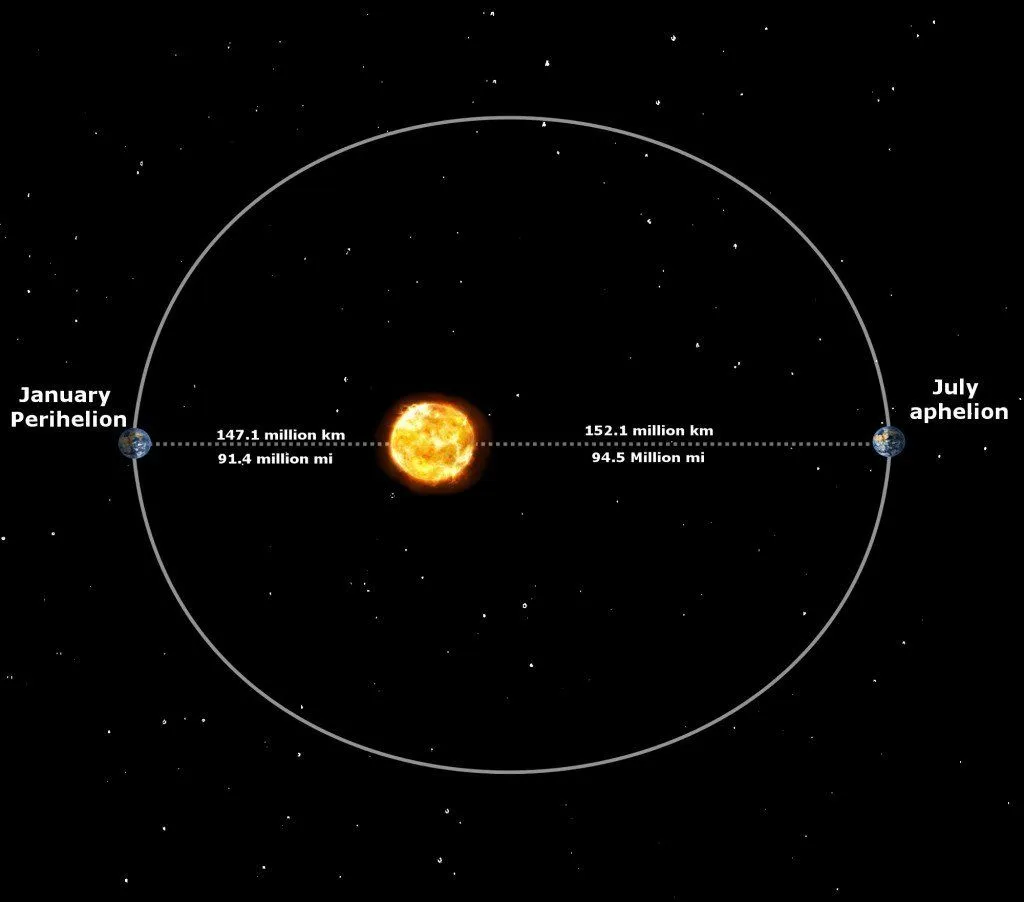
Due to the elliptical geometry of the orbit, the planet’s speed of revolution does not remain constant. At its closest point to the sun (perihelion), its speed is 30,300 m/s (67,780 mph) and at its farthest point (aphelion), the planet’s speed is 29,300 m/s (65,542 mph). (Source)
It’s common knowledge that (barring Leap Years), a year is roughly 365 days long; but, the word ‘roughly’ preceding that duration of a year is very interesting. In reality, the exact time that Earth takes to complete one revolution around the sun is 365.2421891 days, which is generally rounded off to 365.25 days or 365 days and 6 hours, i.e. one-quarter of a day.
What this means is that at the end of a calendar year (a solar year, more specifically), the Earth doesn’t reach the same spot in its orbit as it was a year ago; it’s approximately 6 hours’ worth of revolution shy of being at the same spot.
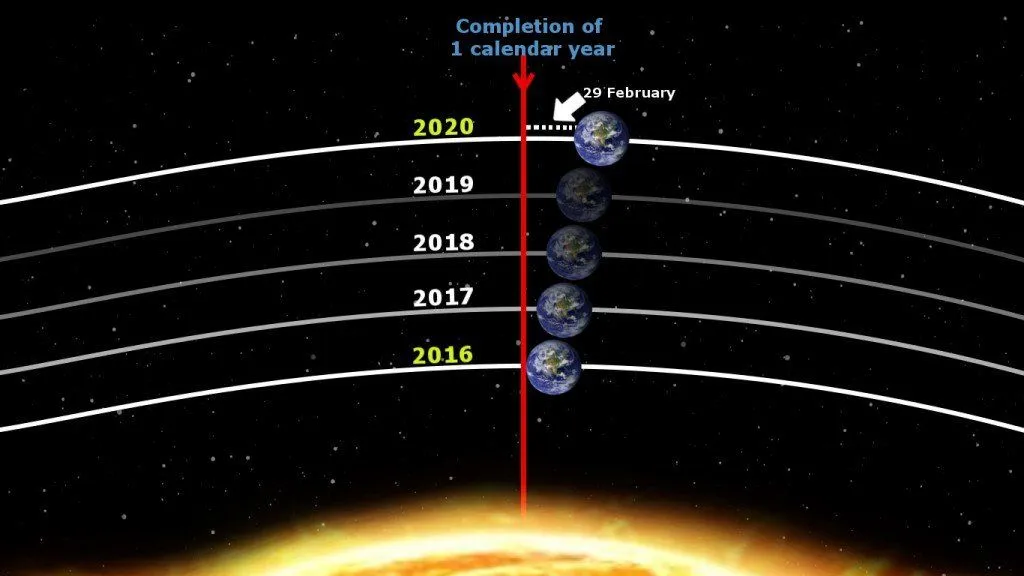
Likewise, in the subsequent year, Earth is 6 hours’ worth of revolution short of being at the same spot as the previous year. This is allowed to go on for 3 years, but in the 4th year, an extra day is added to the month of February, so that year is called a Leap Year. Although this doesn’t add an extra day to your life, but it does help to calibrate the calendar in accordance to the Earth’s motion.
This means that our calendar stays roughly in step with Earth’s actual position in its orbit, but on any specific date the planet is still not in precisely the same spot it occupied a year earlier.
Is Earth Always The Same Distance From The Sun?
A closely related question trips up a lot of people: does Earth stay the same distance from the Sun all year round? The short answer, once again, is no. Because the orbit is an ellipse rather than a perfect circle, our distance from the Sun is constantly changing as we travel along it.

Earth is closest to the Sun at a point called perihelion, which it reaches on or about 3 January, when it sits roughly 147.1 million km (91.4 million miles) away. Six months later, on or about 4 July, it swings out to its farthest point, called aphelion, at about 152.1 million km (94.5 million miles). That works out to a difference of roughly 5.1 million km, a variation of about 3.4 percent between our nearest and farthest approach. On average, Earth orbits about 150 million km (93 million miles) from the Sun, a distance astronomers define as one astronomical unit (AU).
Two things are worth clearing up here. First, notice that Earth is actually closest to the Sun in early January, in the depth of the Northern Hemisphere winter. Our seasons are caused by the tilt of Earth’s axis, not by how near or far we happen to be from the Sun. Second, this changing distance is exactly why the planet does not travel at a constant speed: as we saw above, Earth moves fastest at perihelion and slowest at aphelion. So not only is Earth not in the same place on your birthday, it is not even the same distance from the Sun on any two dates six months apart.
How Long Is A Year On The Other Planets?
Since a year is simply the time a planet takes to complete one revolution around the Sun, it follows that a “year” is a completely different length depending on which planet you happen to be standing on. Earth’s 365-day year is nothing special; it is just the one we happen to measure our lives by.

Planets closer to the Sun have shorter orbits to complete, and they also travel faster, so their years are much shorter than ours. A year on Mercury lasts only about 88 Earth days, and a year on Venus about 225 Earth days. Head outward and the opposite happens: the orbits become enormous and the planets crawl along them. A year on Mars runs to about 687 Earth days (nearly two of ours), Jupiter takes about 12 Earth years to go around once, Saturn about 29.4 Earth years, Uranus about 84 Earth years, and distant Neptune a staggering 165 Earth years. In fact, Neptune, discovered in 1846, only completed its very first full orbit since we found it back in 2011.
| Planet | Length of one year (one orbit of the Sun) |
|---|---|
| Mercury | ~88 Earth days |
| Venus | ~225 Earth days |
| Earth | ~365 days (1 year) |
| Mars | ~687 Earth days (~1.9 Earth years) |
| Jupiter | ~4,333 Earth days (~12 Earth years) |
| Saturn | ~10,756 Earth days (~29.4 Earth years) |
| Uranus | ~30,687 Earth days (~84 Earth years) |
| Neptune | ~60,190 Earth days (~165 Earth years) |
It makes for a fun thought experiment: measure your age in Neptune years and almost nobody alive has celebrated even a single birthday out there.
Is Earth At The Same Spot In Space Every Year On A Given Day?
Now that it’s clear that our home planet does not come back to exactly the same spot in its orbit on a given day every year, another question that pops up is whether it comes back to the same spot in space on a given day every year?
To put it bluntly… Not Even Close!
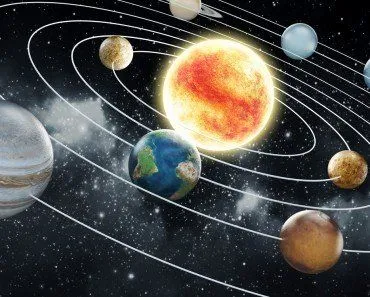
We’ve seen enough pictures, video clips, gifs and even movies about our planet and the solar system to know that all of the latter’s components revolve around the Sun in definite paths. However, there’s a problem. Perhaps it’s due to the dozens of pictures of the solar system that we come across, or simply our own ignorance, but we tend to think of our solar system as a stationary, isolated system that has no motion with respect to the outer reaches of space.
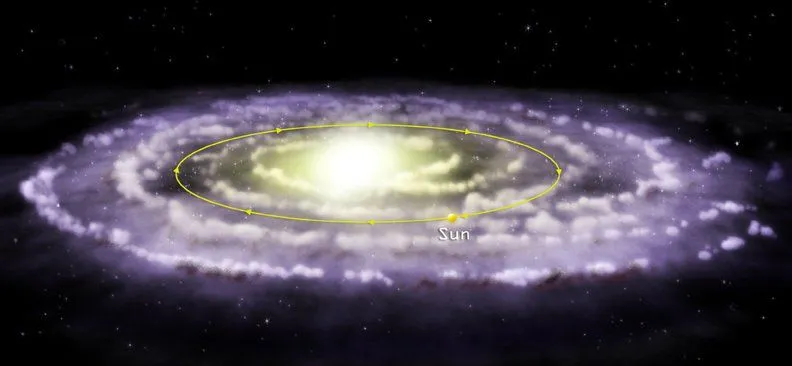
In reality, however, the Sun and the entire solar system are moving as a single entity around the center of the Milky Way. It’s also moving very fast, with an average velocity of 828,000 kmph (514,495 mph)! Even at that incredible speed, it takes our solar system roughly 230 million years to complete one revolution around the Milky Way. (Source).
Here’s a very interesting Vsauce video that might help you get a better visual understanding of the motion of both our planet and the solar system as a whole.
There is one important takeaway from all of this: on any given day, neither the Earth nor any other member of the solar system is at the same spot as it was a year ago. In fact, things will never be in exactly the same place ever again, since the universe is also still expanding at an increasing rate! Every day is a once in an eternity kind of thing!
References (click to expand)
- Does the Sun move around the Milky Way?? - Starchild (NASA). The National Aeronautics and Space Administration
- Our Solar System - Chandra :: Resources :: Q&A. The Chandra X-ray Observatory
- Milankovitch Cycles and Glaciation - www.indiana.edu
- Basics of Space Flight, Chapter 2: Reference Systems - NASA Science
- What Is an Orbit? - NASA Space Place
- Milankovitch (Orbital) Cycles and Their Role in Earth's Climate - NASA Science
- Earth Facts - NASA Science
- How Long is a Year on Other Planets? - NASA Space Place