Table of Contents (click to expand)
Anomers and epimers are both diastereomers. An epimer is a pair of stereoisomers that differs in configuration at exactly one of two or more stereogenic centers. An anomer is a special kind of epimer found in cyclic sugars and glycosides, where the differing center is specifically the anomeric (acetal or hemiacetal) carbon, as in α- and β-D-glucopyranose.
Before we talk about the differences between epimers and anomers in more detail, it helps if we first understand what stereoisomers are all about.
What Is A Stereoisomer?
In order to understand what a stereoisomer is, it’s crucial to know a thing or two about isomerism in general. An isomer is a molecule that has the same molecular formula as another molecule, but possesses different chemical properties. Another way to say this is that isomers contain the same number of atoms of each element, but the arrangement of these atoms is different.
Diastereomers are stereoisomers that have different configurations at one or more (but not all) stereocenters without being mirror images of each other. The term ‘epimer’ is used to refer to diastereomers that differ in configuration at only one chiral center; because that definition assumes the molecule still matches at every other stereocenter, epimers always require at least two stereocenters in the molecule.
An anomer is actually a kind of epimer that differs in configuration, especially at the acetal/hemiacetal carbon.
Epimer Vs Anomer
While an epimer is one of a pair of stereoisomers that differ in configuration at only one chiral (stereogenic) center, an anomer is actually an epimer (also a cyclic saccharide) that differs in configuration, especially at the acetal or hemiacetal carbon (refer to the image below to differentiate between acetal and hemiacetal carbons).
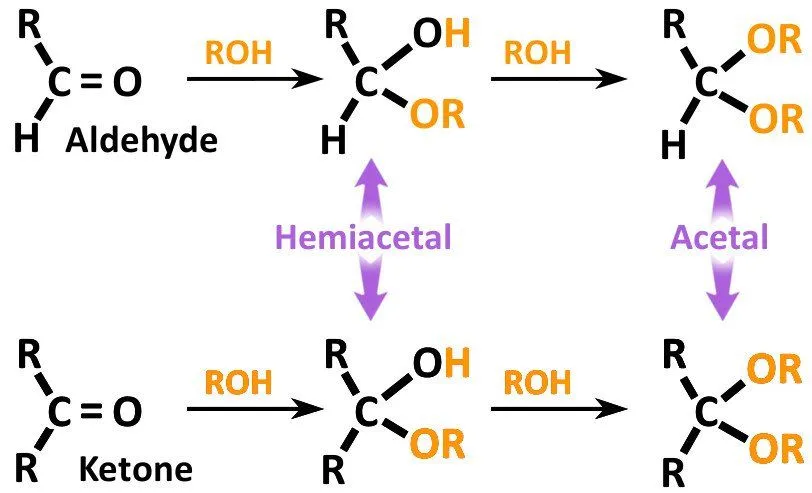
An epimer is one of a pair of stereoisomers that differs in configuration at exactly one chiral (stereogenic) center, with every other stereocenter in the two molecules matching. Because of this matching requirement, epimers are a strict subset of diastereomers and the molecule must have at least two stereocenters to begin with. If a molecule has only a single stereocenter, then flipping it gives an enantiomer (a non-superimposable mirror image), not an epimer. (Source)
Refer to the following figure with two stereoisomers of chlorobutane.
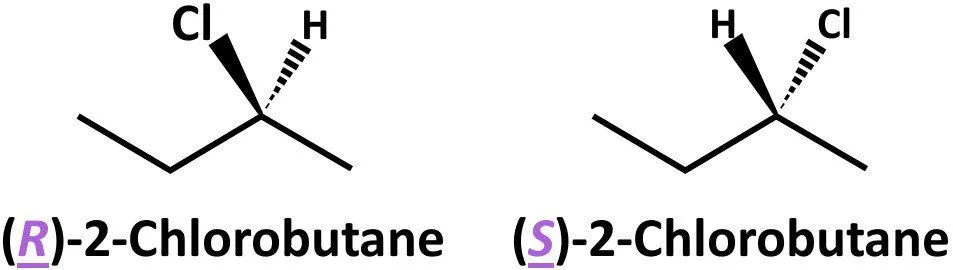
(R)-2-chlorobutane and (S)-2-chlorobutane differ in absolute configuration at the C2 stereocenter. Note that 2-chlorobutane has only one stereocenter, which is why this is an enantiomer pair, not an epimer pair. To see real epimers, we need a molecule with two or more stereocenters, such as tartaric acid below.
On the other hand, in the stereoisomeric structures of tartaric acid, you can see that the two epimers (i.e., (2R,3R)-tartaric acid and (2R,3S)-tartaric acid, the latter being the achiral meso form) differ in absolute configuration at the C3 stereocenter while still matching at C2.
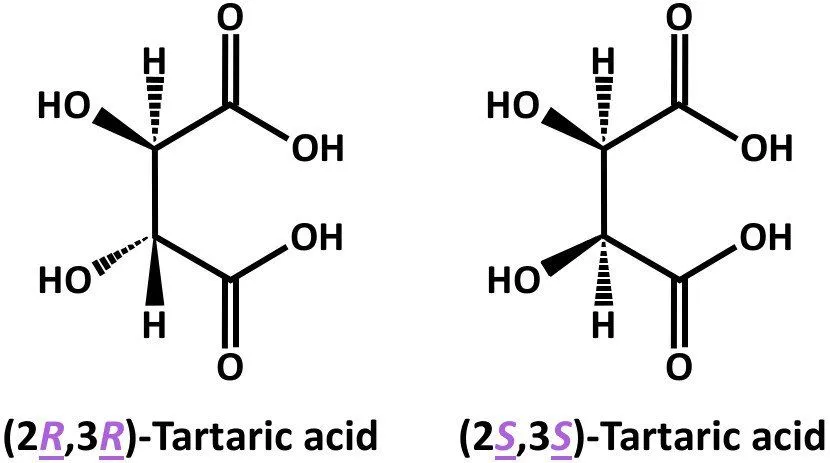
Note that tartaric acid has two stereocenters, which is why these epimers are diastereomers. The most familiar biological epimer pairs come from sugars: D-glucose and D-mannose are C2 epimers (they differ only at carbon 2), while D-glucose and D-galactose are C4 epimers. Both pairs have multiple stereocenters and differ at exactly one, which is the textbook definition of an epimer in action.
An anomer is a kind of stereoisomer; anomers are saccharides or glycosides that are epimers, which are distinct from each other in the configuration at C-2, if they are ketoses, or in the configuration of C-1, if they are aldoses.
In many cases, it so happens that carbohydrates exist in cyclic/acyclic forms. During cyclization, the carbon in the carbonyl group converts into a new stereocenter. Such cyclization results in the formation of two diastereomers, which differ in the position of the attachment of a certain functional group (Source). The new stereocenter is called the ‘anomeric carbon’.
The following figure should help to visualize this:
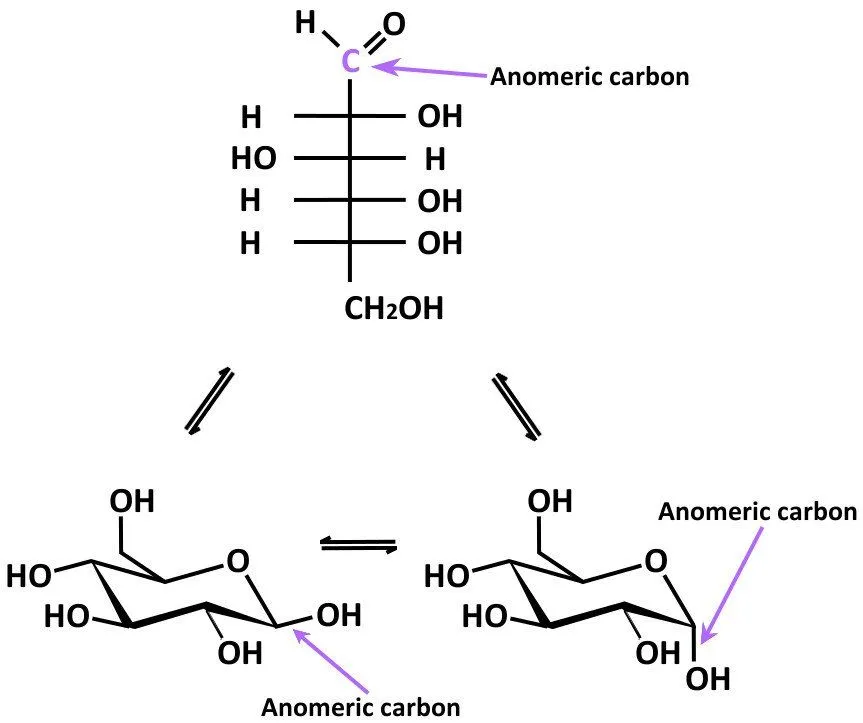
Two anomers are designated alpha and beta, depending on the configurational relationship between the anomeric center and the anomeric reference atom. If the hydroxyl group on C-1 and the -CH2OH group on C5 are on opposite sides of the six-membered ring, C1 is said to be the α anomer. If they are on the same side, C1 is said to be the β anomer.
Example: α-D-Glucopyranose and β-D-glucopyranose.
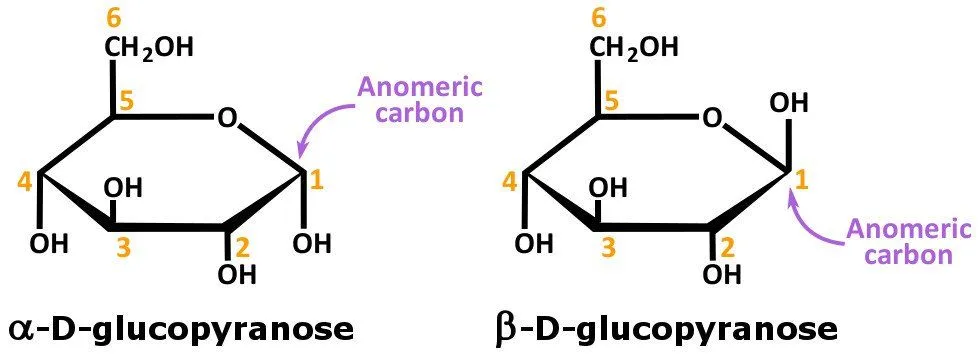
Note that the two stereoisomers (in the figure above) differ from each other in the configuration of C-1.
What Is The Anomeric Carbon?
Since every anomer is defined by a difference at the anomeric carbon, it’s worth pausing on what that carbon actually is. In an open-chain sugar like D-glucose, carbon 1 (C-1) is the carbonyl carbon of the aldehyde group. It is flat (sp2) and therefore not a stereocenter. When the sugar cyclizes, the hydroxyl oxygen on carbon 5 attacks that carbonyl carbon, closing a six-membered ring and forming a cyclic hemiacetal. In doing so, C-1 gains a fourth different group and becomes sp3, so it is now a brand-new stereocenter. That freshly created stereogenic center is the anomeric carbon, and it is the single thing that tells the two anomers apart.
The two configurations this new stereocenter can adopt are labelled α and β. In the standard Haworth drawing of a D-sugar, the α anomer has the C-1 hydroxyl trans to the C-6 group (pointing down, opposite the ring), while the β anomer has it cis to C-6 (pointing up, on the same side). This is exactly why an anomer is a kind of epimer: the two forms match at every other carbon and differ at only one stereocenter, which happens to be the hemiacetal carbon. Stacking the whole family in one line: every anomer is an epimer, and every epimer is a diastereomer, but the relationships do not run in reverse.
This isn’t just bookkeeping. Because the open-chain form can re-form and re-close, a sugar dissolved in water continuously flips between its α and β anomers, a process called mutarotation (from the Latin mutare, “to change”). Fresh D-glucose settles into an equilibrium of roughly 36% α-D-glucopyranose ([α]D = +112°) and 64% β-D-glucopyranose ([α]D = +18.7°), with less than 0.02% present as the open-chain aldehyde. You can watch this with a polarimeter: a freshly dissolved sample of either pure anomer drifts over many minutes to the same equilibrium optical rotation of about +52.7°. The anomeric carbon, then, is not a textbook abstraction; it governs how real sugars behave in solution.
To conclude, both epimers and anomers are stereoisomers; in fact, anomers are a special case of epimers. The main difference between them is that epimers differ in configuration at only one chiral (stereogenic) center, but anomers differ in configuration, especially at the acetal or hemiacetal carbon.
References (click to expand)
- Anomers.
- Designating the Configuration of Chiral Centers.
- http://web.archive.org/web/20220702114629/https://chem.as.uky.edu/research/grossman/stereo/stereoexamps.HTML
- Illustrated Glossary of Organic Chemistry - Epimer.
- Epimers.
- Chirality and Stereoisomers.
- Anomers.
- Anomers. Organic Chemistry (McMurry). Chemistry LibreTexts.
- Anomeric Forms of Glucose. Chemistry LibreTexts.