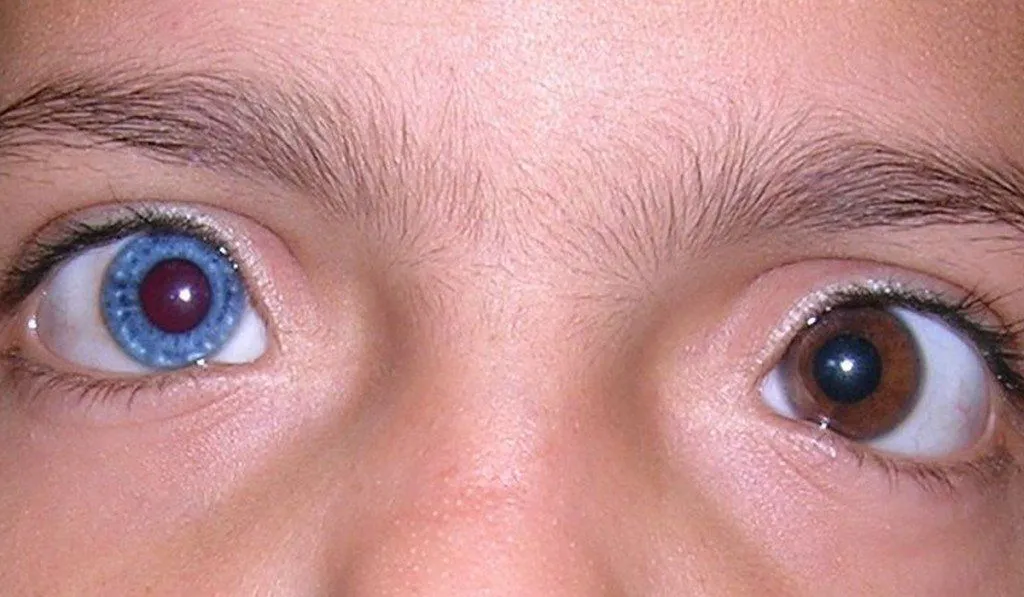
Heterochromia is the condition of having two different eye colours, caused by an uneven distribution of melanin in the irises. It comes in three flavours: complete heterochromia (each eye a different colour), sectoral heterochromia (a patch of a second colour in one iris), and central heterochromia (a ring of a second colour around the pupil). Most cases are harmless and present from birth, but acquired heterochromia can also follow eye injury, surgery, glaucoma medication, or rarer syndromes such as Waardenburg, Horner’s and Parry–Romberg.
The entry of James McAvoy in X-Men: First Class was quite an interesting scene. He was shown in a bar, talking to a pretty, blonde lady. The most striking part about her appearance was her eyes – one was green and the other was blue. In fact, Charles Xavier commented upon her eyes as a conversation starter!
As Professor Charles Xavier said (don’t worry, actual scientists have said it too!), the condition is called Heterochromia. It comes from 2 words; hetero – which means different, and chromia – which refers to color. It is the condition where a person’s eyes are of 2 different colors.
Cause Of Heterochromia
Heterochromia is the condition where a person has 2 different eye colors. These can either be 2 different colors in the same eye, or both eyes may be differently colored.
The color of our iris – the colored portion of the eye – is determined by the pigment melanin. This is the same pigment responsible for the color of our skin and hair. More melanin results in darker eyes, while less melanin leads to lighter eyes. However, the occurrence of green eyes or hazel eyes is not fully understood yet. It was previously believed that eye color followed the standard pattern of dominant-recessive inheritance. However, it has now been proven that eye color is a polygenic trait, i.e., it is affected by multiple genes. If that were not the case, then blue-eyed parents could never give birth to a brown-eyed baby (as blue eye color is a recessive trait).
2 genes however, are supposed to play a major role in eye color. These are the OCA2 and HERC2. The former is involved in the maturation of melanosomes. Melanosomes are the structures that produce melanin (bet you didn’t see that coming!) The latter supposedly controls the expression of OCA2.
Heterochromia occurs due to an uneven distribution of melanin in the eye. This may be a congenital feature, or it could be acquired. Heterochromia may be acquired due to certain diseases, eye injuries, infections, etc. While congenital heterochromia is usually not indicative of anything, it sometimes may occur due to a congenital disorder like Waardenburg Syndrome, Horner’s Syndrome, Parry–Romberg Syndrome, etc.
Classification Of Heterochromia
The pattern of heterochromia, or the uneven distribution of melanin, can occur in 3 different ways. Thankfully, no matter how uncommon heterochromia is, there are people that save us the burden of having to imagine such a beautiful occurrence!
Complete Heterochromia
In this type, both eyes are differently colored. Complete heterochromia is not very common in humans, although it still does occur.

Sectoral Heterochromia
In sectoral heterochromia or partial heterochromia, there is partial mixing of colors. This means that while both eyes are largely of the same color, there may be a tiny patch in one or both eyes of a different color.

Central Heterochromia
A form of partial heterochromia, in this form, the iris has 2 different colors that surround the pupil like a ring. The outer ring is usually the individual’s actual eye color, while the inner ring radiates out from the pupil.

Occurrence Of Heterochromia
Complete heterochromia is very rare in humans. The other 2 forms, however, have a higher frequency than the first one. Furthermore, humans are not the only ones to have this variation. Certain animal species like Siberian huskies, certain cats like Turkish Vans, etc. exhibit a higher likelihood of heterochromia. Huskies are very susceptible to differently colored eyes, one of which one is mostly blue! Apart from cats and dogs, it is also seen in horses, cattle, water buffaloes, etc.
Is Heterochromia Dominant Or Recessive?
This is probably the question people ask most often, usually right after spotting two different colored eyes and wondering whether the trait could be passed on. The honest answer is that heterochromia is neither cleanly dominant nor cleanly recessive. The tidy Punnett-square logic we all learned in school simply does not apply here.
The confusion traces back to how eye color itself works. As we saw earlier, the old "brown beats blue" rule turned out to be far too simplistic. According to MedlinePlus, eye color is a polygenic trait, shaped by many genes working together rather than one gene flipping a single switch. The two on chromosome 15, OCA2 and HERC2, do most of the heavy lifting, but a dozen or so others (including TYR, SLC24A4 and IRF4) chip in too. That tangle is exactly why two blue-eyed parents can occasionally produce a brown-eyed baby.
Heterochromia layers another twist on top of an already complicated picture. According to StatPearls (NCBI Bookshelf), most cases are sporadic and isolated, cropping up on their own without being handed down at all. When congenital heterochromia does run in a family, autosomal dominant inheritance has been reported, but in many cases the cause is genetic mosaicism: a chance change during early development leaves some cells carrying different pigment instructions than their neighbors. So if you were hoping for a clean yes-or-no on whether your own children might inherit it, the science politely declines to give you one.
How Common Is Heterochromia?
Different colored eyes feel like they should be one in a million, and the complete version comes remarkably close. In a 2021 study in the Journal of Optometry, Dabkowski and colleagues combed through 11,111 high-resolution yearbook portraits and confirmed just 7 cases of complete heterochromia, an observed prevalence of about 0.06%, or roughly 1 in 1,600 people. Strikingly, that figure almost exactly matched a much older survey of more than 25,000 people in Vienna, which also landed near 0.06%.

The catch is that those numbers count only the dramatic, full-eye version, which is the rarest form. The partial varieties are more common. Central heterochromia, where a ring of a second color circles the pupil, is subtle enough that plenty of people carry it without ever realizing, sometimes mistaking it for ordinary hazel eyes. Sectoral heterochromia, that little wedge of a different shade in one iris, also turns up more often than the complete form. Even so, a noticeably mismatched eye color still affects well under 1% of people, which is precisely why it stops you in your tracks when you see it.
One reassuring note to close on: rarity does not mean trouble. As the American Academy of Ophthalmology points out, the overwhelming majority of these eye-catching irises are simply a harmless quirk you are born with, carrying no other symptoms or health consequences. It is only when heterochromia appears suddenly later in life, after an injury, certain glaucoma eye drops, or a new medical issue, that it is worth having an eye doctor take a look.
Heterochromia is certainly fascinating, and it definitely adds to the charm of a person. I have to agree with Professor Charles Xavier here – heterochromia is indeed a very groovy mutation!
References (click to expand)
- Is eye color determined by genetics? - MedlinePlus. MedlinePlus
- Heterochromia iridum - Wikipedia. Wikipedia
- Rennie, I. G. (2011, October 7). Don’t it make my blue eyes brown: heterochromia and other abnormalities of the iris. Eye. Springer Science and Business Media LLC.
- Heterochromia. StatPearls. NCBI Bookshelf.
- Dabkowski, B., et al. (2021). Estimating the prevalence of heterochromia iridum from high-resolution digital yearbook portraits. Journal of Optometry.
- Heterochromia. American Academy of Ophthalmology (EyeSmart).